

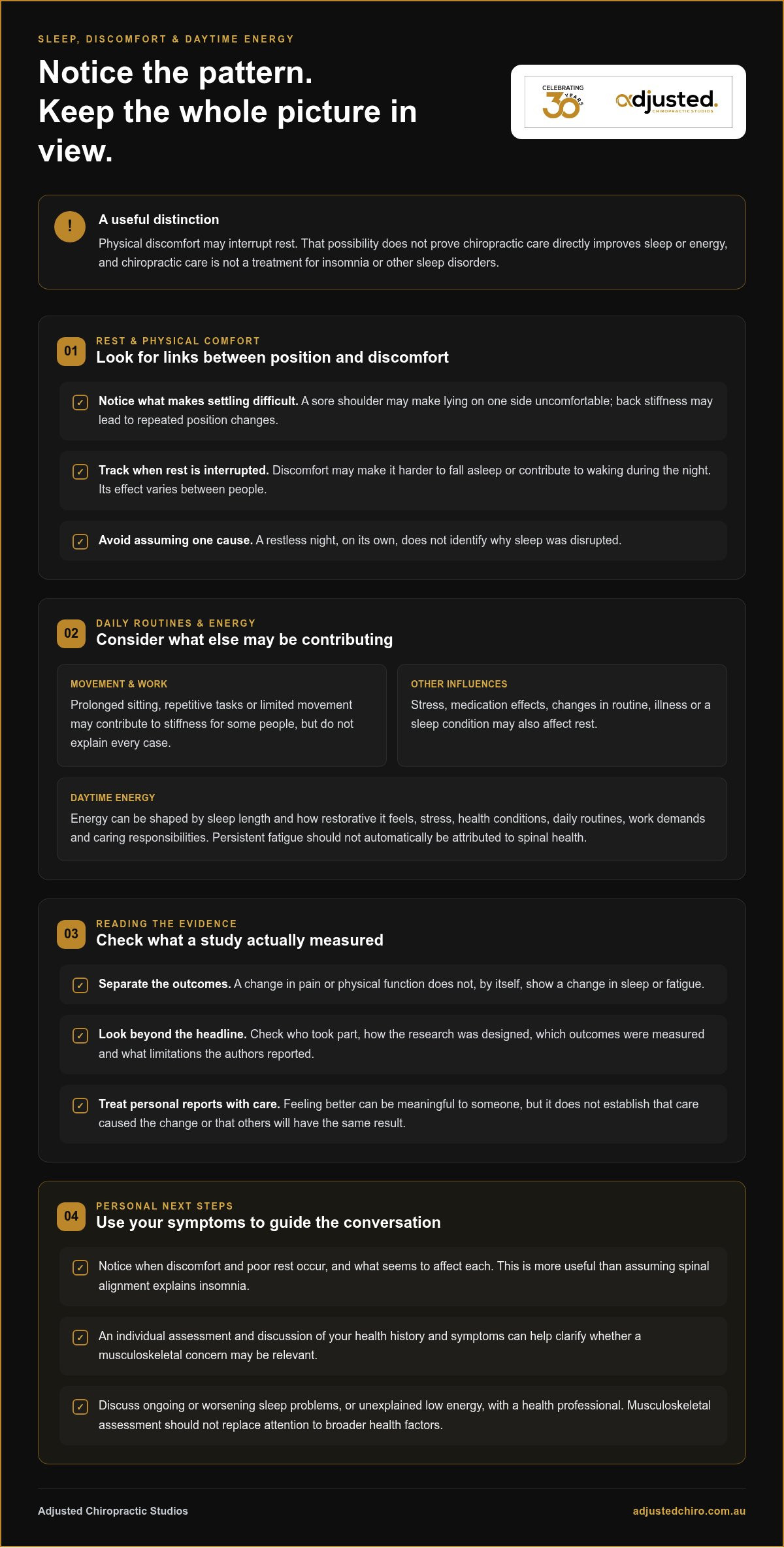
Could a stiff neck or aching back make it harder to settle at night, then leave you low on energy the next day? If you’re exploring Chiropractic sleep energy, it helps to separate a plausible connection from a promise: physical discomfort may interrupt rest, but chiropractic care isn’t a treatment for insomnia or other sleep disorders.
It’s understandable to look for a clear next step when poor sleep and fatigue overlap. Low energy can have many causes, including stress, health conditions and daily routines, so discomfort may be only one part of the picture.
This guide explains how pain, movement, posture and workplace habits may affect rest, what evidence can and can’t tell us about chiropractic care, and when to seek medical assessment. You’ll also learn how an individual assessment, including a discussion of your health history and symptoms, can help determine whether musculoskeletal care may be relevant. For Sydney CBD professionals, Adjusted Chiropractic Studios takes a safety-first, evidence-informed approach, with care tailored to your needs rather than promises of a quick fix or guaranteed change in sleep or energy.
Key Takeaways
- Sleep quality and daytime energy can be affected by several factors. Notice patterns in your symptoms rather than assuming there is one cause.
- Chiropractic sleep energy claims need perspective: evidence about musculoskeletal comfort doesn’t establish that chiropractic care treats sleep disorders or fatigue.
- Feeling more comfortable may help you settle, but it doesn’t guarantee longer or more restorative sleep.
- Try a consistent wind-down routine, a comfortable sleep environment and regular movement, with breaks from prolonged sitting during the day.
- An individualised assessment can help clarify whether musculoskeletal care may be relevant. Seek medical assessment for ongoing sleep problems or unexplained low energy.
How sleep, physical discomfort and daytime energy can be connected
A run of broken nights can make work feel harder, movement less appealing and family routines more demanding. Sleep quality includes how easily you fall asleep, whether you stay asleep and how rested you feel afterwards. Daytime energy is your capacity to concentrate and manage ordinary activities. Neither has a single explanation: discomfort may be one influence, but it’s only part of a wider picture.
For some people, pain or stiffness makes it difficult to settle into a comfortable position. A sore shoulder, for example, may make lying on one side uncomfortable; back stiffness may prompt repeated position changes. That discomfort can interrupt falling asleep or contribute to waking during the night. The effect varies between people, and a restless night doesn’t identify its cause on its own.
Discomfort may be one link between movement and rest, but that possibility is not proof that chiropractic care directly improves sleep or energy. This distinction matters when considering Chiropractic sleep energy claims. A general overview of Chiropractic can provide background on the profession and its approaches, but it doesn’t establish that care treats a sleep disorder.
How discomfort may interfere with rest
When a position aggravates a familiar ache, you might take longer to relax, shift more often or wake to adjust how you’re lying. Even small interruptions can feel frustrating when you’re already tired. During the day, prolonged sitting, repetitive tasks or limited movement may also contribute to stiffness for some people, although these factors don’t explain every case.
Sleep disruption can have unrelated causes, including stress, medication effects, changes in routine, illness or a sleep condition. If discomfort and poor rest occur together, notice when each happens and what seems to affect it. This is more useful than assuming spinal alignment explains insomnia.
Why low energy needs a broader view
Energy can be influenced by how long you sleep, how restorative that sleep feels, stress, health conditions and daily routines. Work demands, caring responsibilities and changes in activity may also shape how you feel. A difficult night can leave you tired the next day, but persistent fatigue shouldn’t automatically be attributed to spinal health or assumed to have one musculoskeletal cause.
If low energy continues, worsens or affects your ability to manage everyday life, discuss it with a health professional so other possible causes can be considered. An assessment of musculoskeletal concerns may still be relevant if pain or stiffness is part of your experience, but it shouldn’t replace attention to broader health factors.
For Sydney CBD adults seeking context on personalised spinal care, Adult Chiropractic Sydney: Expert Spinal Care for CBD Professionals explains the clinic’s adult-care approach. Keeping the focus on your individual symptoms helps distinguish a physical issue that may warrant assessment from fatigue that needs broader investigation.
What evidence says about chiropractic care, sleep and energy
Claims about sleep and energy need careful interpretation. Research showing that a person’s pain or physical function changes after care does not, by itself, show that the care directly improves sleep or resolves fatigue. These are different outcomes and need to be measured separately.
Chiropractic care should not be presented as a proven treatment for insomnia. If discomfort contributes to difficulty settling or staying asleep, addressing that musculoskeletal concern may be relevant to the person’s care. It still doesn’t establish that chiropractic directly changes sleep, treats a sleep disorder or restores daytime energy.
What research can and cannot show
To judge a study, look beyond its headline. Check who took part, how the research was designed, what outcomes were measured and what limitations the authors reported. A small study, a patient’s account and a controlled comparison are not interchangeable forms of evidence. A person’s report of feeling better can be meaningful to them, but it doesn’t establish that care caused the change or that others will experience the same result.
Sleep quality, pain, physical function and fatigue should each be assessed on their own terms. If a study measures pain but not sleep, its findings can’t confirm a sleep benefit. If it records sleep alongside treatment, that association alone doesn’t establish cause and effect. A sound summary reflects the full paper’s conclusions rather than extending them into claims the researchers didn’t make.
This is why Chiropractic sleep energy claims deserve a measured reading. Before citing a paper, verify its design, participants, outcome measures and limitations in the full text. Don’t rely on a search-result snippet or assume that a change in one measure proves an improvement in another. The distinction is clear without statistics or broad promises.
Why individual results may differ
Sleep concerns can involve several influences at once: physical discomfort, stress, work schedules, daily routines or other health factors. Their relative importance differs from person to person and may change over time. An adjustment cannot be assumed to alter anyone’s sleep or energy, so avoid predictions about individual outcomes. A clinical discussion can instead clarify whether a musculoskeletal issue is present and whether it is appropriate to address.
If you’re weighing care options for a spinal concern, the article Physiotherapy vs Chiropractic Care: Which is Best for Your Spinal Health? offers a broader comparison of care contexts. Keep the question focused on your own symptoms, goals and relevant health history, rather than treating either approach as a guaranteed answer to sleep problems.
For Sydney CBD adults considering whether musculoskeletal discomfort may be part of the picture, an individual chiropractic assessment can help clarify the concern and discuss appropriate next steps. Evidence-informed care should be clear about its scope and limits. Consider further medical assessment when persistent sleep difficulties or fatigue need broader evaluation.
Chiropractic for sleep and energy: realistic expectations and common misconceptions
It’s reasonable to hope that addressing physical discomfort may make rest easier. But care for a musculoskeletal concern and assessment of a sleep disorder are different things. Keeping that distinction clear helps you make informed decisions without expecting one treatment to resolve every factor affecting your sleep or energy.
Does an adjustment directly treat insomnia?
No. Chiropractic care should not be represented as an established treatment for insomnia. A chiropractor may assess relevant musculoskeletal concerns, such as pain or restricted movement, and discuss care within their scope. An adjustment should not be described as resetting sleep, changing hormones or restoring the nervous system. If you have ongoing difficulty sleeping, seek assessment for the sleep concern itself.
That boundary is central to responsible Chiropractic sleep energy information: care may address a physical issue that matters to your comfort, but that isn’t the same as diagnosing or treating a sleep disorder. A diagnosed condition may need its own assessment and evidence-based management.
Can feeling less discomfort change the sleep experience?
Possibly, if discomfort is one reason you struggle to settle or keep changing position. Feeling more comfortable could make rest easier for some people, but it doesn’t guarantee longer, uninterrupted or restorative sleep. Stress, work patterns and other health factors may still affect the night. The article Precise Spinal Adjustment in Sydney: A Clinical Guide to Professional Alignment provides adjustment context without promising a sleep outcome.
Use the distinction below to weigh claims and decide what kind of support may fit your situation:
| Reasonable possibility | Unsupported promise | Appropriate next step |
|---|---|---|
| Assessing a musculoskeletal concern that may contribute to discomfort at rest. | An adjustment will cure insomnia, prevent waking or restore daytime energy. | Discuss persistent sleep disruption with a health professional. |
| Exploring whether pain or stiffness affects comfortable movement and rest. | Improved comfort guarantees deeper or more restorative sleep. | Consider individualised musculoskeletal care if that concern is relevant. |
| Recognising that several factors may influence sleep and fatigue. | Spinal health explains every case of low energy. | Seek broader assessment for ongoing or unexplained fatigue. |
There’s no need to dismiss a physical concern, but persistent fatigue or disrupted sleep deserves more than an assumption about spinal health. If symptoms continue, worsen or interfere with daily life, arrange an appropriate medical assessment. If pain or stiffness is also present, describe how it affects movement, rest and routine so those concerns can be considered alongside the broader picture. Care should be guided by your individual health history and goals, with realistic expectations from the outset.
Practical steps to support rest, movement and energy
Small, steady habits can help you notice what supports your rest and how your body feels during the day. They aren’t a substitute for assessment when symptoms persist, and there’s no single routine that works for everyone. Treat them as practical ways to observe patterns and support your wellbeing, not as a guaranteed fix.
Daily habits that may support more settled sleep
Where practical, keep a fairly regular time for going to bed and getting up. Create a wind-down routine that feels manageable, and make your sleep space comfortable for you. Notice whether a demanding workday, stress or late activity seems to affect your rest. You could briefly record these observations alongside how you feel the next day, without judging yourself for an occasional disrupted night.
- Ease out of the workday: Set aside a short, repeatable period to transition from work tasks to rest.
- Make comfort a priority: Adjust your bedding or room setup to suit your needs, especially if a particular position aggravates discomfort.
- Move regularly: Choose suitable movement that fits your ability and routine, and take breaks from prolonged sitting or standing where possible.
- Notice patterns: For a brief period, jot down sleep and wake times, interruptions, discomfort, daytime energy and relevant changes in routine.
A simple record can make a conversation about your health history more useful. For example, noting that stiffness tends to follow a long day at a desk, or that low energy persists despite a steadier routine, gives a health professional more context than a general impression. You don’t need to track every detail. Keep it brief and stop if it becomes stressful.
When to seek professional assessment
Arrange an individual assessment if pain continues, sleep disruption keeps recurring or low energy persists. A medical practitioner can assess suspected sleep disorders and significant fatigue, including possible causes beyond musculoskeletal discomfort. Seek prompt medical advice for symptoms that are sudden or severe. Self-care habits may support daily wellbeing, but they shouldn’t delay assessment when symptoms are worsening or interfering with everyday life.
If discomfort is affecting how you move or rest, a personalised chiropractic assessment may help clarify whether a musculoskeletal concern is relevant. It can also help distinguish that concern from sleep or energy issues that need broader medical attention. The phrase Chiropractic sleep energy shouldn’t imply that chiropractic treats a sleep disorder; care should be based on your health history, symptoms and individual needs.
For Sydney CBD adults whose sleep is being disrupted by physical discomfort, book an individual chiropractic assessment to discuss your movement concerns and appropriate next steps.
How an individualised chiropractic assessment may fit your next steps in Sydney
If pain or stiffness is affecting how you move or rest, an individual assessment can help clarify whether a musculoskeletal concern is part of the picture. It begins with listening: what you’ve noticed, how long it has been happening, what makes it better or worse, and how it affects work, movement and daily life. You can also share your goals and any sleep or energy concerns, so these are understood in context rather than treated as proof of a spinal cause.
What to expect from a personalised assessment
Your health history and current symptoms help guide the assessment. The clinician considers relevant musculoskeletal findings and discusses what they may mean for your individual presentation. If Core Score scanning is used, it is an assessment technology, not a test that diagnoses sleep disorders or explains low energy. Recommendations depend on your history, examination and goals; an adjustment is not assumed to be appropriate for everyone.
Where clinically appropriate, care may include spinal adjustments and a tailored corrective pathway, a structured plan of interventions intended to support function and stability. The next steps should be explained clearly, including how they relate to the concern being assessed. The aim is a considered approach to musculoskeletal health, not a promise of better sleep or more energy.
Chiropractic assessment also has limits. It doesn’t replace medical investigation of suspected sleep disorders, persistent sleep disruption or unexplained fatigue. If those concerns continue, worsen or affect your day-to-day functioning, discuss them with an appropriate medical practitioner. Musculoskeletal care can be considered alongside that broader assessment when relevant, rather than in its place.
A considered next step at Adjusted Chiropractic Studios
Adjusted Chiropractic Studios has served Sydney CBD for over 30 years, with a safety-first approach to clinical adjustments. The Hunter Street studio is opposite Martin Place Metro station, convenient for people working or travelling through the CBD. The focus is on understanding your concerns and considering appropriate care based on your individual presentation.
Online claims about Chiropractic sleep energy can make the connection sound certain. A personal assessment offers a more measured starting point: discuss the discomfort you’re experiencing, understand what can be assessed and consider whether musculoskeletal care is relevant to your next steps.
If you’re in Sydney and ongoing pain or stiffness is affecting your comfort, book an assessment online. Bring any questions about how your symptoms relate to movement or rest; the discussion can focus on your health history, findings and appropriate options, without assuming chiropractic care will resolve sleep or energy concerns.
Choose a thoughtful next step for your wellbeing
Better rest and steadier energy are worthwhile goals, but the path forward depends on what’s affecting you. If pain or stiffness is limiting comfortable movement, an individual assessment can help clarify whether that concern may benefit from musculoskeletal care. Ongoing sleep disruption or unexplained fatigue also deserves medical assessment, rather than assumptions about spinal health.
A balanced view of Chiropractic sleep energy means staying open to support while keeping expectations grounded. You can bring your questions, describe how symptoms affect your daily life and work with a clinician to understand appropriate next steps. Care should be shaped around your presentation, not a promise of a particular sleep or energy outcome.
If musculoskeletal discomfort is part of your concern, book an individual chiropractic assessment in Sydney to discuss your needs. A considered first step can help you move forward with greater clarity and confidence.
Frequently Asked Questions
Can chiropractic care help you sleep better?
Chiropractic care may be relevant if musculoskeletal discomfort makes it difficult to rest comfortably, but it isn’t an established treatment for insomnia. If neck or back symptoms make turning in bed uncomfortable, an assessment can consider that physical concern. Note whether waking tends to coincide with discomfort and share the pattern with a health professional. Ongoing sleep problems still deserve medical assessment, particularly if they affect your daily functioning.
Does a spinal adjustment give you more energy?
A spinal adjustment can’t be relied on to increase energy. If pain limits movement or affects rest, addressing that concern may be one part of care, but tiredness has many possible influences. Consider when fatigue occurs and whether it comes with other changes in your health. Persistent or unexplained low energy should be discussed with a medical practitioner rather than assumed to be a spinal issue. Chiropractic sleep energy claims should be viewed cautiously.
Can poor posture affect sleep quality?
Poor posture may contribute to discomfort for some people, but posture alone shouldn’t be assumed to cause poor sleep. For example, if your neck feels uncomfortable after a long period at a desk, notice whether that same area bothers you when settling into bed. Changing position may help you find a more comfortable posture, but ongoing sleep difficulty can have other causes and may need broader assessment.
What should you do if pain keeps waking you at night?
If pain repeatedly wakes you, arrange an assessment instead of relying only on changes to pillows or sleeping position. Note where the pain occurs, whether it spreads elsewhere, when it tends to wake you and whether particular movements affect it. Share any recent changes in the symptoms and how they affect daily activities. Seek prompt medical advice if the pain is sudden or severe, or if you’re concerned about your symptoms.
Can chiropractic care treat sleep apnoea?
No. Chiropractic care isn’t a treatment for sleep apnoea. If someone has noticed loud snoring, pauses in breathing during sleep or gasping, discuss these concerns with a medical practitioner for appropriate assessment. Don’t rely on spinal adjustments to diagnose or manage a suspected breathing-related sleep condition. Musculoskeletal care may be considered separately if you also have a physical concern, but it doesn’t replace medical care for possible sleep apnoea.
When should you see a doctor about low energy and poor sleep?
See a medical practitioner if poor sleep or low energy persists, worsens, has no clear explanation or interferes with work and everyday activities. It may help to bring a brief record of your sleep, fatigue and any other symptoms, along with a list of medicines you take. Seek prompt medical advice if symptoms come on suddenly or feel severe. A doctor can assess whether further investigation or support is appropriate.



