

The best ergonomics training isn’t necessarily the session with the longest checklist. It’s the one that helps people apply practical changes to the way they work. If desk-based staff are experiencing discomfort or postural stress, choosing corporate ergonomics training Sydney businesses can put into practice means looking beyond a one-off presentation.
You’re right to want training that fits the different roles and work settings across your team, with value beyond the day itself. This guide explains how to compare training approaches, what to look for in practical guidance and how everyday workplace habits relate to spinal health and workplace injury prevention.
At Adjusted Chiropractic Studios, we bring more than 30 years of experience in Sydney CBD and have presented corporate health talks for organisations including Macquarie Bank, St George Bank and Aurecon. We’ll explain how relevant experience, clear education and useful strategies can support a considered approach for your workplace, whether staff work in the office, at home or across both.
Key Takeaways
- Understand how sustained positions and repetitive tasks can contribute to postural stress, and why training should reflect the work people actually do.
- Use practical workstation, posture variation and movement guidance to help employees connect everyday habits with spinal health.
- Compare one-off education with follow-up learning against your team’s goals, roles and work settings.
- Assess corporate ergonomics training Sydney options with a clear framework: define goals, identify roles, check relevance, consider delivery and plan follow-up.
- Learn how Adjusted Chiropractic Studios connects workplace ergonomics with employee spinal health, drawing on its Sydney CBD experience since 1994.
Corporate ergonomics training in Sydney: what workplace challenges can it address?
Corporate ergonomics training is practical education that helps employees consider how their work setup, posture, movement and physical demands relate to their daily tasks. It can give staff ways to review their routines and make sensible adjustments, while recognising that individual discomfort may need personalised attention.
For Sydney employers, corporate ergonomics training teams can apply should reflect real tasks, not just generic advice. A desk-based employee may spend long periods at a screen, while another role may involve frequent keyboard use, handling equipment or moving between workstations. Repeated tasks and sustained or awkward positions can contribute to postural stress and discomfort over time.
Ergonomics looks at how people interact with their work and surroundings. For a broader introduction, see What is Ergonomics? In practice, training turns that idea into habits employees can review across office and home work settings. It provides general education, not an individual diagnosis or treatment plan.
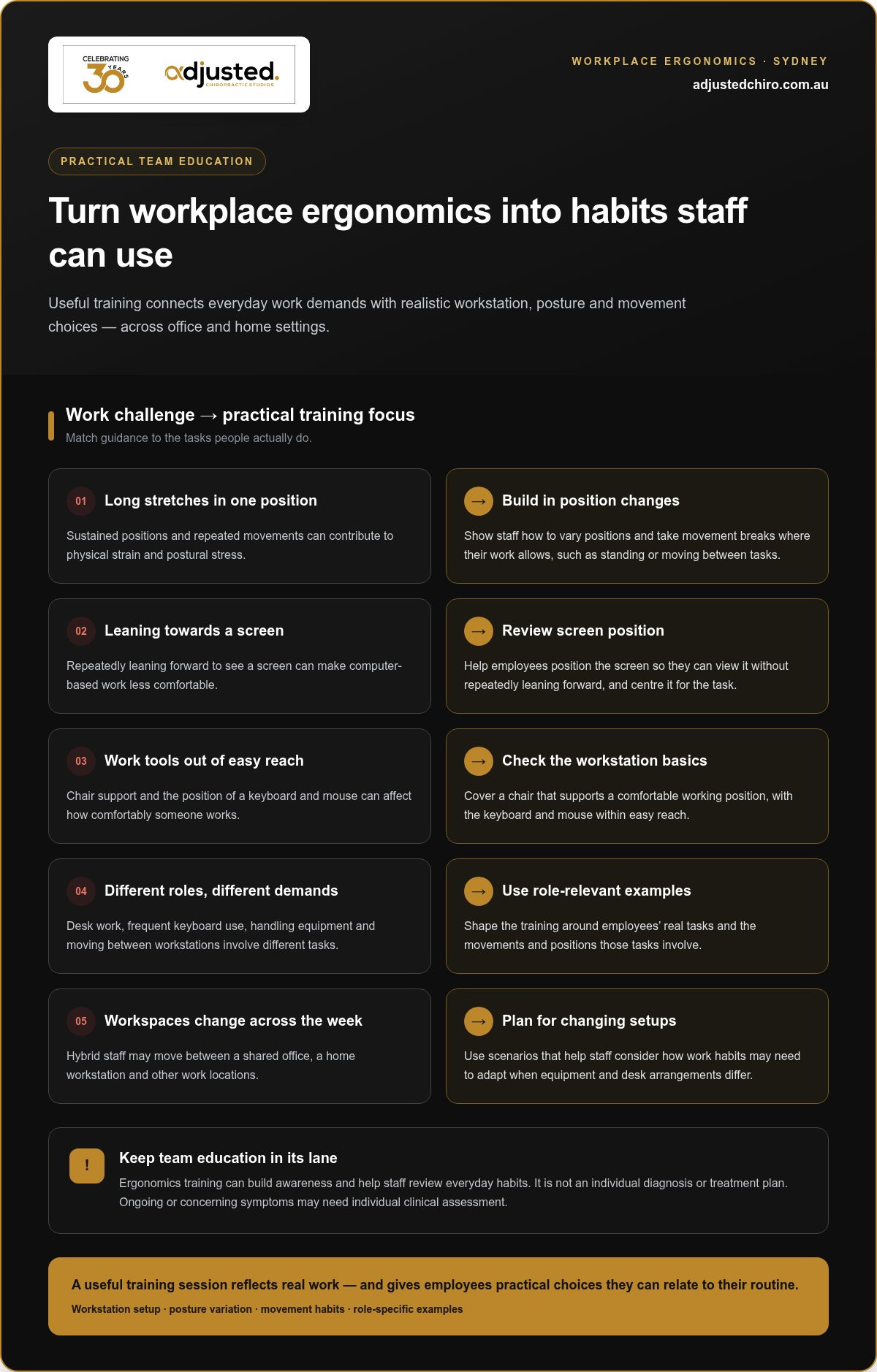
That distinction matters. Training can help a team notice common setup and movement patterns, but it can’t assess each employee’s health needs. Someone experiencing ongoing or concerning symptoms may need individual clinical assessment. Clear boundaries help employers provide useful education without treating a group session as a substitute for personalised care.
Which workplace habits can ergonomics training help employees review?
Employees can check whether their screen is positioned so they can view it without repeatedly leaning forward, whether their chair supports a comfortable working position, and whether their keyboard and mouse are within easy reach. They can also consider whether the screen is centred for the task and whether the workspace allows them to change position comfortably. These checks are relevant to Sydney CBD roles involving long periods of computer-based work.
Training can prompt staff to vary their positions and take movement breaks where their work allows. For example, employees might consider whether they can stand or move between tasks instead of staying in the same position for long stretches. These habits may interrupt extended periods of stillness, but they can’t guarantee that discomfort or injury will be prevented. The aim is to make practical choices easier to remember during a busy workday.
How does ergonomics connect with employee spinal health?
The spine and surrounding muscles respond to the demands placed on them throughout the day. Remaining in one position for extended periods or repeating the same movements can contribute to physical strain. That doesn’t mean the same posture will affect everyone in the same way. Comfort and tolerance differ between individuals.
Spinal health education connects those physical demands with everyday choices: how a workstation is arranged, when an employee changes position and how movement fits into their routine. It can build awareness across a team while leaving room for individual needs. Training supports workplace learning; it doesn’t diagnose a condition or replace personalised clinical care.
What should effective workplace ergonomics training in Sydney include?
Useful training starts with the work employees actually do. Content should reflect their tasks, workspaces and daily routines, then turn ergonomic principles into clear choices staff can apply. For employers considering corporate ergonomics training, the team’s learning goals should shape what’s covered rather than a fixed list of topics.
Core content may include workstation setup, posture variation and movement habits. Employees should understand how to arrange their work area, adjust their position as tasks change and build movement into the working day where practical. Spinal health education can explain how the spine and surrounding muscles respond to physical demands without diagnosing individual staff or implying one posture suits everyone.
Training can also draw on guidance from different sources. For general background, the US Occupational Safety and Health Administration’s OSHA Guidelines for Workplace Ergonomics discusses workplace ergonomics. It’s a reference, not a substitute for Australian workplace guidance or advice suited to your organisation.
How can training address different roles and work settings?
Employees’ needs vary with their tasks. Desk-based staff may benefit from guidance on computer work, while roles with more varied physical demands may need examples relevant to the movements and positions involved. A hybrid team may also move between a shared office, a home workstation and other work locations, where setups differ.
Role-specific scenarios make general principles easier to understand. For instance, training can explore how an employee might adapt work habits when moving between locations, or how a particular task influences posture and movement. The aim is relevant education, not an assumption that every employee needs the same adjustments.
What makes ergonomics education practical rather than generic?
Look for guidance staff can relate to their usual work, with clear examples and time to raise questions. Employees might discuss what makes it difficult to change position during a busy day or how to adapt when equipment or desk arrangements differ. This helps people connect the information with their routines and identify realistic habits to try.
Practical education supports awareness and informed choices. It shouldn’t promise guaranteed injury prevention or productivity gains, as outcomes depend on individual and workplace factors. Set the scope against your learning goals, whether you want to build general understanding, address specific work patterns or reinforce existing wellbeing education.
If you’re shaping a workplace learning plan, explore corporate health training focused on workplace ergonomics and employee spinal health.
Is one-off corporate ergonomics training enough for lasting workplace change?
A single session can introduce useful ideas, but it won’t automatically change daily habits or address every workplace concern. Whether it’s enough depends on your goal, the roles involved and how employees can apply the learning afterwards. Corporate ergonomics training should be considered as part of a broader approach to workplace injury prevention, not as a promise of reduced injuries, absenteeism or costs.
Relevance and participation matter. Staff can engage more readily with information when it reflects their working conditions and gives them a chance to ask questions. Reinforcement can keep the learning in view, though it can’t guarantee that every employee will adopt the same habits or experience the same results.
When might a focused training session suit a Sydney team?
A focused session may suit a team seeking shared awareness of workstation and movement habits. To keep it useful, set a clear audience and learning objective, such as helping office staff recognise setup choices they can review during their workday. One session can establish common language and offer practical guidance, but may not address every role-specific issue or individual concern across a varied workforce.
When could ongoing reinforcement be more suitable?
Further learning may be worth considering when staff have varied tasks, work across office and home settings, or experience changing work arrangements. Reinforcement could revisit key ideas or give employees another opportunity to reflect on how they apply them. It supports continued learning, but doesn’t guarantee an outcome. Align any follow-up with your existing workplace injury prevention plans.
To choose between a single session and continued reinforcement, consider what employees need to learn and what happens after the training. If the aim is to introduce shared ergonomic principles, focused education may be a suitable starting point. If you want to support learning across different teams or work settings, plan how those differences will be revisited.
Keep expectations measured. Training can explain practical concepts and prompt employees to reflect on workplace habits; it can’t, on its own, resolve every physical concern or establish that risks have been eliminated. A considered approach matches the learning format to the team’s needs, encourages questions and connects the education with existing workplace routines.
How can Sydney employers compare corporate ergonomics training options?
A clear comparison starts with your team’s needs, not the delivery format. Use this five-step framework to assess whether a training approach fits your workplace:
- Define your goals. Decide what employees should understand or be better able to review after the training.
- Identify the roles involved. Note the tasks staff perform and differences in physical demands across teams.
- Assess relevance. Check whether the examples reflect employees’ actual workspaces and routines.
- Review delivery. Consider how the content will be presented and whether the learning conditions suit your team.
- Plan follow-up. Decide how employees can revisit the learning or connect it with existing workplace injury prevention plans.
This framework helps you compare corporate ergonomics training on practical fit, rather than choosing by session format alone. Consider whether your employees work in a Sydney CBD office, from home or across both settings, and what would make it easier for them to participate and ask questions.
Which questions clarify your team’s training needs?
Start by identifying the work-related challenges employees and managers want to address. Are staff seeking shared guidance on everyday workstation habits, or do different roles have distinct ergonomic concerns? Consider how setups vary between office, hybrid and home-working arrangements. Set a realistic learning aim, such as helping employees recognise and review everyday ergonomic habits, rather than expecting a training session to resolve every concern.
What signals experience and local relevance?
Look for relevant health expertise, clear practical explanations and experience presenting to corporate audiences. Examples should make sense for your employees’ tasks and routines, rather than relying on generic advice. Local access may also matter for Sydney CBD teams. Adjusted Chiropractic Studios has operated in the CBD since 1994, at its Hunter Street location opposite Martin Place Metro station, and has presented corporate health talks for Macquarie Bank, St George Bank, Aurecon, Hudson Recruitment, North Shore BMW and BlueFin Resources. These examples describe corporate talk experience, not endorsement by those organisations.
For wider planning context, read the workplace injury prevention programme guide. To explore training that connects workplace ergonomics with employee spinal health, visit Adjusted Chiropractic Studios’ corporate health training.
Corporate ergonomics training with Adjusted Chiropractic Studios in Sydney
Adjusted Chiropractic Studios provides corporate health training focused on workplace ergonomics and employee spinal health. The training connects practical workplace education with a clearer understanding of how everyday work habits relate to the body. For employers considering corporate ergonomics training their teams can relate to, local clinical experience and relevant corporate education provide useful context.
Adjusted has served the Sydney CBD community since 1994 and has presented corporate health talks for Macquarie Bank, St George Bank, Aurecon, Hudson Recruitment, North Shore BMW and BlueFin Resources. These organisations are examples of past corporate talk experience, not endorsements. The practice is on Hunter Street opposite Martin Place Metro station, near Wynyard and Barangaroo, making its CBD location relevant for local workplace decision-makers.
How does Adjusted connect workplace ergonomics with spinal health?
Corporate training focuses on practical education about work habits and spinal health. Clear explanations help employees understand how posture, movement and workspace choices relate to physical demands, while recognising that individual needs differ. The approach is evidence-informed and grounded in a safety-first clinical philosophy.
Workplace education is distinct from individual clinical care. Employees with personal concerns may benefit from an assessment suited to their circumstances. Adjusted’s adult chiropractic care for Sydney CBD professionals addresses individual spinal health needs through personalised care, rather than treating a group training session as an individual assessment.
What is a straightforward next step for Sydney employers?
Begin by outlining who the training is for, where employees work and what you’d like them to learn. For example, consider whether the team is based in one CBD office or works across office and home settings, and whether the learning aim is general awareness or a particular workplace concern. These details help shape a relevant conversation about corporate health training without assuming every team needs the same approach.
Adjusted Chiropractic Studios brings its Sydney CBD experience and focus on ergonomics and employee spinal health to workplace training. If you’re planning training for your Sydney workplace, outline your team’s needs and learning objectives as a starting point.
Build practical ergonomics habits across your Sydney team
Effective workplace ergonomics training starts with your team’s real tasks and settings. Focus on practical guidance employees can apply to workstation setup, posture variation and movement, then decide whether a focused session or follow-up learning best suits your goals. Training can support awareness and healthier workplace habits, but it can’t guarantee injury prevention or replace individual clinical care.
Adjusted Chiropractic Studios connects workplace ergonomics with employee spinal health. The Sydney CBD practice has operated since 1994 and has presented corporate health talks for organisations including Macquarie Bank, St George Bank and Aurecon. These talks reflect experience with corporate audiences, not endorsement by those organisations. The studio is on Hunter Street, opposite Martin Place Metro station.
If you’re considering corporate ergonomics training Sydney employees can relate to, start with your team’s roles, work settings and learning priorities. Discuss corporate ergonomics training for your Sydney workplace with Adjusted Chiropractic Studios and take a considered next step towards practical workplace education.
Frequently asked questions
What is corporate ergonomics training?
Corporate ergonomics training is practical education about how work setup, posture, movement and physical demands relate to employees’ daily tasks. It can cover workstation habits, changing positions and ways to notice physical strain during work. For Sydney teams, useful training reflects the roles and settings employees actually have, including office and home work. It supports awareness and learning, but isn’t an individual diagnosis or treatment plan.
Can workplace ergonomics training help prevent injuries?
Workplace ergonomics training can support injury prevention by helping employees understand work habits and physical demands they can review. For example, staff may learn to adjust their workstation or vary their position where their tasks allow. Training alone can’t guarantee that injuries will be prevented or reduced. Its role is to build practical awareness and support workplace injury prevention alongside broader workplace planning and attention to individual concerns.
What should corporate ergonomics training cover?
Useful corporate ergonomics training should relate to employees’ tasks, workspaces and everyday routines. It may cover screen, chair and input-device positioning, posture variation and movement habits, with clear examples staff can apply to their usual work. It should also make space for questions and explain how everyday work demands relate to spinal health. The scope should match the employer’s learning goals and the needs of different roles.
Is one ergonomics training session enough for a workplace?
One session may suit a team seeking shared awareness of workstation and movement habits, but it may not address every role or workplace goal. Where tasks or work arrangements vary, follow-up learning can provide opportunities to revisit key ideas and reflect on how they apply. Choose based on your team’s needs and objectives. Neither a one-off session nor ongoing learning guarantees lasting behaviour change or specific injury outcomes.
How do Sydney employers choose an ergonomics training provider?
Start by defining what your team needs to learn, then consider whether the training reflects its roles, tasks and work settings. Look for clear, practical explanations, relevant health expertise and experience presenting to corporate audiences. Adjusted Chiropractic Studios focuses its corporate health training on workplace ergonomics and employee spinal health, drawing on Sydney CBD experience since 1994 and corporate talks for organisations including Macquarie Bank, St George Bank and Aurecon. Those talks don’t imply endorsement.
Can ergonomics training support hybrid and work-from-home employees?
Yes. Training can address how employees apply ergonomic principles across office and home workspaces, where desk arrangements, equipment and routines may differ. It can help staff review their setup and consider practical movement habits in each setting. Employers can make the learning more relevant by considering the locations and tasks their team works across. General training supports awareness, while individual discomfort or health concerns may call for personalised assessment.
Where is Adjusted Chiropractic Studios located in Sydney?
Adjusted Chiropractic Studios is on Hunter Street in Sydney CBD, opposite Martin Place Metro station and near Wynyard and Barangaroo. The practice has served the Sydney CBD community since 1994 and provides corporate health training focused on workplace ergonomics and employee spinal health. Its central location is relevant for local workplace decision-makers planning training for Sydney teams, including staff based around Martin Place or nearby CBD workplaces.



