

Persistent knee joint discomfort often stems from pelvic misalignments or altered gait mechanics rather than isolated local damage, which is why knee pain chiropractic care Sydney focuses on those biomechanical root causes. Chiropractic care restores mobility without reliance on immediate surgical intervention, so you can weigh a structured plan against surgery on clear clinical grounds.
Key Takeaways: Chiropractic care for knee pain in Sydney addresses joint dysfunction by correcting pelvic and spinal misalignments that cause uneven weight distribution and mechanical strain.
- Skip it when you experience severe structural trauma, acute infection, or sudden severe swelling.
- Chiropractic care is best for those seeking non-surgical alternatives for arthritis or patellofemoral syndrome.
- The article details how Dr. Eloise Henderson resolved running pain by correcting a rotated pelvis.
Lasting knee relief starts above the joint
Long-term mobility comes from correcting whole-body mechanics that load your knees, not from treating the joint in isolation.
Typical situations we see, with a concrete next step drawn from the same clinical approach:
- Desk-based work in Sydney CBD with stiffness from sitting (postural stress): prioritise pelvic and spinal alignment so weight distribution normalises when you walk.
- Running limited by persistent knee discomfort: request a full kinetic-chain assessment; a rotated pelvis was the root cause in Dr Eloise Henderson’s case before she returned to longer distances.
- Knee arthritis (musculoskeletal condition) symptoms that flare with daily movement: pair structural care with allied nutrition support aimed at systemic inflammation.
With clients we see that knee arthritis symptoms often stem from misalignments higher up the kinetic chain. Misaligned pelvic structure or spinal troubles alter weight distribution whenever you stroll around Sydney. Your knee joints act like shock absorbers in a vehicle; if the framework above them is off balance, the lower joints take extra strain. A clear chiropractic adjustment guide explains how targeted care restores balance.
Addressing stiffness from sitting through structured care supports joint alignment. Tailored treatment remains our priority so your body can withstand routine bodily stress. At Adjusted Chiropractic Studios, our team listens to your health history and designs a clear strategy aimed at durable mobility.
Chronic knee pain traces back to whole-body mechanics
Chronic knee pain is ongoing discomfort or reduced joint function that stems from joint strain, structural misalignments, or altered lower-body biomechanics.
Imagine running with slightly misaligned bicycle pedals. Over time, that tiny imbalance wears down the chain; your lower limbs work similarly. Discomfort often originates from local injuries, mechanical issues, or underlying knee arthritis.
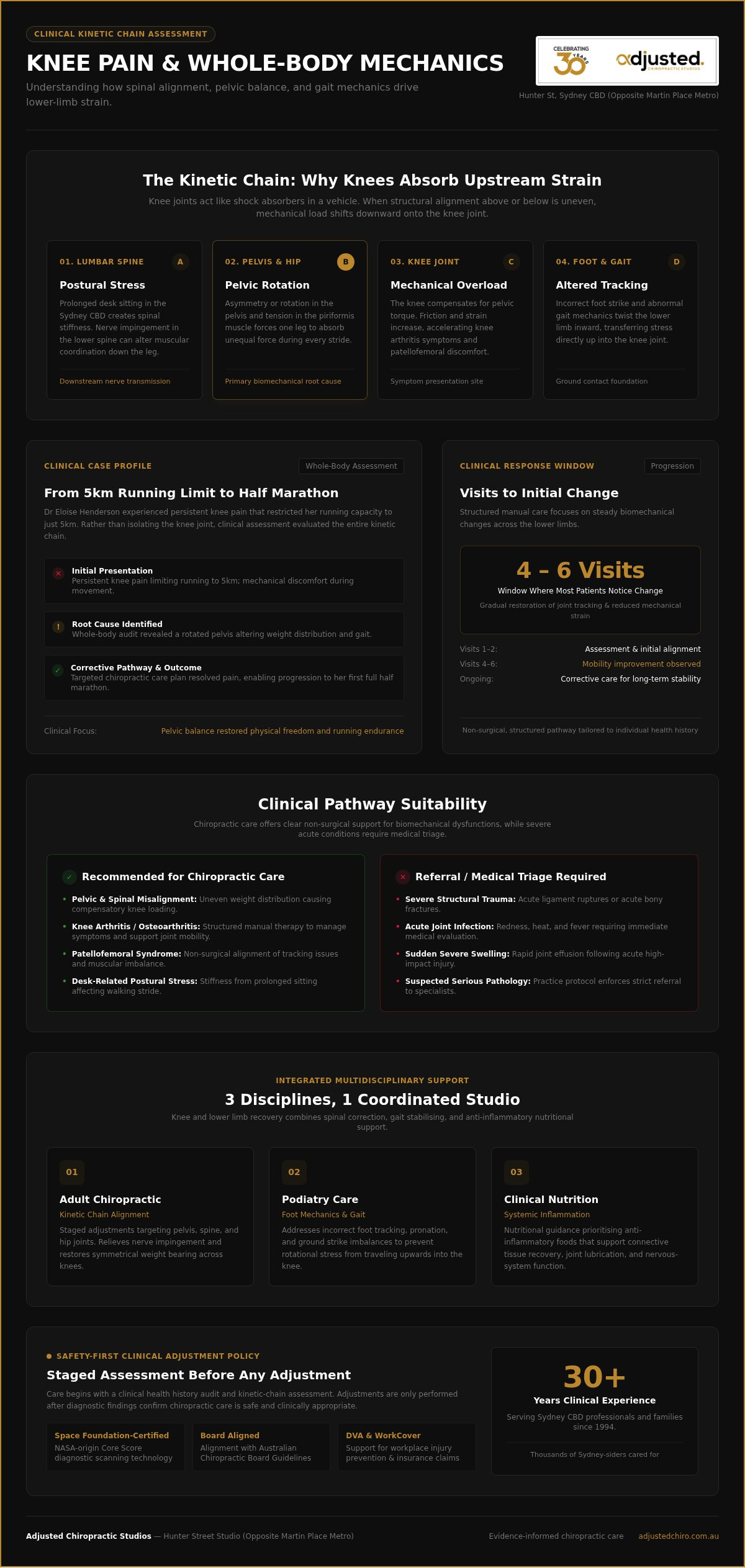
At our practice, Dr Eloise Henderson experienced persistent knee pain that limited her running to 5km. A chiropractor assessed her body as a whole, discovered a rotated pelvis as the root cause, and created a focused chiropractic care plan. She became pain-free and went on to run her first half marathon. Addressing whole-body alignment transformed her movement.
When hip or spinal issues alter your gait, extra pressure settles on your lower joints. Our Sydney CBD team evaluates your entire kinetic chain, linking your spine, pelvis, and feet so you can move with less strain. If your condition involves severe foot mechanics, combining care with podiatry-focused foot care restores total lower-body stability.
Chiropractic care can reduce knee pain without surgery
Chiropractic care offers a non-surgical alternative for managing joint discomfort by restoring proper biomechanics and joint alignment throughout your lower limbs. Structured manual care helps address underlying joint strain before you consider invasive procedures.
Incorrect foot tracking frequently drives the joint into painful positions. Misalignment in your hips or spine can also transfer stress downwards, compounding knee arthritis symptoms during daily movement. Structured manual therapy is used in clinic to support pain reduction and mobility in people with lower limb osteoarthritis.
At our Hunter Street clinic, we combine hands-on adjustments with precise movement strategies to build long-term stability. If you work in the CBD, spinal care for CBD professionals helps address postural stress (stiffness from sitting) that impacts lower limb function. Non-invasive care gives you a realistic path back to comfortable movement. More on this: Adult Chiropractic Sydney.
Hips, spine and feet often drive knee strain
Knee discomfort often stems from poor biomechanics in the hips, back, or feet rather than an isolated joint issue.
Our clinical experience shows that ongoing joint stress typically stems from altered mechanics further up the body. When the pelvis lacks proper symmetry, the lower leg must offset that imbalance while walking or exercising. Targeted hip pain support in Sydney helps restore balance across your entire lower body.
Long periods at a desk can create stiffness from sitting that alters your normal stride. Muscle imbalance in the piriformis muscle often alters leg mechanics, while a pinched nerve (nerve impingement) in the lower spine can send pain downward.
Our clinical nutritionist collaborates with our chiropractors so your dietary plan enhances structural alignment and supports your nervous system, which can accelerate progress on a personalised plan toward steadier movement.
A staged assessment before any adjustment
We structure your knee assessment methodically to identify the root biomechanical issues affecting your movement, and we only adjust after that work is complete.
From client work we see how stiffness from sitting alters lower limb alignment; correcting it helps you rebuild reliable joint function. We maintain a strict policy: we do not perform adjustments until we have fully analysed your results and confirmed that chiropractic care is the appropriate path for your specific situation. This safety-first clinical adjustment policy protects your wellbeing.
- Detailed consultation: Your practitioner reviews your complete health history and daily movement demands.
- Clinical examination: We evaluate joint movement, focusing on areas like knee arthritis or a pinched nerve.
- Diagnostic analysis: Objective testing measures your neurological efficiency and postural balance.
- Care plan: We design a tailored plan to restore your long-term joint function.
Tip: Always ensure your practitioner conducts a thorough neurological and postural assessment before commencing structural adjustments.
Conservative pathways compared for lower limb pain
Selecting non-surgical support for joint discomfort means matching your functional goals with the right clinical modalities. Knee arthritis responds well to structured physical therapies, tailored movement strategies, and soft tissue management.
| Care Pathway | Primary Clinical Focus | Ideal Patient Outcome |
|---|---|---|
| Chiropractic Care | Biomechanical alignment and joint function | Improved mobility and reduced physical strain |
| Podiatry | Lower limb alignment and foot mechanics | Restored gait balance and reduced joint impact |
| Targeted Nutrition | Joint support and dietary strategies | Reduced systemic inflammation and tissue recovery |
Persistent lower limb strain often stems from unaddressed postural stress at your desk. Addressing spinal movement alongside local joint therapy provides balanced support and builds long-term stability. Adjusted Chiropractic Studios helps you work toward durable joint function by targeting root causes rather than symptoms alone.
Most patients notice change within four to six visits
Most patients notice functional improvements within four to six visits; full resolution still depends on a personalised plan.
In our Sydney CBD clinic, we often observe that knee issues stem from stiffness from sitting or a pinched nerve in the lower back. Standard care plans typically schedule two sessions weekly for the first month to restore joint mechanics. Frequency then decreases as your body adapts.
Too many practices hide their timelines, leaving patients uncertain about total costs and duration. We believe transparent, goal-driven planning is essential for your financial clarity and your mobility goals. Every individual heals differently based on lifestyle, age, and systemic inflammation. A full clinical audit establishes your exact trajectory early.
Request a personalised consultation to receive an exact care estimate tailored to your health history. Clear communication and trackable clinical milestones keep your recovery on course.
Among Adjusted Chiropractic Studios’s Google reviews, Adam (5★) wrote:
"Superb experience from day 1. The chiropractic journey so far has been a personable and goal-driven one. Dr’s are professional and impart a wealth of knowledge to ensure every chance in maximising results outside the clinic rooms. Highly recommend."
Care plans work best when transparent timelines sit alongside practical guidance you can use between visits.
When manual care should wait for medical review
Direct manual treatment is not appropriate for every presentation of knee pain.
If your pain stems from severe structural trauma, acute infection, or sudden severe swelling, immediate medical evaluation takes precedence. Primary medical care suits structural emergencies; tailored biomechanical support fits stable, non-emergency joint issues.
Our clinical focus prioritises your safety. Investigative methods align strictly with the Australian Chiropractic Board Guidelines, so every scan and adjustment meets required safety standards for paediatric and adult care.
When diagnostic findings show that conservative care cannot help, we prompt a referral for medical or surgical review. Thorough screening protects your health. Our team guides you toward the correct professional pathway whenever primary care falls outside our scope.
Frequently asked questions
Can a chiropractor treat knee pain?
Chiropractors evaluate your entire body to address joint alignment, biomechanics, and nerve function affecting your knee. Your clinical pathway begins with a comprehensive health history and careful physical examination. Following our safety-first clinical adjustment policy, we do not perform adjustments until we fully analyse your diagnostic results. Methods aligned with Australian Chiropractic Board Guidelines help improve overall movement.
Can chiropractic care help with knee arthritis?
Chiropractic care supports joint function in people managing knee arthritis by restoring balance across the lower limb. Our integrated allied-health team collaborates across disciplines to create your individualised management plan. For instance, our clinical nutritionist works with our chiropractors to coordinate care and select anti-inflammatory foods, aiming to reduce postural stress and protect long-term joint health.
Will I need surgery for my knee pain?
Many conservative options exist to restore movement before you consider invasive surgical options. Objective assessments help determine whether gentle joint care, lifestyle adjustments, or nutritional support suit your goals. If your initial examination indicates serious underlying structural issues, our clinic immediately refers suspected serious conditions to appropriate medical specialists. Dr Eloise Henderson became pain-free through dedicated chiropractic care and went on to run her first half marathon.
What is patellofemoral syndrome?
Patello-femoral syndrome occurs when your kneecap moves incorrectly along the thigh bone, often triggering discomfort during daily activities. This improper tracking creates localised irritation, much like a door rubbing against its frame. Our care focuses on identifying faulty mechanics and reducing nerve impingement (pinched nerve) in the kinetic chain so balanced muscle pull supports steadier daily movement.
Is it better to rest my knee or keep moving when it hurts?
Controlled movement usually supports recovery better than total bed rest. Gentle activity keeps joints lubricated, whereas prolonged stiffness from sitting can worsen discomfort. We guide you through safe activities designed to build joint stability without overloading injured tissues.
Next Steps for Your Knee Health
Persistent knee discomfort is best addressed by clarifying structural alignment and joint function first, then choosing a plan that matches how you actually move each day. Managing chronic knee arthritis needs an approach tailored to your routine, the same decision thread that opened this guide: root-cause mechanics, clear timelines, and safety before any adjustment.
At Adjusted Chiropractic Studios, Dr Adrian Couzner brings over 30 years of clinical experience. Working alongside Nutritional Medicine Practitioner Mandy Rancev, our integrated allied-health team delivers individualised care backed by a safety-first clinical adjustment policy. We focus on finding root causes rather than quick fixes.
To explore a structured plan for more comfortable movement, book your initial assessment via Adjusted Chiropractic Studios.



