
What if that satisfying “pop” you get from twisting your neck is actually making your spinal tension worse? It’s a common habit for many Sydney professionals, especially after a long day hunched over a desk in the CBD. You feel a momentary sense of relief, yet the stiffness inevitably returns, often with even more intensity. We understand how frustrating it is to feel trapped in a cycle of recurring tightness and the nagging worry that you might be wearing out your joints prematurely.
Getting adjusted compared with self-manipulating involves a fundamental shift from moving what’s already loose to targeting the segments that are actually stuck. While self-cracking might provide a temporary endorphin rush, it often overstretches healthy ligaments while leaving the underlying restriction untouched. In this article, you’ll discover the clinical difference between a specific chiropractic adjustment and simply “cracking” your own back. We will explore why self-manipulating might be doing more harm than good and how a methodical, investigative approach can help you achieve the lasting physical freedom you deserve.
Key Takeaways
- Understand why the audible “pop” of self-cracking offers only fleeting relief while often leaving the true source of your tension unaddressed.
- Recognise the vital clinical difference of getting adjusted compared with self-manipulating to ensure you aren’t inadvertently destabilising your own spine.
- Identify the long-term risks associated with habitual “cracking,” such as ligament laxity and the development of chronic joint hypermobility.
- Learn practical strategies to break the cycle of self-manipulation, including the “Wait 10 Minutes” rule and targeted ergonomic improvements.
- Discover how objective diagnostic technology can replace guesswork with a precise, evidence-based plan for your long-term spinal health.
The Habit of ‘Cracking’ Your Own Back: Why It Feels Good (Temporarily)
Many of us have experienced that familiar, nagging tightness after a long morning at the desk. You twist your torso or tilt your neck, hear a sharp “pop,” and feel an immediate wave of relief. This habit is known as self-manipulation: the act of forcing your own joints to release without a professional clinical assessment. While it might feel like you are fixing the problem, you are simply triggering a chemical reaction rather than addressing a structural issue. Understanding the clinical reality of getting adjusted compared with self-manipulating is the first step toward moving beyond temporary fixes and toward long-term spinal stability.
The Cavitation Phenomenon Explained
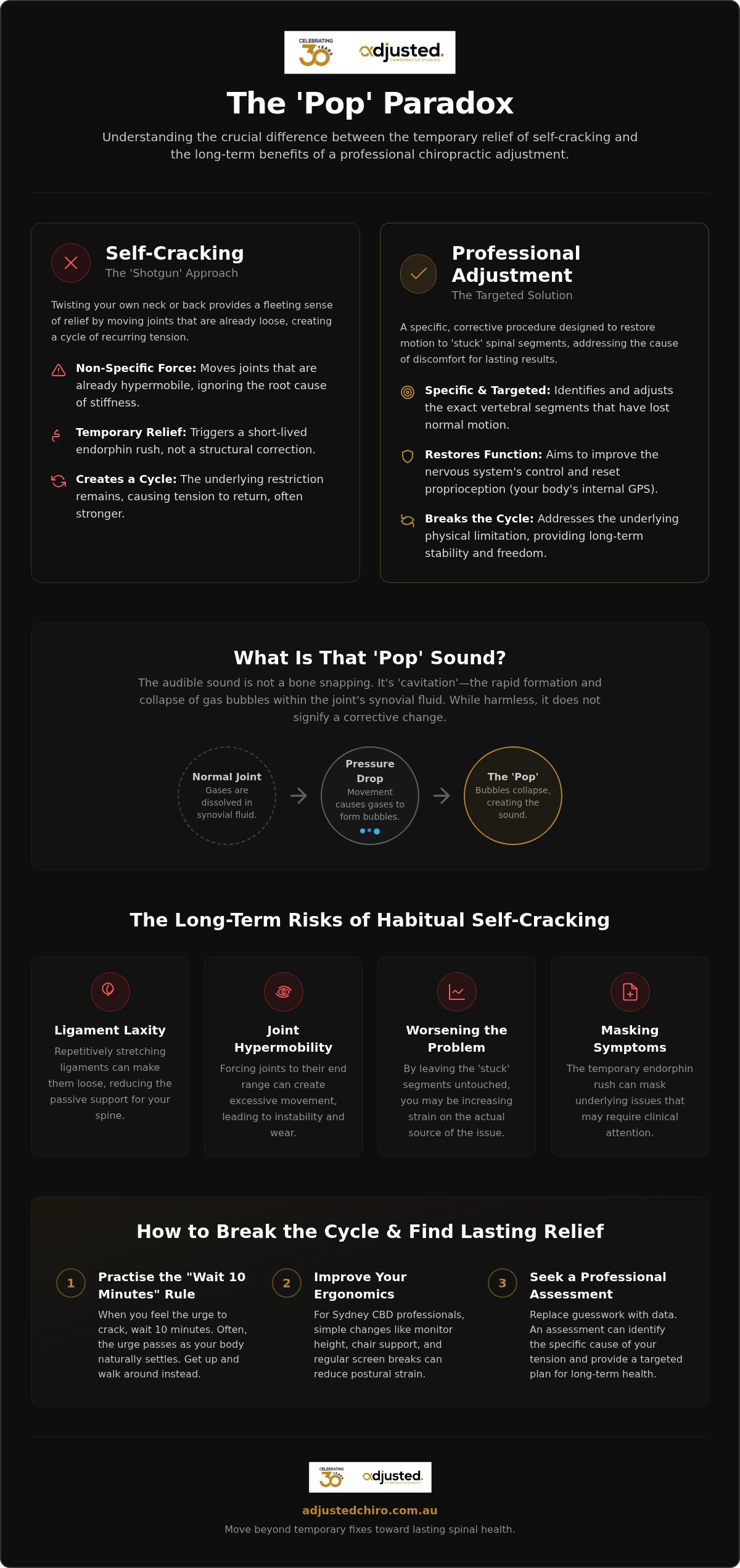
The sound you hear isn’t a bone “snapping” back into place. It is a process called cavitation. Your spinal joints are surrounded by synovial fluid, which contains dissolved gases like nitrogen and carbon dioxide. When you force a joint to its end range, the pressure within the joint capsule drops rapidly. This causes the dissolved gases to form tiny bubbles that quickly collapse, creating the audible “pop” we all recognise. The Science of Joint Cracking confirms that while this sound is harmless in isolation, it doesn’t signify a corrective change. Unlike a precise spinal adjustment sydney, which targets specific “stuck” segments to restore function, self-cracking is non-specific. You are usually just popping the joints that are already moving too much, leaving the truly restricted ones untouched.
Why Sydney Professionals Get Hooked on Self-Cracking
Living and working in the Sydney CBD often involves hours of sedentary office work, which places immense strain on the postural muscles. This sustained “stuckness” creates a natural urge to stretch and move. When you crack your own back, your brain releases a small burst of endorphins, the body’s natural feel-good chemicals. This creates a powerful psychological feedback loop. You feel a “hit” of relief, but because the underlying joint restriction hasn’t been corrected, the tension returns within the hour. By late arvo, you find yourself needing to crack your neck again just to get through the next meeting. This cycle is why getting adjusted compared with self-manipulating is so different; one provides a fleeting chemical reward, while the other aims to resolve the physical limitation causing the urge in the first place.
The Science of a Chiropractic Adjustment vs Self-Manipulation
Getting adjusted compared with self-manipulating involves a fundamental difference in how force is applied to your spine. While self-cracking is a non-specific release of pressure, a professional adjustment is a highly targeted corrective procedure. A chiropractor doesn’t just look for a sound; they look for a restoration of function in a specific segment that has lost its normal range of motion. This clinical precision ensures that we are addressing the root cause of your discomfort rather than merely treating a symptom.
Specificity and Force Vectors
To achieve a corrective result, a practitioner must isolate a single vertebral segment. This is done through a combination of manual palpation and objective diagnostic tools, such as NASA-certified Core Score scanning. By identifying the exact “subluxation,” the chiropractor can calculate a precise force vector, adjusting the angle and depth of the thrust to match your unique anatomy. An HVLA thrust is a high-velocity, low-amplitude movement designed for precision. This specific input helps reset your proprioception, which is essentially the nervous system’s internal GPS, allowing the brain to communicate more effectively with the spinal muscles and supporting tissues.
Self-Manipulation: The ‘Shotgun’ Approach
When you attempt to crack your own back, you lack the mechanical leverage to isolate a restricted joint. Instead of moving the “stuck” segment, the force naturally follows the path of least resistance, moving the segments that are already too loose (hypermobile). This non-specific “shotgun” approach often requires you to rotate your neck or back to its extreme end-range to get a sound, which can strain delicate connective tissues. Research into the risks of spinal manipulation highlights that without clinical oversight, these repetitive, non-specific movements can lead to instability and other complications.
- Professional adjustments target restricted joints specifically to restore mobility.
- Self-manipulation typically moves hypermobile joints above or below the true problem.
- Precision vectors used by professionals prevent unnecessary ligament strain.
- Objective scanning takes the guesswork out of spinal alignment.
The clinical reality of getting adjusted compared with self-manipulating is that professional care prioritises long-term stability over a five-minute fix. If you find yourself constantly seeking that “pop” without lasting change, it may be time to move toward a more methodical approach to spinal care. Identifying the true source of your tension is the only way to break the cycle of recurring stiffness and reclaim your physical freedom.
The Risks of Self-Cracking: From Ligament Laxity to Hypermobility
While the immediate “pop” feels like a release, the long-term physical cost of habitual self-cracking can be significant. The primary danger lies in creating joint hypermobility. This occurs when the ligaments, which function like the structural rubber bands of your spine, become permanently stretched. Once these tissues lose their elasticity, the joint loses its inherent stability. This is why getting adjusted compared with self-manipulating is a choice between building long-term resilience or accidental destabilisation. When a joint is hypermobile, it no longer maintains its proper alignment under the stresses of daily life, leaving you more vulnerable to injury.
Over Manipulation Syndrome (OMS)
Over Manipulation Syndrome is a clinical reality for many who habitually pop their own joints. It manifests as a cycle where the spine feels progressively more “unstable,” leading to a frequent urge to crack for a momentary sense of comfort. You might find that the relief lasts only minutes before the stiffness returns. This repetitive, non-specific trauma can accelerate wear and tear on the spinal discs. Instead of resolving the issue, OMS creates a dependency on the habit while the underlying spinal dysfunction continues to worsen beneath the surface.
The ‘Hypermobile Joint’ Trap
Most people don’t realise that when they self-manipulate, they are almost always moving the segments that are already moving too much. The truly “stuck” joint remains locked, forcing the segments above and below to compensate by over-working. This creates a “hypermobile joint trap” where the loose joints get even looser, while the restricted joint remains immobile. This imbalance increases the risk of nerve irritation and inflammation in the surrounding tissues. It’s a counter-productive cycle that fails to address the actual source of your physical limitation.
To protect these unstable areas, the brain often signals the surrounding muscles to contract, creating painful knots or “muscle guarding.” If you are searching for neck stiffness treatment sydney, it’s often because your body is trying to splint an unstable neck caused by years of self-popping. The muscles aren’t just tight; they are working overtime to hold your spine together because the ligaments have been overstretched. Breaking this cycle requires a professional assessment to identify which joints need more movement and which ones need to be stabilised. A thorough spinal health check sydney can take the guesswork out of your recovery by pinpointing these specific imbalances before they lead to permanent changes.
Breaking the Habit: Better Ergonomics for Sydney CBD Professionals
For the busy professional working in the heart of the Sydney CBD, the urge to “pop” the neck often feels like a necessary part of the afternoon routine. This desire is usually a signal from your body that it has reached its limit of static postural strain. Understanding the long-term value of getting adjusted compared with self-manipulating starts with recognising that your environment often dictates your physical habits. If you are constantly fighting the urge to crack your back, it is essential to identify the underlying trigger. Is it simple postural fatigue, or could it be a more complex issue requiring herniated disc treatment sydney? Identifying these triggers is the first step in moving from temporary relief toward sustained wellness.
One of the most effective ways to break the habit is the “Wait 10 Minutes” rule. When the urge to self-manipulate strikes, commit to waiting ten minutes before acting on it. Use this time to change your physical state: stand up, walk to the office kitchen, or perform a gentle stretch. SafeWork Australia notes that sitting for more than 30 minutes without a break is considered a hazardous sustained posture. Often, simply breaking the static hold on your spinal joints will cause the urge to dissipate without the need for a forceful, non-specific crack.
Corrective Posture Strategies
Your workstation setup is the primary factor in daily spinal tension. Ensure your monitor is positioned so the top third of the screen is at eye level; this prevents the forward-head posture that leads to “tech neck.” Your chair should provide firm support for the natural inward curve of your lower back. If your current office chair is lacking, a simple lumbar roll can make a significant difference. We also recommend “movement snacks” every half hour. These brief intervals of movement prevent the joints from becoming “stuck” and reduce the buildup of the pressure that leads to the urge to self-manipulate.
Safe Stretching Alternatives
Instead of a sharp twist, try gentle mobility exercises that reset the nervous system without straining the ligaments. Chin tucks are excellent for realigning the cervical spine, while shoulder blade retractions help open the chest and counteract a slumped posture. Desk-bound workers can also benefit from the “Brugger’s Relief” position. Sit at the edge of your chair, turn your palms outward, and take three deep diaphragmatic breaths. This position actively reverses the “C-shape” slump of office work. If these gentle stretches fail to provide lasting comfort, it is a clear sign that a deeper joint restriction is present. In these instances, consulting a qualified chiropractor sydney is the most reliable way to restore proper function. To ensure your spine is functioning at its best, we invite you to book a professional spinal assessment today.
Why Professional Care Wins: The Adjusted Chiropractic Approach
After 30 years of clinical experience in the Sydney CBD, we’ve observed a clear pattern among professionals: the more they self-manipulate, the more unstable their spine becomes. Clinical wisdom is the cornerstone of our practice. It allows us to distinguish between a joint that needs movement and one that requires stabilisation. Getting adjusted compared with self-manipulating isn’t just about a different technique; it’s about a fundamental shift from guesswork to precise, evidence-based care. We don’t just treat the area where you feel tension; we investigate the underlying cause of your nervous system stress to ensure your physical freedom is restored for the long term.
The Core Score Advantage
One of the primary ways we ensure precision is through NASA-certified technology. Our core score spinal scan provides a digital map of your nervous system function. This objective data identifies exactly where your spine is under stress, even in areas where you might not yet feel pain. By removing the guesswork, we can deliver a precise, safe, and effective adjustment that targets the “stuck” segments we discussed earlier. This technological insight ensures that every movement we make is purposeful and designed to restore your physical freedom without overstretching healthy ligaments. It’s a level of specificity that simply cannot be achieved through self-popping.
A Partnership in Wellbeing
Your journey with us begins with a thorough investigative consultation. We take the time to understand your history, your workplace ergonomics, and your long-term health goals. This initial evaluation is a collaborative process where we explain our findings and develop an individualised care plan tailored to your specific needs. We focus on transitioning you from “relief care,” where we address immediate symptoms, to “wellness care,” which prioritises sustained stability and vitality. Our goal is to move beyond the “one-size-fits-all” pop and toward a methodical approach that respects your body’s unique anatomy.
- Comprehensive assessment of your spinal health and nervous system function.
- Use of advanced diagnostic technology to pinpoint specific subluxations.
- Tailored corrective pathways that prioritise joint stability over temporary relief.
- A focus on long-term wellness rather than superficial, recurring fixes.
Breaking the habit of self-cracking is much easier when you have a clear, corrective pathway to follow. We act as your wise mentor in this process, guiding you away from the risks of hypermobility and toward a future of physical freedom. Book your evaluation at Adjusted Chiropractic Studios today to find the real cause of your tension and start your journey toward lasting spinal health.
Reclaiming Your Long-Term Spinal Stability
Moving beyond the temporary “pop” of self-cracking is a vital step toward protecting the structural integrity of your spine. While the urge to release tension is understandable, especially for Sydney CBD office workers, habitual self-manipulation often leads to ligament laxity and joint instability. We’ve explored how getting adjusted compared with self-manipulating shifts the focus from a non-specific “shotgun” approach to precise, evidence-based care that targets the true source of your restriction. By choosing professional assessment over guesswork, you ensure that your healthy joints remain stable while the restricted ones regain their natural function.
At Adjusted Chiropractic Studios, we combine over 30 years of clinical experience with NASA-certified Core Score technology to provide a patient-centric, investigative approach to your health. Our goal is to guide you away from the cycle of recurring stiffness and toward a future of physical freedom and vitality. You don’t have to manage spinal tension on your own. Book your clinical spinal evaluation at Adjusted Chiropractic Sydney CBD today and take the first step toward a more stable, resilient you. We look forward to partnering with you on your journey to sustained wellness.
Frequently Asked Questions
Is it bad to crack your own neck every day?
Yes, habitual self-cracking can lead to joint instability and ligament laxity. When you pop your neck daily, you are usually moving segments that are already hypermobile rather than the ones that are truly restricted. Over time, this repetitive stretching of the joint capsule can cause the surrounding muscles to tighten in an effort to protect the unstable area. This is why getting adjusted compared with self-manipulating offers a safer path to long-term spinal health.
What is the difference between a ‘crack’ and a chiropractic adjustment?
The primary difference lies in clinical specificity. A “crack” is a non-specific release of gas bubbles, known as cavitation, from any joint that happens to move. In contrast, a chiropractic adjustment is a precise, high-velocity, low-amplitude (HVLA) thrust directed at a specific vertebral segment identified through assessment. While self-cracking offers a fleeting endorphin hit, a professional adjustment aims to restore proper neurological function and joint mechanics to the areas that are actually restricted.
Can self-manipulation cause a stroke or serious injury?
While serious complications like stroke are extremely rare, self-manipulation carries significant risks of disc herniation, nerve irritation, and muscle strains. The danger often comes from forcing the neck or back into extreme end-range rotation to achieve a sound. Without the clinical training to calculate precise force vectors, you may inadvertently damage delicate connective tissues. This is why professional evaluation is essential for those experiencing chronic spinal tension or recurring stiffness.
Why do I feel the need to crack my back all the time?
You feel the urge to crack because your body is trying to compensate for a joint that isn’t moving correctly. When one segment is restricted, the joints above and below must work harder, leading to a buildup of pressure. Popping these loose joints provides a temporary endorphin release, but it doesn’t fix the underlying “stuck” segment. This creates a repetitive cycle where the tension returns quickly because the root cause remains unaddressed.
Does cracking your knuckles or back cause arthritis?
There is no definitive evidence that cracking your knuckles causes arthritis, but the same isn’t true for the spine. Habitual self-cracking can lead to “Over Manipulation Syndrome,” which causes joint instability. When spinal segments lose their structural integrity, it can lead to premature wear and tear on the intervertebral discs and facet joints. Maintaining proper alignment through professional care helps preserve joint health and prevents the uneven loading that contributes to degenerative changes.
How can a chiropractor help me stop cracking my own back?
We help by identifying and correcting the specific joint restrictions that create the urge to crack. By using NASA-certified Core Score technology, we pinpoint exactly where your nervous system is under stress. Once the truly restricted segments are moving properly, the compensatory hypermobility in the surrounding joints usually settles down. This removes the physical pressure and the psychological need for that temporary “pop,” allowing your spine to stabilise naturally.
Is it safe for a chiropractor to adjust my neck?
Yes, professional neck adjustments are remarkably safe when performed by a registered chiropractor. As a regulated health profession in Australia, we undergo years of clinical training to perform these procedures with precision. Getting adjusted compared with self-manipulating ensures that the movement is controlled, specific, and based on a thorough physical examination. We always screen for contraindications and use gentle, evidence-based techniques to restore mobility without overstretching the supporting ligaments of the cervical spine.
Can children be adjusted, or is it only for adults?
Chiropractic care is suitable for people of all ages, including children and infants. We use significantly gentler techniques for kids, often involving no more pressure than you would use to check the ripeness of a tomato. Children’s spines undergo immense stress during birth and developmental milestones like learning to walk. Addressing minor imbalances early can support healthy nervous system development and help prevent the postural issues that often lead to chronic tension in adulthood.