What if easing back pain at your desk isn’t about holding one perfect posture all day? If you’re dealing with office worker back pain in Sydney, long spells of sitting, limited movement and workstation habits may all play a part. It can be difficult to know which changes might help when your workday is already full.
Your discomfort is real, and small, practical adjustments can be a useful place to start. This guide explains common workday factors that may contribute to back pain, from sustained postures to infrequent movement. It also offers realistic ways to adjust how you sit, move and organise your workstation, and explains when an individual assessment may help you consider your next steps.
At Adjusted Chiropractic Studios, care begins with listening to your concerns and understanding your health history. An individual assessment then considers your needs and physical findings. Read on to explore supportive workday habits and what a personalised next step may involve, so you can make informed choices about your comfort and movement.
Key Takeaways
- Office worker back pain in Sydney can have more than one contributing factor, so a single posture rule may not explain your discomfort.
- A chair adjustment may support comfort, while varying your position and building brief movement into the day serve different purposes.
- Notice when discomfort builds and what you’re doing at the time. That pattern can help guide practical workstation and workday changes.
- An individual assessment considers your health history and physical findings. Space-certified Core Score testing may also inform the process.
- Spinal adjustments have potential risks. Your chiropractor discusses the risks and rewards with you before proceeding.
Why Sydney CBD office work can leave your back uncomfortable
If discomfort gathers through a morning of meetings, lingers after hours of screen work and makes the trip home harder, it can be frustrating to work out what’s contributing. Office worker back pain in Sydney may be associated with workday habits, but desk work isn’t the only possible factor. Back pain can have different patterns and possible causes, so one worker’s experience won’t necessarily explain another’s. Back pain can also vary in where it’s felt and how it affects movement.
One useful term is postural stress: physical strain that can build when you hold a position or repeatedly work in a way that feels uncomfortable. It doesn’t mean there’s one universally correct posture you must maintain. Your body’s needs, tasks and comfort can change across the day, so varying your position and moving when practical may be more useful than trying to sit perfectly still.
A work habit may contribute to discomfort, but it doesn’t confirm the cause of an individual’s back pain. Noticing a pattern can guide practical changes, while persistent or concerning symptoms deserve attention to your individual circumstances rather than assumptions based on your desk setup alone.
How desk routines can contribute to postural stress
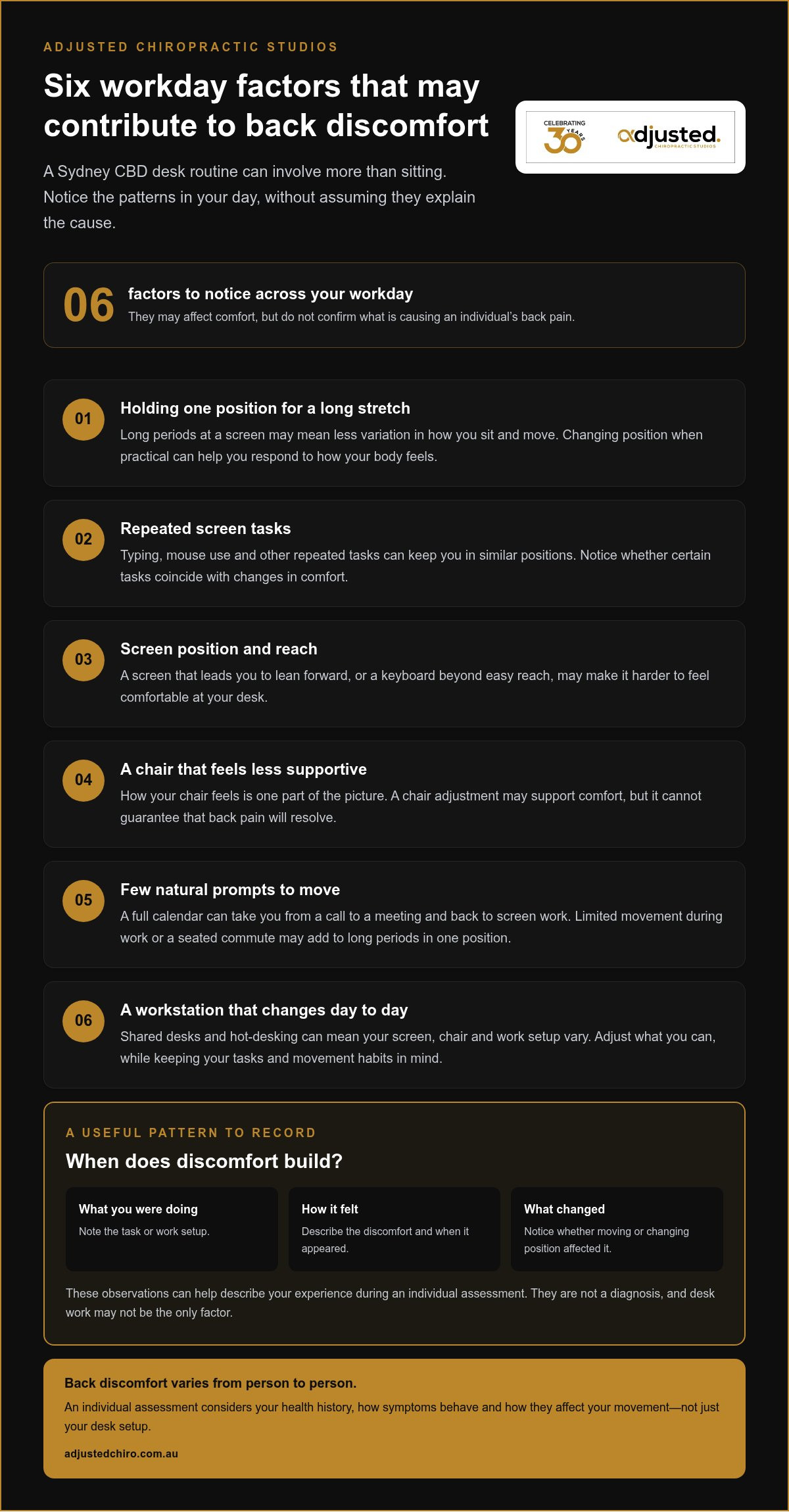
Holding one position for a long stretch can increase physical strain, particularly if your work keeps you focused on a screen without a natural prompt to move. Repeated tasks, such as typing or using a mouse, can also mean you spend much of the day in a similar position. These habits may affect comfort, but they won’t explain every person’s symptoms.
Small setup details can shape how desk work feels. A screen that encourages you to lean forward, a keyboard placed beyond easy reach, or a chair that doesn’t feel supportive may make it harder to stay comfortable. Shared desks and hot-desking can mean your setup changes from day to day. Adjust what you can, then consider your work tasks, movement habits and personal circumstances too.
Why a Sydney CBD workday can make movement harder
In the Sydney CBD, a packed calendar might mean moving from a video call straight into a meeting, then returning to a long stretch of screen tasks. Some workers spend the commute seated as well, adding another period with limited movement before or after desk time. Others walk between meetings or use a different setup during the day. There’s no single routine that applies to everyone.
When work is demanding, it can be easy to notice discomfort only once it has built up. Pay attention to when it starts, what tasks you’ve been doing and whether changing position affects how you feel. These observations aren’t a diagnosis, but they can help you make sense of your workday and identify a manageable change. The next sections cover practical adjustments and when an individual assessment may help you plan what to do next.
What happens to your back during long desk-work periods?
A back that feels different by the end of the day can leave you wondering whether you’ve caused an injury. Aching, tightness or stiffness is useful information, but it doesn’t identify a specific structure or confirm a diagnosis. The same workday can feel different from one person to another, and the intensity of discomfort alone can’t explain what is happening.
For office worker back pain in Sydney, it’s helpful to distinguish a symptom that coincides with desk work from a confirmed cause. Your work pattern may be relevant, but a clinician also considers your health history, how symptoms behave and how they affect your movement. That broader context matters because desk-related discomfort doesn’t follow one universal pattern.
Why changing position can matter more than holding perfect posture
Rather than judging your back against a single posture standard, notice how it responds to the demands of your day. A position that feels manageable during one task may feel less comfortable during another. Changing position lets you respond to those differences instead of spending the day trying to maintain a fixed shape.
This isn’t a test of whether you’ve sat “correctly”. If you notice a change in comfort after moving, take it as an observation, not proof of a particular cause. The aim is to understand your own responses while recognising that they may not tell the whole story.
How screen work and repeated tasks affect the workday
Some desk roles involve long stretches of concentrated work, while others alternate between calls, documents and different tasks. Repeating similar actions may also make one part of the workday feel more demanding than another. These differences can be useful to note if you’re trying to understand when discomfort tends to appear.
Keep a brief record of what you were doing, how the discomfort felt and whether it affected an activity afterwards. A few clear observations can help you describe the pattern during an assessment. They don’t establish a diagnosis, and they shouldn’t lead you to assume work is the only factor involved.
If symptoms keep troubling you, an individual assessment can help put those observations in context. Personalised chiropractic care begins with understanding your concerns and circumstances, rather than treating a workday pattern as a diagnosis.
Can a better chair or posture fix office worker back pain?
A more comfortable chair or a change to how you sit may help you feel better at your desk, but neither can guarantee that back pain will resolve. Office worker back pain in Sydney doesn’t have a single workstation fix: equipment, movement habits and individual health circumstances each play a different role. A chair supports your working position, changing position breaks up long periods of sitting, and an individual assessment helps put recurring symptoms in context.
What a chair and workstation change can, and cannot, do
Think of a workstation adjustment as something to test for comfort, not as a treatment with a guaranteed result. You might bring frequently used items within easy reach, adjust your screen so you’re not repeatedly leaning towards it, or change your chair position to find a more comfortable working posture. The right adjustment depends on your body, tasks and setup.
Try one manageable change at a time. Notice whether it makes desk work feel easier, then keep, adapt or undo the change based on your experience. This helps you understand what feels supportive without overhauling everything at once. A new chair may suit your workspace, but no particular chair type can be assumed to prevent or treat everyone’s back pain.
Movement has a separate purpose. A brief change of position or walk between tasks can interrupt a long stretch at the desk, while a workstation adjustment changes how you interact with your setup. Neither replaces an individual assessment if symptoms keep returning. These approaches can complement one another rather than act as alternative cures.
When persistent discomfort deserves an individual assessment
If discomfort keeps returning, lasts beyond a short-lived episode or affects what you can comfortably do, consider an individual discussion and examination. A clinician can ask about your symptoms and health history and assess your circumstances before discussing suitable next steps. The fact that pain appears after desk work is useful context, but it doesn’t confirm that the workstation caused it.
Persistent symptoms deserve individual attention because no universal posture rule can explain every person’s pain. This can help distinguish what you’ve noticed at work from what an assessment may find, and support a plan shaped around your needs rather than a generic instruction to sit differently.
At Adjusted Chiropractic Studios, recommendations follow a personalised assessment. If spinal adjustments are considered, they have potential risks, and the chiropractor discusses the risks and rewards with you before proceeding. If you’d like to explore an individual approach, personalised chiropractic care can be a relevant next step.
Practical Sydney office habits to support back comfort
When your calendar is full, advice to “move more” can feel hard to put into practice. A simple sequence can make it manageable: notice when discomfort appears, vary your position, fit in brief movement where practical, then review how your workstation feels. For office worker back pain in Sydney, the aim is to find realistic habits that fit your day, not to follow a rigid routine or treat every symptom the same way.
- Notice the pattern. Pay attention to when discomfort starts, what you’re working on and whether it changes as your day progresses. These observations can help you decide what to adjust.
- Vary your position. Change how you’re sitting or stand for a task when that feels comfortable and suits the work.
- Plan brief movement. Use natural gaps, such as before a meeting or after finishing a task, to stand or take a short walk.
- Review your setup. Check whether your screen, keyboard and chair feel workable, especially if you’re using a shared desk.
A manageable movement routine for desk-based work
Rather than setting a strict interval that may clash with your workload, link movement to regular parts of your schedule. You might stand while reviewing a document, walk to speak with a colleague when practical, or take a short stroll after a block of screen work. In meeting-heavy Sydney CBD offices, a brief change of position between calls may be easier to sustain than a lengthy routine.
Gentle stretches are optional, not a requirement or a prescribed treatment. Choose only movements that feel comfortable, and stop if an activity causes or worsens symptoms. If movement feels difficult or your discomfort persists, seek individual guidance rather than pushing through.
Small workstation changes to test during the week
At a fixed or shared desk, check that frequently used items are within comfortable reach and that you can view your screen without repeatedly leaning or turning. Adjust one element at a time, then notice whether your comfort changes during the tasks you do most. This gives you a clearer sense of what may help in your particular setup without assuming one arrangement suits everyone.
For employers, workplace injury prevention can include looking at how work is organised alongside workstation habits. Adjusted Chiropractic Studios’ Corporate Health Training provides workplace education to help teams understand practical health habits. This education can inform general workplace practices, while an individual assessment remains a separate step for a person with ongoing discomfort.
How personalised chiropractic care can help Sydney office workers plan next steps
If back discomfort keeps interrupting your workday, an individual assessment can help you consider what to do next. At Adjusted Chiropractic Studios, the process begins with your health history and a conversation about your symptoms, daily activities and goals. A physical assessment follows, helping the chiropractor understand your circumstances before discussing recommendations. Desk habits are useful context, but they don’t determine a diagnosis on their own.
Adjusted Chiropractic Studios has provided care in Sydney CBD for 30+ years. The team has 40+ years combined experience and has helped over 18,000 people. This experience supports a careful, individual approach, while your assessment remains focused on your own health history and findings.
What to expect from an individual assessment
Your first visit includes time to discuss what you’ve noticed, when discomfort occurs and how it affects your daily activities. The chiropractor reviews your health history and completes a physical assessment. Digital spinal X-rays are considered only if indicated, not automatically for every person. This helps keep recommendations relevant to your needs rather than relying on a standard approach.
Adjusted Studio’s adult chiropractic care is personalised to the individual. The assessment is also a chance for you to ask questions and understand the reasoning behind any suggested next steps.
How a personalised corrective pathway is discussed
After the assessment, the chiropractor explains their findings and discusses recommendations with you. Space-certified Core Score testing may form part of the assessment approach. It is one tool to inform the process, not a test that identifies every possible cause of pain. Any suggested care is discussed in light of your circumstances, and the number of sessions can vary between individuals.
If spinal adjustments are considered, they are gentle and focused on your comfort. Adjustments have potential risks, so the chiropractor discusses the risks and rewards with you before proceeding. You can talk through your questions before deciding whether to continue.
For office worker back pain in Sydney, practical workday changes may be useful, and an individual assessment can help you consider them alongside your symptoms and health history. You can book directly with Adjusted Chiropractic Studios, with no referral required. The Sydney CBD studio is on Hunter Street, opposite Martin Place Metro station and near Wynyard, Barangaroo and Martin Place. If ongoing discomfort is affecting your work or everyday movement, we’re here to listen and help you consider an informed next step.
Take a considered next step towards greater comfort
Your back discomfort doesn’t have to be something you simply work around. If it continues to affect your work or daily activities, you can choose to have your concerns discussed and assessed individually. For office worker back pain in Sydney, the next step can be a conversation focused on your experience, priorities and questions, rather than trying to fit your symptoms into a general rule.
You’re in control of deciding what feels right after discussing your options. A thoughtful conversation can help you understand the proposed approach and make an informed choice about how to proceed.
If you’re ready to take that step, book an appointment with Adjusted Chiropractic Studios. We’re here to listen and support you as you consider a path towards greater comfort and confidence.
Frequently Asked Questions
Can sitting at a desk all day cause back pain?
Sitting may be one factor, but it doesn’t establish the cause of your symptoms. Not everyone who spends the day at a desk develops back pain, and discomfort can have contributors beyond work. If you’re concerned, consider whether it also occurs away from your desk or affects activities outside work. Sharing that broader picture can help a clinician understand your experience.
How often should office workers take movement breaks?
There’s no single break schedule that fits every role or person. Rather than aiming for a fixed number, consider whether your workday has long stretches without a natural pause. You might use a transition, such as finishing a call or submitting a task, as a cue to change position. If a movement break worsens your symptoms, stop and seek individual guidance.
Is a standing desk better for back pain than sitting?
No desk type is automatically better for everyone. A standing desk can offer another way to work, but it won’t suit every task or person. If you try one, pay attention to how you feel while standing and afterwards, and avoid assuming that more standing is always beneficial. Your comfort and ability to manage daily tasks are more useful guides than the desk’s label.
What should I do if my back pain keeps coming back after work?
If pain keeps returning, note whether it affects sleep, walking, household tasks or activities you usually enjoy. Recording how long each episode lasts and whether it settles on days away from work can provide useful context for a health discussion. You don’t need to work out the cause yourself. An individual assessment can help you consider appropriate next steps.
Can stress at work affect how back pain feels?
Stress may influence how discomfort feels, but it doesn’t prove that stress is the cause. A deadline-heavy week, poor sleep or feeling unable to pause may coincide with changes in how you experience symptoms. If you notice that pattern, mention it alongside physical symptoms in a health discussion. Considering both work pressures and physical factors can give a fuller view of your circumstances.
Do I need a referral to book a chiropractic appointment in Sydney?
No, you can book directly with Adjusted Chiropractic Studios in Sydney without a referral. Appointments can be booked online or by phone. Before booking, you may find it helpful to note what you’d like to discuss, such as when symptoms began or what you hope to understand. This can help you feel prepared to explain your concerns in your own words.