

Could choosing between an Activator and a drop-piece be the wrong place to start? If unfamiliar technique names have you wondering what may happen during chiropractic care, it helps to know these refer to two different things, not two names for the same method. People searching for “adjust chiropractic activator drop-piece” may be trying to understand whether these options are different, and what an appointment might involve. It’s understandable to want clarity, especially if you’re concerned about discomfort or whether a technique suits your needs.
This guide explains how a handheld Activator instrument differs from a drop-piece section built into a chiropractic table, and what evidence can and can’t tell you about either approach. You’ll also learn why research findings don’t guarantee a particular result for you. The starting point is an individual assessment, not a predetermined technique. Your chiropractor can consider your symptoms, health history, movement, daily activities and preferences when discussing care. Sharing what aggravates or eases your discomfort, along with any concerns about treatment, helps make that discussion relevant to your goals.
Key Takeaways
- Understand why “adjust chiropractic activator drop-piece” can sound like one technique, even though an Activator is a handheld instrument and a drop-piece is part of a chiropractic table.
- Compare what each tool describes and how it may be used, without assuming the two approaches are opposites.
- Learn what the review of the Activator Adjusting Instrument for musculoskeletal disorders included, and why its findings can’t predict an individual result.
- Prepare for an appointment by noting your symptoms, relevant health history, previous care and any concerns about comfort.
- See how personalised chiropractic care at Adjusted starts with listening and assessment, rather than presuming a particular technique.
Activator chiropractic adjustment and drop-piece: what each term means
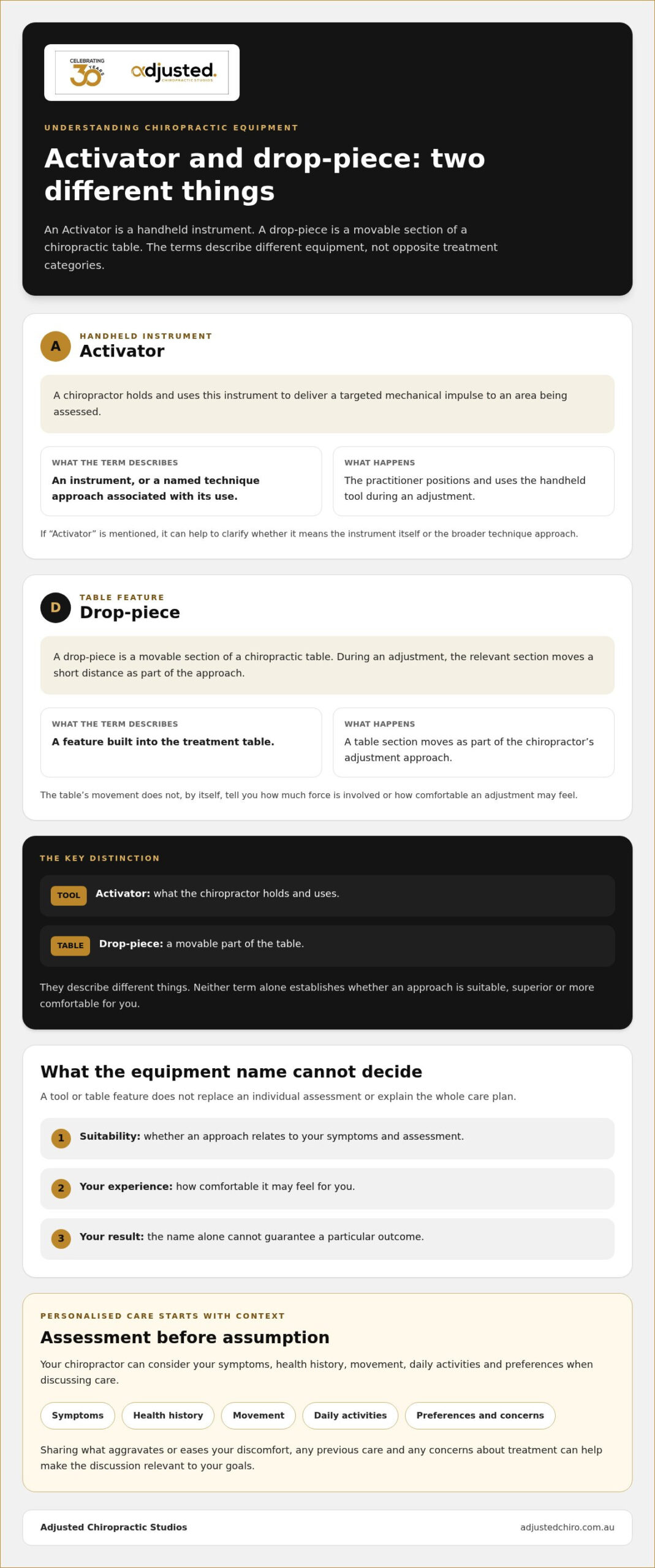
Similar-sounding technique terms can be confusing when you’re researching chiropractic care, particularly when they appear together in a description of an appointment. The key is to distinguish the equipment from the way care is described: an Activator is a handheld adjusting instrument, while a drop-piece is a movable part of a chiropractic table.
An Activator is an instrument; a drop-piece is a table feature. Neither name, on its own, tells you whether an approach is appropriate for your symptoms, health history or preferences. Knowing the difference gives you a clearer starting point for discussing what an adjustment involves and why a particular approach may be considered.
What is an Activator chiropractic adjustment?
An Activator chiropractic adjustment involves a chiropractor using a handheld instrument to deliver a targeted mechanical impulse to an area being assessed. The chiropractor positions and uses the instrument; it isn’t a section of the treatment table. “Activator” may refer to the instrument itself or to a named technique approach associated with its use.
That distinction matters when you’re researching different ways to adjust chiropractic care. A description of an Activator tells you about the tool or approach, but it doesn’t establish what will happen during your appointment. The details depend on the assessment and the plan discussed with you. The name alone can’t guarantee a particular experience or result.
If you see “Activator” mentioned without further explanation, clarify whether it refers to the handheld instrument or the broader technique approach. The meanings are related, but they aren’t identical: one names a piece of equipment, while the other can describe a way of applying care.
What does drop-piece mean in chiropractic care?
A drop-piece is a movable section of a chiropractic table, designed to shift during an adjustment. It is part of the table, not a handheld instrument. In a drop-piece approach, the practitioner applies an adjustment while the relevant table section moves a short distance. That movement is a feature of the table, but it doesn’t tell you how much force is involved.
For example, if someone says a chiropractor used a drop-piece, they’re describing a table feature involved in the adjustment. If they say an Activator was used, they’re referring to a handheld tool or a named technique approach. These terms describe different things. They aren’t opposite labels for manual and non-manual care.
Keeping the distinction in mind can make appointment conversations clearer. Ask what a term refers to, what the approach involves and how it relates to your assessment. A useful explanation connects the equipment or method to your individual needs, rather than suggesting that a tool’s name alone determines whether it’s suitable for you.
How Activator instruments and drop-piece tables work differently
An Activator and a drop-piece table can both be discussed in relation to chiropractic adjustments, but they describe different equipment. One is held and used by the chiropractor; the other is part of the table. They are not opposing treatment categories, and the name of a tool or table feature doesn’t determine which approach is appropriate for you. When you’re comparing adjust chiropractic activator drop-piece options, focus on what each term means and how the proposed approach relates to your assessment.
| Feature | Activator instrument | Drop-piece table |
|---|---|---|
| Equipment | A handheld adjusting instrument | A chiropractic table with a movable section |
| How it is used | The chiropractor uses the instrument during an adjustment | A relevant table section moves as part of the adjustment approach |
| What the term describes | An instrument, or a named technique approach | A feature of the treatment table |
An instrument describes what the chiropractor uses; a table feature describes where part of the adjustment takes place. Neither term, by itself, indicates that an approach is superior, more suitable or more comfortable. Those questions call for an individual assessment and a conversation about your needs, previous experiences and preferences.
How the Activator instrument delivers an adjustment
An Activator is a handheld tool used by a chiropractor during an adjustment. The practitioner positions and uses the instrument as part of the approach being applied. This describes the equipment, not a predicted outcome or a recommendation for a particular diagnosis. The term may also refer to a named technique approach, so it can help to clarify which meaning is intended.
Your symptoms, health history and assessment findings inform clinical decisions. A tool’s name alone doesn’t explain why it might be considered, whether it suits your circumstances or what the overall care plan involves. If you’re unsure, ask for the approach to be explained in plain language before deciding how you feel about it.
How a drop-piece table feature is used
With a drop-piece table, a section of the table moves as part of the chiropractor’s adjustment approach. That movement is distinct from using a handheld instrument. The table feature doesn’t, on its own, establish the force used, how comfortable the adjustment may feel or whether it is suitable for you.
Rather than choosing between Activator and drop-piece based on the equipment name, consider how the chiropractor’s assessment and clinical judgement guide the approach for your individual circumstances. Relevant symptoms, previous care and your preferences all help inform that discussion.
At Adjusted Chiropractic Studios in Sydney CBD, care starts with individual assessment and a safety-first, evidence-informed approach, rather than assuming a particular technique. To learn more about our approach, explore our chiropractic care approach.
What research says about Activator adjustments, and what it cannot tell you
If you’re weighing different adjustment approaches, research can offer useful context, but it can’t decide what is right for you. A 2012 systematic review examined the Activator Adjusting Instrument and Activator Methods Chiropractic Technique for musculoskeletal disorders. It included eight eligible articles and reported that, in the populations studied, Activator care produced clinically meaningful benefits comparable to high-velocity, low-amplitude manipulation or trigger-point therapy.
The review found comparable clinically meaningful benefits in the studied populations, but it doesn’t prove that Activator care works for every condition or person. A finding from a review can inform a discussion, but it doesn’t replace an individual assessment or promise a particular result.
How to read the Activator evidence in context
A systematic review brings together and assesses studies on a defined subject. It can summarise what the available research reports, but its conclusions are bounded by the evidence it reviews. In this case, the subject was Activator-related care for musculoskeletal disorders, not every form of chiropractic treatment or every possible clinical situation.
The review’s comparisons should be read narrowly: it reported comparable clinically meaningful benefits to high-velocity, low-amplitude manipulation or trigger-point therapy in the populations studied. This doesn’t establish that the approaches are interchangeable for all patients, nor does it tell you how a drop-piece table compares. The review was published in 2012, which is also relevant when considering how current it is.
Why individual assessment still matters
Research findings describe groups; they can’t account for every detail of your circumstances. A chiropractor considers your symptoms, health history and examination findings, then applies clinical judgement when discussing whether an approach may be appropriate. Your preferences and concerns also matter to that conversation.
For example, two people may use the same name for their concern while having different symptoms, movement limitations or previous care. A study’s average finding can’t tell either person which approach should be selected. Asking what an adjustment involves and how it relates to your assessment can help you understand the options without assuming one is universally safer, gentler or more effective.
Evidence can help frame questions, but it can’t settle every personal decision. The research discussed here concerns Activator methods, not a direct comparison with a drop-piece table. For your care, the relevant question is how the assessment, your needs and the available evidence are considered together.
Questions to discuss before an Activator or drop-piece adjustment
It’s reasonable to want a clear explanation before an adjustment, especially if a technique is unfamiliar or you’re unsure how it may feel. A useful conversation starts with what you’re experiencing, then covers relevant health details, the proposed approach and your comfort. You don’t need to know the name of a diagnosis or decide which technique is right before an assessment.
What to share during a chiropractic assessment
Describe your main concern in everyday language. Explain where you feel discomfort, when it began and whether it affects tasks such as sitting at work, turning your head, walking or sleeping. Mention whether symptoms have changed and what you’ve noticed about movement or daily activities. These details help your chiropractor understand how the issue affects your routine.
It can also help to share relevant health history, previous treatment experiences and any circumstances that may affect your assessment. You could mention a past injury, a treatment that felt uncomfortable, or practical demands such as long periods at a desk. You’re not expected to interpret these details yourself. Your chiropractor considers them alongside the examination.
How to discuss comfort and informed participation
Before an adjustment begins, ask what the approach involves and what you may feel or notice. If an Activator instrument or drop-piece table has been discussed, ask which one is meant, how it relates to your assessment and whether there are other options to consider. This helps you understand the plan without assuming that one technique suits a particular symptom.
If you’re anxious, have concerns about movement or need more explanation, say so. Ask how the chiropractor will respond if you feel uncomfortable, and agree on how you can signal that you’d like to pause. You’re entitled to ask questions and take time to understand what’s proposed. Discomfort isn’t something you need to accept as proof that treatment is working.
- Describe your main concern, when it started and how it affects everyday activities.
- Share relevant health history, previous care and any circumstances that may influence the assessment.
- Ask what the proposed approach involves and why it is being considered for your situation.
- Discuss comfort, raise concerns and ask how you can pause if you need to.
These steps can make the conversation clearer whether you’re exploring an Activator, a drop-piece or another approach. For further context on what a professional adjustment may involve, read our guide to a professional spinal adjustment in Sydney.
At Adjusted Chiropractic Studios, personalised chiropractic care starts with listening and assessing your individual needs. If you’re considering care in Sydney CBD, book a chiropractic assessment to discuss your concerns and goals.
How personalised chiropractic care starts at Adjusted in Sydney CBD
If you’re unsure which adjustment approach may suit you, you don’t need to arrive with a technique already chosen. At Adjusted Chiropractic Studios, the starting point is listening to your concerns and assessing you as an individual. That means considering what you’re experiencing and what matters in your daily life before discussing care. The aim is a considered plan, not an assumption based on a technique name.
Adjusted has served the Sydney CBD community for over 30 years. The Hunter Street studio is opposite Martin Place Metro station, with Wynyard and Barangaroo nearby. For professionals balancing desk-based work, commuting and family commitments, a clear discussion of how spinal health fits into everyday movement can help make care relevant to real life.
Assessment before decisions about care
Your concerns and health history help inform an individual assessment. The chiropractor considers what you describe alongside clinical findings, then discusses suitable care options and the reasoning behind them. This gives you space to understand the proposed approach and how it relates to your needs, rather than expecting you to choose from unfamiliar terms yourself.
For instance, you might explain how discomfort affects sitting through a workday, turning to look over your shoulder or keeping up with usual activities. These practical details provide context for the conversation. If you’ve had previous care or have concerns about a particular type of adjustment, sharing that information can help guide the assessment and discussion.
Questions about how to adjust chiropractic Activator drop-piece care are best considered in that individual context. The goal isn’t to select an instrument or table feature based on its name, but to understand what the assessment indicates and discuss an appropriate way forward. Care is safety-first and evidence-informed, with decisions grounded in your circumstances.
A Sydney CBD clinic with an integrated perspective
Chiropractic, podiatry and nutrition are distinct services within the studio. Their presence reflects an integrated allied-health setting, while your chiropractic assessment remains focused on your own concerns and goals. Adjusted has built lasting relationships with thousands of Sydney professionals and their families, supporting people with different routines, responsibilities and movement needs.
If you’d like to learn more about how individual needs inform adult care, the adult chiropractic care guide offers further context. It can help you think about questions to raise, whether your concerns relate to work posture, movement or discomfort during everyday activities.
When you’re ready to discuss your needs, you can book a chiropractic consultation with Adjusted. It’s a considered next step towards understanding your assessment and the care options that may be appropriate for you.
Take the next step with confidence
You don’t need to arrive with a preferred technique or all the right terminology. Talk through what you’re experiencing, what you hope to return to doing, and any concerns you have about an adjustment. That conversation can turn questions about how to adjust chiropractic Activator drop-piece options to your needs into a clearer discussion about assessment and care.
At Adjusted Chiropractic Studios, your concerns and goals guide the conversation. Care is safety-first and evidence-informed, with your individual needs considered before decisions are made. You can raise questions, ask for an explanation and take part in deciding what feels appropriate to discuss next.
If you’re ready to explore your options with a chiropractor, book a personalised chiropractic consultation with Adjusted. A thoughtful conversation is a positive starting point for making informed choices about your spinal health and everyday movement.
Frequently Asked Questions
Is an Activator adjustment the same as a drop-piece adjustment?
No. An Activator adjustment involves a handheld instrument, while a drop-piece adjustment uses a movable section of a chiropractic table. The wording adjust chiropractic activator drop-piece can blur these separate terms, so clarify which tool or table feature is being discussed. If someone mentions both, ask how each relates to the proposed care plan rather than assuming they describe one combined technique.
Does an Activator adjustment make a popping or cracking sound?
It may make a brief sound, but a sound isn’t a reliable way to judge what an adjustment has done. The instrument itself may produce a mechanical click, and joint sounds can vary between people and appointments. You don’t need to hear a pop for an adjustment to have taken place. If noise makes you uneasy, mention that before care begins and ask what sounds you might notice.
Can an Activator instrument be used during the same appointment as a drop-piece table?
Different equipment may be used during one appointment, but that doesn’t mean both are needed or appropriate for every person. The plan depends on the assessment and the chiropractor’s clinical judgement. If both terms come up, ask what role each would have and whether using more than one approach is relevant to your circumstances. You can discuss the plan before agreeing to proceed.
Is an Activator chiropractic adjustment suitable for everyone?
No single adjustment approach is automatically suitable for everyone. A chiropractor needs to consider your symptoms, health history, examination findings and personal preferences before discussing care. For example, tell them if a previous treatment caused concern or if a movement feels difficult. That information helps inform clinical decisions; you don’t need to diagnose the problem or select a technique yourself.
What should I expect to feel during an instrument-assisted adjustment?
The sensation can vary with the approach and the person, so it’s best not to expect one specific feeling. You may notice contact from the instrument and hear a brief mechanical sound. If something feels unexpected, uncomfortable or worrying, say so rather than trying to tolerate it in silence. Your response is useful information for the chiropractor and can guide a discussion about how to proceed.
Can I ask my chiropractor to explain or pause an adjustment?
Yes. You can ask for an explanation before an adjustment, raise a concern during the discussion or request a pause if you’re unsure. For instance, you might say, “Could you explain what you’re about to do?” or “I’d like to stop for a moment.” Clear communication helps you take part in decisions about your care, and you don’t need to continue while you have unanswered questions.



