
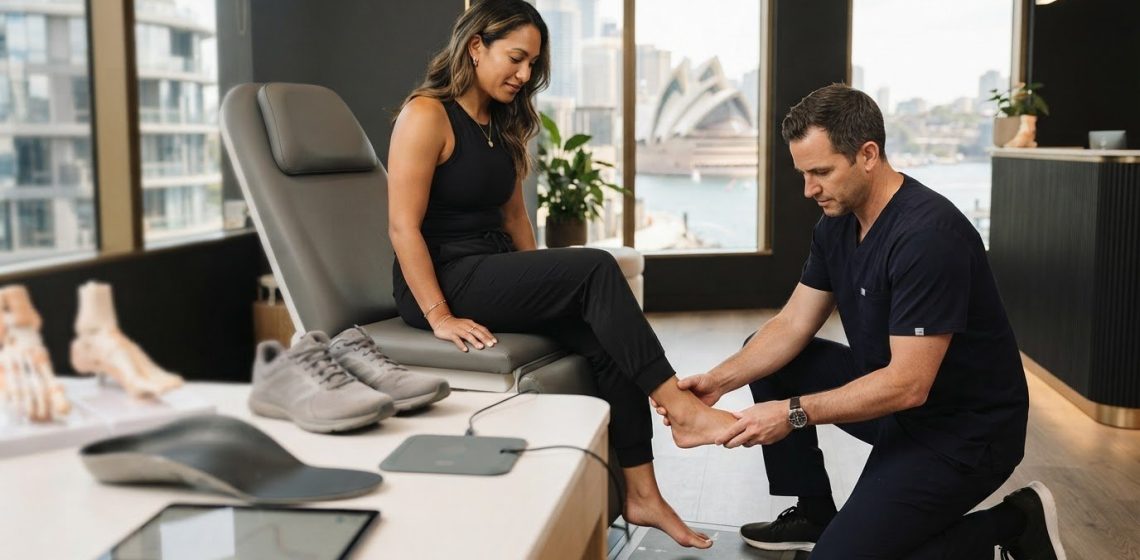
Could the right foot support begin with understanding how you move, rather than choosing an insole first? If you’re considering custom orthotics in Sydney, it’s understandable to wonder whether they suit your concern, how they differ from ordinary insoles and whether they’ll work with the shoes you wear every day.
Orthotics aren’t a one-size-fits-all answer. A personalised podiatry assessment considers your foot concerns, movement, daily activities and goals before discussing whether custom support may be appropriate. Your work routine, exercise and usual footwear can all help shape that conversation.
This guide explains what a podiatry assessment may consider, how to compare support options and what details to bring to a consultation. At Adjusted Chiropractic Studios in Sydney CBD, podiatry is part of a multidisciplinary practice. Your concerns and lifestyle can inform a considered next step, so you can make an informed decision about support based on your needs rather than the device alone.
Key Takeaways
- Learn how prescribed foot orthoses differ from retail insoles, and why a device is only one possible part of care.
- See how a podiatrist can connect your symptoms and goals with your walking, work, sport and footwear.
- Compare custom orthotics, retail insoles and non-device care by their purpose and level of individual assessment.
- Use a preparation checklist to bring useful details about your symptoms, health history and daily demands to a consultation.
- Explore custom orthotics Sydney through a considered podiatry consultation focused on your individual needs.
Custom orthotics in Sydney: what they are and when they may be considered
If foot discomfort keeps returning, or certain activities leave your feet feeling strained, it’s reasonable to ask whether an orthotic could have a role in your care. The answer depends on more than the symptom alone. A podiatrist considers how your feet function, what you need to do each day and whether a prescribed device may suit your needs. For people exploring custom orthotics Sydney, the starting point is an individual assessment, not a particular device.
A custom orthotic is a prescribed foot orthosis selected or designed to address needs identified through an individual assessment. It differs from a general-purpose insole, which is made for wider use rather than guided by your personal clinical findings.
Orthotics may be discussed in relation to practical goals such as walking more comfortably, managing a workday, taking part in sport or finding support that works with your preferred footwear. They’re one possible part of a care plan, not a promise of relief. An overview of Orthotics describes the broader range of orthotic devices and their applications. A podiatry assessment helps relate possible options to your circumstances.
What makes an orthotic custom rather than off the shelf?
Customisation is based on assessment and clinical reasoning. A podiatrist considers your symptoms, foot function, health history and goals before discussing whether a prescribed device is appropriate. A standard insole may suit someone seeking general cushioning or everyday comfort, and it isn’t automatically the wrong choice. The difference is that a custom option is considered in response to assessed individual needs, rather than selected as a broadly available product.
Which foot concerns can prompt an orthotics discussion?
Recurring discomfort, or concerns that arise during walking, work or exercise, may be useful reasons to discuss your feet with a podiatrist. People often ask about orthotics for plantar fasciitis or flat feet, but those labels alone don’t establish that a device is suitable. Your symptoms, function, health history and assessment all matter. A useful discussion connects what you’re experiencing with the activities you want to manage, rather than assuming the same support is right for everyone.
Notice when a concern appears: after standing at work, during a walk, while running or in a particular pair of shoes. These details give a podiatrist practical context for discussing your options. The aim is to decide whether orthotics have a place in your care, or whether another approach better fits your needs and routine.
How a Sydney podiatrist assesses whether custom orthotics suit you
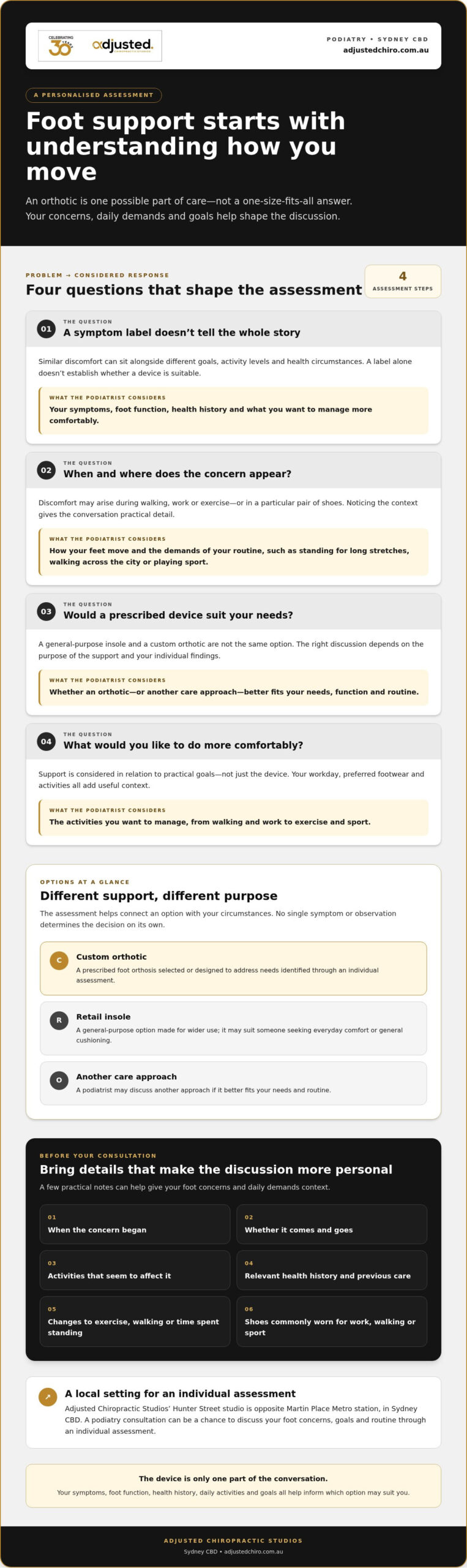
A useful orthotics assessment begins with your experience, not an assumption about what your feet need. A podiatrist listens to your concerns, reviews your health history, considers how your feet function and discusses suitable options. This helps clarify how symptoms relate to your routine, whether you spend much of the day standing, walk between appointments, play sport or wear particular shoes for work.
Orthotic decisions follow individual assessment rather than a symptom label alone. Two people with similar discomfort may have different goals, activity levels and health circumstances. If you’re considering custom orthotics Sydney, an assessment is an opportunity to discuss those differences and whether orthotics or another approach may be appropriate.
- Discuss your concerns. Describe where you notice discomfort, when it occurs and what you hope to do more comfortably.
- Review your health history. Share relevant health information, previous care and any changes to your usual activity.
- Consider foot function. The podiatrist relates your symptoms to how your feet move and the demands placed on them.
- Talk through options. Assessment findings inform a discussion about whether orthotics or another care approach better fits your needs.
What information helps personalise the assessment?
Before your appointment, note when the concern began, whether it comes and goes, and which activities seem to affect it. Mention changes such as starting a new exercise routine, walking more or spending longer periods standing at work. Previous care and relevant health history can add context. If practical, bring the shoes you commonly wear for work, walking or sport, so your footwear preferences can be part of the conversation.
What might a podiatry assessment consider?
The discussion may cover foot comfort, movement and the functional demands of your day. Someone who stands for long stretches may have different needs from a recreational runner or a person who walks across the city for work. The podiatrist uses the information gathered to explain what the findings may mean for your options. No single symptom or observation determines the decision on its own.
Adjusted Chiropractic Studios’ Hunter Street studio is opposite Martin Place Metro station, in a convenient Sydney CBD location for city workers and nearby residents. A podiatry consultation in Sydney CBD gives you an opportunity to discuss your foot concerns and goals through an individual assessment. The conversation can cover orthotics or another approach that better suits your function and routine.
Custom orthotics, retail insoles or other care: how to compare your options
Choosing support can feel confusing when different options seem to address the same concern. Start with your goal: are you looking for general comfort in a shoe, or do you have recurring discomfort or changes in function that need individual assessment? Custom orthotics, retail insoles and non-device care serve different purposes. None is automatically right for everyone.
The table below outlines the main differences. Use it to frame your decision, not as a substitute for advice based on your circumstances.
| Option | Purpose and intended use | Individual assessment and review |
|---|---|---|
| Custom orthotics | A prescribed option considered for assessed foot needs and particular everyday, work or activity demands. | Involves individual podiatry assessment. Clinical review can help determine suitability and whether the option remains appropriate to your needs. |
| Retail insoles | May suit general comfort or a preference for additional cushioning in some shoes. | Usually selected without an individual podiatry assessment. Check how they sit in the shoe and whether they feel comfortable during use. |
| Non-device care | May involve practical changes or other care guided by your concerns and functional needs. | What’s appropriate depends on individual assessment. Review may be useful if symptoms persist, change or affect daily activity. |
Compare options by the problem you want to address, not by assuming more specialised support is always better. A retail insole may be reasonable if your goal is general comfort. If discomfort keeps returning, changes over time or limits walking, work or exercise, an individual assessment can help clarify what may be contributing and which options are worth discussing.
When might a simpler insole be worth considering?
If your main aim is general comfort or a different feel inside a shoe, an off-the-shelf insole may be worth considering. However, an insole that feels suitable in one pair may not sit comfortably in another. Shoe shape, available space and your own comfort all matter. Don’t assume every insole suits every foot or shoe. Pay attention to how your feet feel during ordinary use.
When is a podiatry discussion the more useful next step?
Recurring symptoms, changes in function or uncertainty about what’s driving discomfort are good reasons to seek an individual assessment. A podiatrist can consider orthotics alongside other care options, rather than treating a device as the only response. If you’re weighing up custom orthotics Sydney, an assessment can make the discussion more specific to your symptoms and routine. A podiatry consultation in Sydney CBD gives you an opportunity to discuss your concerns and goals with a podiatrist.
Getting ready for a custom orthotics consultation in Sydney
A little preparation can help you make good use of your podiatry consultation. You don’t need to arrive with a diagnosis or know which option you want. A clear account of what you’re experiencing, what you’ve tried and what you’d like to do more comfortably gives the clinician useful context for discussing next steps.
Before your appointment, jot down a few notes:
- Symptoms: Where you feel discomfort, when it started, how often it occurs and whether anything changes it.
- Activities: The effect on work, exercise, longer walks or other parts of your routine.
- Health history: Relevant health information, previous care and any recent changes in activity.
- Footwear: Shoes you commonly wear for work, exercise or walking, if practical to bring.
- Personal goals: What you’d like to manage more comfortably, such as a full workday on your feet or regular walks.
These details help keep the conversation focused on your life, not just your feet in isolation. If you’re considering custom orthotics Sydney, think about which shoes you’d expect to wear with any proposed support and what your usual day asks of you.
What should you bring or be ready to discuss?
Choose shoes that reflect your real routine, rather than a pair you rarely wear. A work shoe, walking shoe or sports shoe may each feel different and serve a different purpose. Be ready to describe which activities bring on symptoms, what you’ve tried and whether anything helped or made the concern worse. There’s no need to prepare medical terminology. Your own observations are valuable.
What should a clear care discussion cover?
Ask how the assessment findings relate to the suggested approach and your everyday function. If orthotics are discussed, ask how they may work with your usual footwear, what adjustment to wearing them might involve and when reassessment could be appropriate. A useful conversation should also cover other relevant options. An orthotic isn’t automatically needed, and the plan should reflect your assessment and goals.
It’s reasonable to leave with a clear understanding of what was considered, why an option may suit your needs and what the next step involves. The clinician can discuss the findings, suitable options and any review plan relevant to your situation. If something is unclear, ask for an explanation in everyday terms. Feeling informed helps you take part in decisions about your care.
If you’re ready to discuss your foot concerns and goals, book a podiatry consultation in Sydney CBD.
Explore custom orthotics with Adjusted Chiropractic Studios in Sydney CBD
If foot concerns are affecting your walking, work or preferred activities, a podiatry consultation can be a considered next step. It gives you space to explain what you’re experiencing, what you’d like to manage more comfortably and what your routine involves. The discussion is guided by your individual needs, not an assumption that every person with foot discomfort needs an orthotic.
At Adjusted Chiropractic Studios, podiatry sits within a multidisciplinary practice alongside chiropractic and nutrition. The evidence-informed approach begins with your concerns and goals, then uses the assessment to guide a discussion about suitable options. If custom orthotics are considered, they’re one possible part of care, not a guaranteed device or outcome.
Why choose a Sydney CBD clinic for podiatry care?
Adjusted Chiropractic Studios has served Sydney CBD since 1994, supporting local professionals and families. Podiatry is offered within a studio that also provides chiropractic and nutrition, bringing these services together in one setting. Your foot concerns receive individual attention, with options considered in the context of your assessment and everyday routine.
Foot comfort can influence how you move through a working day, commute or exercise routine. If you’re also managing broader musculoskeletal concerns, the clinic’s adult chiropractic care guide explains how personalised care can consider movement and everyday demands.
Take the next step at Adjusted Chiropractic Studios
A consultation is a collaborative discussion. You can describe when your concern arises, the activities you want to keep doing and any footwear considerations that matter to you. The podiatrist can discuss assessment findings and explain whether orthotics or another approach may fit your circumstances. You should leave with a clearer understanding of the reasoning behind the options discussed, without pressure to choose a particular device.
If you’re considering custom orthotics Sydney, a measured conversation can help turn uncertainty into a clearer plan. Bring questions about how your foot concerns relate to your routine, which options may be appropriate and what any proposed care involves. The goal is an informed next step grounded in your assessment, not a promise of a particular result.
To discuss your foot concerns and personal goals with a podiatrist, book a podiatry consultation.
Take a considered next step for your feet
Your next step doesn’t need to be a decision about a device. It can simply be a conversation about what’s making daily movement difficult and what you’d like to do more comfortably. A podiatry consultation can help you understand how your concerns relate to your routine and whether custom orthotics Sydney may be worth discussing as part of an individual care approach.
Bring your questions, the shoes you rely on and an honest picture of the activities you want to keep up. Together, these details can support a practical discussion grounded in your needs, rather than assumptions about what should work. You can take time to understand the options and decide on a suitable way forward.
Book a podiatry consultation with Adjusted Chiropractic Studios to discuss your foot concerns and goals. A thoughtful assessment is a positive step towards making informed choices about your movement and support.
Frequently Asked Questions
Do custom orthotics help with foot pain?
Custom orthotics may be considered for some types of foot pain, but they don’t suit everyone or guarantee relief. A podiatrist can consider your symptoms alongside your health history and daily demands before discussing care options. Before an appointment, note when discomfort occurs, such as after a long commute or a shift spent standing. This can make a custom orthotics Sydney discussion more specific to your experience.
Are custom orthotics suitable for flat feet?
Having flat feet doesn’t automatically mean you need custom orthotics. Some people have flat feet without pain or difficulty with everyday activities, while others may have concerns worth assessing. Consider whether you’re comfortable during activities that matter to you, such as walking around the shops or standing at work. If discomfort or changes in function affect your routine, a podiatrist can help you consider what support, if any, may be appropriate.
Can custom orthotics help with plantar fasciitis?
Orthotics may be discussed as one option for someone with plantar fasciitis, but they shouldn’t be treated as a guaranteed fix. Foot pain can have different contributing factors, so the right approach depends on your individual situation. Notice how the discomfort affects everyday activities, such as getting through a workday or going for a walk. If it persists, worsens or limits your routine, seek advice from a podiatrist.
Can I wear custom orthotics in all my shoes?
Not necessarily. Shoes differ in shape, depth and intended use, so an orthotic that fits one pair may not sit comfortably in another. A work shoe, for example, may have less room inside than a walking shoe. Bring the pairs you rely on most to your consultation where practical. Your podiatrist can discuss compatibility and what to consider across your usual footwear, rather than assuming one device works in every shoe.
Do custom orthotics need a break-in period?
Adjustment varies, so follow the specific instructions given by your treating clinician rather than using a fixed schedule based on someone else’s experience. Pay attention to how your feet feel during ordinary activities and note any discomfort, skin irritation or change in symptoms. If an issue persists or affects your walking, discuss it with your clinician. They can consider whether the device, footwear or care plan needs review.
How do I know if my orthotics need to be reviewed?
A review may be useful if your symptoms change, the orthotics become uncomfortable, or changes to your shoes or activity affect how they feel. Returning to regular exercise or switching to different work footwear, for example, may alter how you use them. Note what changed and when you notice it, then discuss this with your podiatrist. Avoid modifying the device yourself, as an assessment can help guide the next step.



