

What if recurring pain-related absences are more than a rostering challenge? They may be a reason to look at how work affects people’s bodies. For Sydney employers, reducing employee absenteeism due to pain starts with understanding patterns, not assuming their cause. Discomfort can also affect employees who attend work but struggle to function as usual.
It’s understandable to want clear answers when absences disrupt operations. Attendance figures alone rarely show whether posture, repetitive tasks, limited movement or another factor is contributing. A supportive response considers both the practical demands of the role and the employee’s experience.
This guide explains how to review absence patterns without jumping to conclusions, make practical changes that support movement and posture, and start respectful conversations. It also explains how workplace health training can complement individual support, giving you a considered basis for responding to pain while supporting employee wellbeing and day-to-day business needs.
Key Takeaways
- Treat reported pain as a reason to listen and investigate, not as a diagnosis or proof of what caused an absence.
- Review absence patterns alongside work tasks and employee feedback, handling personal information carefully.
- Match workplace education, ergonomic changes and individual support to the needs identified. These approaches can work together.
- Use a simple listen, assess, act and review cycle to make changes manageable and identify what may need adjusting.
- Reducing employee absenteeism due to pain means considering workplace habits as well as each employee’s individual support needs.
What pain-related employee absenteeism can signal in Sydney workplaces
When an employee takes time away from work because of pain, the absence is useful information, but it doesn’t explain the whole situation. Pain-related employee absenteeism is an absence from work that an employee reports is connected to pain or physical discomfort. That report alone doesn’t establish a medical diagnosis or cause. This distinction helps employers respond with care rather than guesswork.
For a Sydney team, an absence might follow a demanding work period, a difficult commute or discomfort that has built over time. The pain may be genuine even when its source is unclear. It may relate to work, life outside work, or several factors together. Attendance records can prompt a closer look, but they can’t provide a complete account of someone’s health or circumstances.
Absenteeism can have medical, personal and workplace-related influences. A general overview of Absenteeism in the workplace provides useful background, but employers still need to understand the experiences behind their own team’s patterns.
How pain can affect attendance and work participation
Pain doesn’t affect every employee in the same way. One person may find prolonged desk work uncomfortable, while another may notice symptoms during a long train journey or after walking between a station and the office. For some, discomfort makes a particular task harder without preventing them from attending. For others, taking time away may feel necessary.
These examples are prompts for conversation, not grounds for diagnosing a condition or assuming work caused it. The aim is to understand what the employee says is affecting their attendance or participation, then consider relevant work factors respectfully.
Why absence data needs employee context
Raw totals can conceal different experiences. The same number of absent days might reflect one episode for one employee and several separate periods for another. A team-wide figure can also obscure whether absences are spread across roles or appear alongside particular tasks, schedules or work locations.
Use the figures as a starting point, then invite voluntary feedback through a respectful, private conversation. Ask open questions about work demands and whether practical changes may help. Don’t press for personal medical details that aren’t needed to understand work-related concerns, and avoid drawing conclusions about an individual from a team trend.
Absence is only part of the picture. Presenteeism means being at work while functioning below normal capacity because of illness or discomfort. An employee may attend but find it harder to concentrate, move comfortably or complete usual tasks. This is a separate issue, not a replacement measure for absence. Together, attendance information and voluntary employee feedback give employers a more grounded basis for exploring support, without treating every report of pain as proof of a workplace cause.
How Sydney employers can assess pain-related absence and workplace patterns
A useful assessment starts with what you can observe, then checks those observations against work context and employee feedback. The aim isn’t to prove that a job caused pain. It’s to notice where a closer look or practical change may be worthwhile, while keeping individual circumstances private.
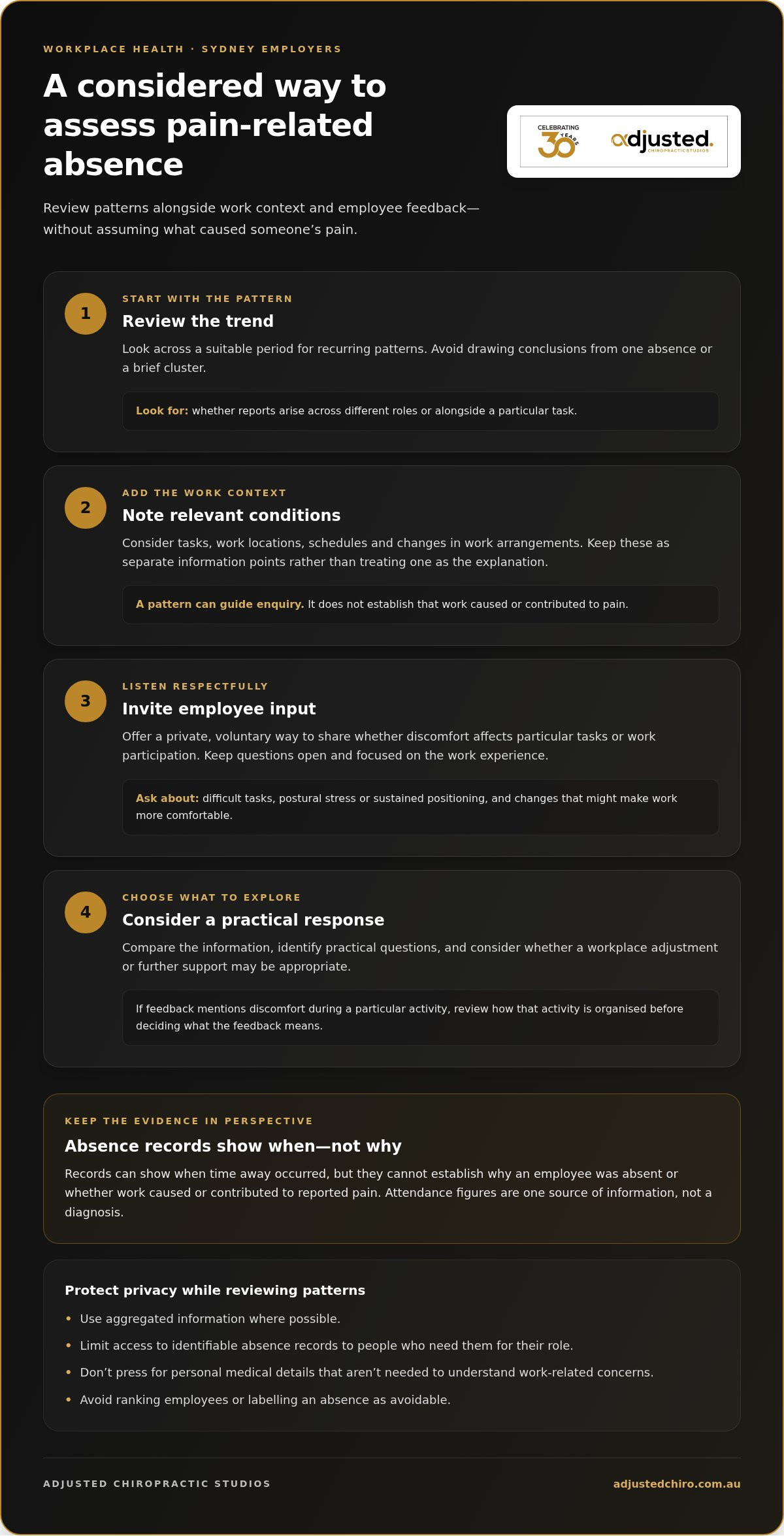
Absence records can show when time away occurred, but they cannot establish why an employee was absent or whether work caused or contributed to reported pain. Treat records as one source of information, not a diagnosis or finding about an employee’s health.
A simple sequence can help your team assess patterns consistently:
- Review the trend. Look across a suitable period for recurring patterns, rather than drawing conclusions from one absence or a brief cluster.
- Add work context. Note relevant tasks, work locations, schedules or changes in work arrangements without assuming any one factor explains an absence.
- Invite employee input. Offer a private, voluntary way to share whether discomfort affects particular tasks or work participation.
- Decide what to explore. Compare the information, identify practical questions and consider whether a workplace adjustment or further support may be appropriate.
Review patterns without making assumptions
Compare broad trends over time, such as whether reports arise across different roles or alongside a particular task. Keep work tasks, location and reported discomfort as separate information points. For example, if feedback mentions discomfort during a specific activity, review how that activity is organised before deciding what the feedback means. A pattern can guide further enquiry, but it doesn’t establish cause.
Use aggregated information where possible, and limit access to identifiable absence records to people who need them for their role. Avoid ranking employees or labelling an absence as avoidable. Those approaches can discourage honest reporting and obscure work conditions that may deserve attention.
Include employee experience and presenteeism
Make feedback easy to give without requiring someone to disclose a diagnosis. A brief private conversation or confidential feedback channel can ask whether any tasks feel difficult, whether postural stress or sustained positioning is a concern, and what change might make work more comfortable. Keep questions open and focused on the work experience.
Also make space for employees who are present but report reduced function. They may find a task harder to complete, need to change position more often or be working below their usual capacity. Record this as employee feedback, not as proof of a particular health condition or workplace cause.
For Sydney teams, corporate health training can build shared understanding of workplace ergonomics and spinal health, alongside a careful review of the tasks and feedback your assessment identifies. This provides a considered next step in reducing employee absenteeism due to pain, without treating attendance figures as the whole story.
Which workplace responses may help address pain-related employee absence?
Once you’ve identified a possible workplace pattern, choose a response that fits the issue rather than defaulting to a single solution. Workplace education can build shared awareness, ergonomic changes can address features of a task or setup, and individualised support can respond to an employee’s own concerns. These options can complement one another, guided by observed needs and employee feedback.
Workplace injury prevention is a structured approach to reducing workplace injuries and related claims. It involves considering how work is performed and where adjustments may be useful, rather than promising that absence will be eliminated. A plan might combine practical training with changes to workstations or task routines, then review whether those changes suit the team.
- Education helps employees recognise habits around posture, movement and work setup.
- Ergonomic changes address practical features of tasks, equipment or the work environment.
- Individual support gives an employee space to discuss reported concerns and consider suitable care.
Workplace education and ergonomic improvements
Training can help staff notice how prolonged positioning, limited movement or repeated tasks affect comfort during the working day. It can also offer practical ways to vary posture and build movement into ordinary routines. In a Sydney CBD office, for example, employees can review how their desk arrangement fits their tasks instead of relying on generic posture advice.
Changes should reflect the work people actually do and what employees report. Adjusting a workstation may be relevant for desk-based tasks, while other roles may call for a closer look at different movements or routines. The Office Ergonomics Training Sydney article offers related context on workplace education, and the Workplace Injury Prevention Programme Sydney resource can inform a broader prevention approach.
Individualised support alongside workplace changes
Where an employee describes ongoing discomfort, difficulty with particular movements or reduced confidence in a task, an individual assessment may help clarify their concerns and guide next steps. It should take account of the person’s health history, reported symptoms and goals, rather than assume a diagnosis from their job or absence record.
At Adjusted Chiropractic Studios, adult chiropractic care involves personalised assessment and a safety-first approach. Care is considered in light of the individual’s needs, and an appropriate plan is discussed without promising a particular result. For an overview of this approach, the Adult Chiropractic Sydney: Expert Spinal Care for CBD Professionals article provides related information.
Workplace and individual responses aren’t competing choices. Training may address shared habits, an ergonomic change may respond to a task-related issue, and individual care may support a person’s specific concerns. Used thoughtfully, these options provide a practical basis for reducing employee absenteeism due to pain while recognising that each employee and workplace has different needs.
How to build a practical pain-related absence plan for a Sydney team
A useful plan turns what you’ve heard and observed into a measured response. It doesn’t need to begin with a large programme or assume every employee needs the same support. Start with a clear purpose: understand the work-related barriers employees report, make proportionate changes, then review whether those changes are helping.
A simple cycle keeps the process manageable:
- Listen. Invite employees to share, voluntarily and privately, what makes work uncomfortable or difficult. Explain how feedback will be used and who will have access to it.
- Assess. Consider employee comments alongside relevant tasks, work setup and broad absence patterns. Keep reported experiences distinct from assumptions about cause.
- Act. Choose a response that matches the issue, such as team education about movement habits or an individual conversation about specific support.
- Review. Set a point to revisit the changes, employee feedback and relevant attendance patterns. Decide whether to continue, adapt or explore another approach.
Turn workplace observations into proportionate actions
Begin with the actual setup and reported barriers, not a solution chosen in advance. If employees describe difficulty maintaining one position during desk-based work, review how the task is organised and consider practical movement education. If a concern is personal or affects one employee differently, a private discussion may be more appropriate than a team-wide response.
Keep communication specific and supportive. Explain what you’ve noticed without attributing a diagnosis or blame, then ask what change may help with the work itself. For example, focus on whether a task, workstation arrangement or routine can be adjusted, rather than asking employees to justify their absence. Choose actions that fit the concern and the team’s needs.
Review whether the response is useful
Before introducing a change, decide what you’ll revisit and when. This could include whether employees find a new work routine practical, whether they still report barriers, and how broad absence patterns look over time. Use consistent measures, but interpret them carefully. Attendance can shift for reasons unrelated to a workplace change, and positive staff feedback is useful information even if absence figures stay much the same.
A planned review checks whether an approach remains useful; it doesn’t promise that absence will fall or prove that one change caused a particular result. If staff continue to report difficulty, ask what isn’t working and adjust the response. If feedback suggests the change is helpful, retain it while continuing to monitor whether it suits the work.
This listen, assess, act and review cycle gives Sydney employers a practical structure for reducing employee absenteeism due to pain without treating the process as a guaranteed fix. Adjusted Chiropractic Studios provides workplace health training focused on ergonomics and employee spinal health.
How Adjusted Chiropractic Studios supports Sydney employers and employees
Workplace health training is most useful when it speaks to the realities of a team’s working day. Adjusted Chiropractic Studios provides corporate health training focused on workplace ergonomics and employee spinal health. Employers can share their team’s priorities and work context to shape a relevant discussion, whether that means considering desk-based demands, movement habits or how spinal health relates to everyday tasks.
Serving Sydney CBD since 1994, the studio has presented corporate health talks for organisations including Macquarie Bank, St George Bank and Aurecon. This experience with Sydney professionals helps ground workplace conversations in familiar office environments and the practical demands of city work.
What a workplace health training conversation can cover
A conversation can begin with what your team wants to understand or improve. Topics may include how people arrange their workstations, how posture changes during the day, and where movement can fit into regular work routines. The focus is on connecting spinal health information with the work setting, so employees can consider habits and setup in relation to their own tasks.
For example, an employer might identify long periods at a computer as a topic for discussion, while another team may want to explore different workplace routines. Sharing these priorities helps direct attention to what matters in your Sydney workplace.
Where individualised care fits
Employees with personal health concerns can access care suited to their circumstances. Adjusted Chiropractic Studios offers adult chiropractic, podiatry and nutrition through an integrated allied-health team. Each area addresses different aspects of health, and an individual appointment allows the practitioner to consider the person’s needs rather than treating a workplace trend as a personal diagnosis.
For chiropractic care, the studio follows a safety-first clinical adjustment policy and takes an evidence-informed approach. The aim is to understand the person’s concerns and discuss appropriate care clearly, with their health history and goals in mind.
If your organisation is considering a workplace health discussion, discuss corporate health training with Adjusted Chiropractic Studios. Sharing your team’s priorities can help start a focused conversation about workplace ergonomics and spinal health.
Make your next workplace health step a considered one
A more supportive response to pain-related absence doesn’t have to begin with a major programme. It can start with a clear conversation about what employees are experiencing and which practical workplace changes may be worth exploring. From there, you can decide whether team education, individual support or a combination of both best fits your workplace.
Reducing employee absenteeism due to pain is a continuing process of listening, learning and adjusting. The aim isn’t to promise a particular attendance outcome, but to create a thoughtful basis for supporting people and reviewing what works for your team.
To discuss workplace health training for your Sydney team, contact Adjusted Chiropractic Studios about corporate health training. A measured first step can help your team move towards healthier, more supportive work habits.
Frequently Asked Questions
Does every case of pain-related absence mean an employee has a workplace injury?
No. An absence linked to pain doesn’t automatically mean a workplace injury has occurred. If an employee raises a concern, follow your organisation’s established reporting process and record the information they provide in factual, neutral terms. Keep observations, employee statements and any formal assessment distinct. This creates a clearer record for appropriate follow-up without labelling the event or reaching conclusions beyond the information available.
Can employees experience pain-related presenteeism without taking time off?
Yes. An employee can keep attending while finding parts of their role harder to manage. A manager might notice tasks taking longer, changes in usual work patterns or repeated requests to alter duties, but these signs alone don’t establish the reason. Regular workload check-ins can help identify whether someone wants to discuss their capacity or task demands, without treating a change in performance as proof of a health problem.
Can remote and hybrid employees experience work-related pain?
Yes. The physical demands of remote work can vary between home and office days, and even between different rooms at home. Employers can make it easier for staff to raise setup concerns by including workstation questions in regular remote-work check-ins and reviewing whether equipment can be arranged consistently across locations. Consider the full working day, including video meetings and task transitions, rather than focusing only on the desk itself.
Should employers wait for a formal diagnosis before discussing workplace changes?
No. A formal diagnosis isn’t a prerequisite for discussing a temporary, practical adjustment to a work task. For example, an employer and employee might agree to trial a change in task order, then set a date to review how it is working. Keep the discussion about work capacity and agreed duties. If a health assessment is needed, the employee can address that through appropriate channels.
Is an ergonomics workshop enough to address pain-related employee absence?
It depends on what the team needs. A workshop can introduce ideas, but employers should also consider whether employees have the opportunity to apply them in their actual work setting. After training, invite feedback on what was relevant and what remains difficult. If staff can’t put a suggested habit into practice because of equipment, workflow or scheduling, that points to a separate workplace issue to address.
How can employers discuss pain-related absence without making employees uncomfortable?
Give the employee some choice about the format and timing of the conversation, and explain its purpose beforehand. For example, offer a private meeting or a written way to share work-related concerns. Agree on what, if anything, will be recorded or shared with others, and summarise any actions you both accept. A clear process and predictable follow-up can make the discussion feel more respectful and manageable.



