

What if a well-attended wellbeing initiative still fails to address what staff actually need? For Sydney employers, the ROI of employee wellness programs isn’t established by attendance or positive feedback alone. It depends on whether the support fits workplace pressures and leads to changes you can meaningfully measure.
It’s understandable to want clear evidence that an investment is worthwhile, especially when absence, presenteeism, staff turnover and workplace injuries can have several contributing causes. Compare results with a baseline and account for other workplace changes to assess a programme fairly. Avoid attributing every shift to one initiative.
This guide explains how to match programme inputs with employee and business outcomes, compare approaches against your team’s needs, and interpret results over time. You’ll also see where focused support, such as workplace ergonomics and spinal health education, may fit within a broader wellbeing strategy. The aim is a measured, evidence-informed next step for your Sydney workplace, not a one-size-fits-all promise.
Key Takeaways
- Assess the ROI of employee wellness programs by comparing programme inputs with relevant outcomes, not participation alone.
- Start with a specific workplace need, then set a baseline so you can interpret change more fairly.
- Compare wellbeing initiatives, staff surveys and targeted health training by purpose, audience, delivery and useful indicators.
- Choose a small set of measures that can guide a decision, and review them over an appropriate period.
- Use your findings to select a proportionate next step, such as workplace ergonomics and spinal health training where it fits your team’s needs.
What does ROI of employee wellness programs actually measure?
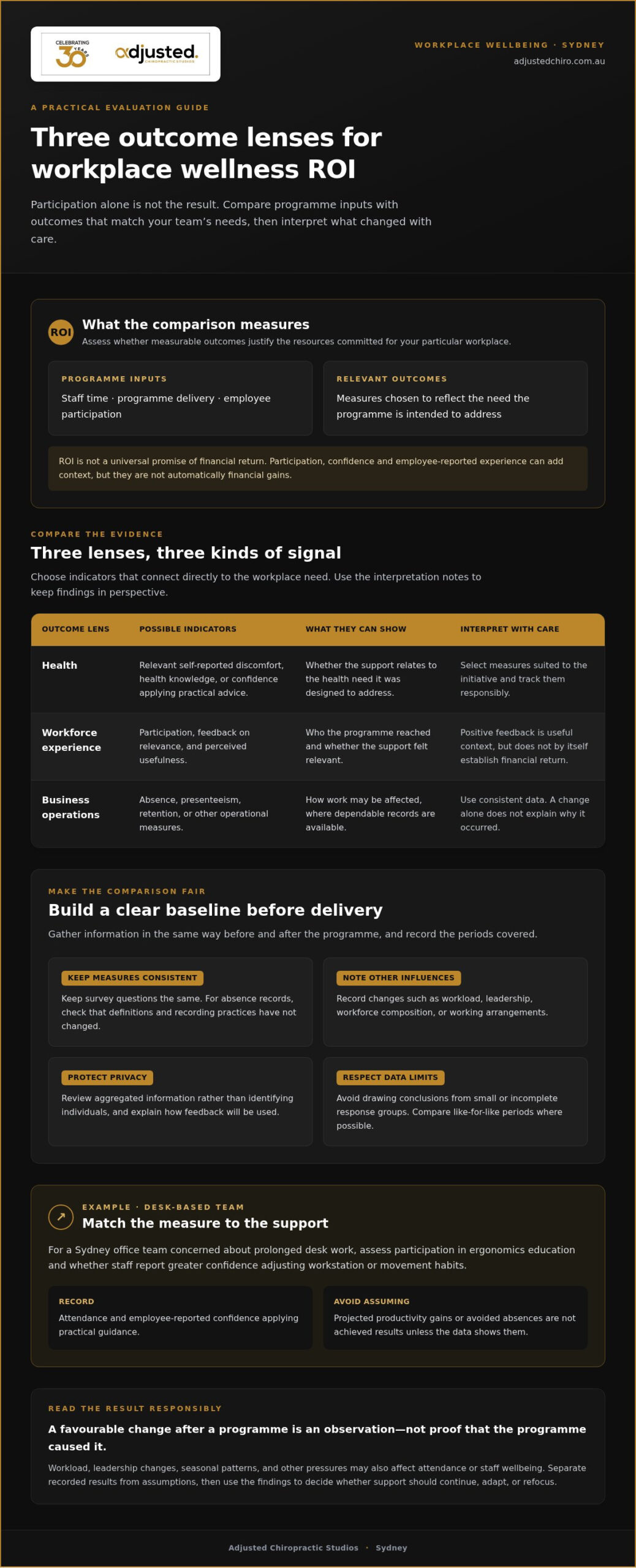
The ROI of employee wellness programs compares the resources committed to an initiative with the relevant organisational outcomes that can be measured. Inputs may include staff time, programme delivery and employee participation. Outcomes might include changes in health indicators or workplace performance, provided the measures suit the initiative and can be tracked responsibly.
Wellness ROI assesses whether a programme’s measurable outcomes justify its inputs for a particular workplace. It is not a universal promise of financial return.
That distinction matters. An initiative informed by the principles of health promotion may support employee wellbeing, but its value depends on its design, delivery and fit with the team’s needs. Financial return is one part of the picture. Participation, confidence and employee-reported experience can also indicate whether support is reaching people and feels relevant. These workforce outcomes are valuable, but they are not automatically financial gains.
Which workplace outcomes might an employer track?
Choose indicators that connect directly to the need the programme is intended to address. For a Sydney office team concerned about prolonged desk work, for example, assess whether staff take part in ergonomics education and report greater confidence adjusting their workstation or movement habits.
- Health: relevant self-reported discomfort, health knowledge or confidence in applying practical advice.
- Workforce experience: participation, feedback on relevance and perceived usefulness.
- Business operations: absence, presenteeism, retention or other operational measures, where reliable records are available.
Absenteeism and presenteeism can help show how work is affected, but only if your organisation has consistent, dependable data. Participation and feedback add context by showing who the programme reached and whether the support addressed a genuine need.
Why does a positive outcome not automatically prove ROI?
A favourable change after a programme is an observation, not proof that the programme caused it. Workload may have eased, leadership may have changed, or seasonal patterns may have affected attendance and staff wellbeing at the same time. Without considering these influences, you could credit an initiative for a shift it did not produce, or overlook its contribution when other pressures remain.
Separate measured results from assumptions. For example, record that employee feedback improved after ergonomics training if that is what your data shows. Don’t present projected productivity gains or hypothetical avoided absences as achieved results. Careful interpretation gives employers a clearer basis for deciding whether to continue, adapt or refocus support.
How can employers assess the business case for employee wellness?
Begin with a workplace need, not a popular activity. Ask what employees are experiencing and what the organisation wants to improve. A Sydney team spending long periods at desks, for instance, may benefit from support focused on workstation habits and movement. If feedback points to wider needs, a broader wellbeing initiative may be a better fit. Let the intended outcome guide the programme.
Set a baseline before delivery. Choose indicators your organisation already collects consistently, such as participation, relevant employee feedback or dependable absence records. Agree on a review period and note what could affect results, including workload, leadership or team changes. This gives you a reference point for assessing programme reach and outcomes against the original objective.
A sound business case for employee wellness connects the purpose of support with observable workplace needs. The University of Georgia’s overview of health promotion can help frame that purpose, but your evaluation still needs measures suited to your team. The ROI of employee wellness programs cannot be judged fairly if the aim, baseline and indicators are unclear.
How should a workplace set a useful baseline?
Gather information in the same way before and after delivery, and record the periods covered. If you use a staff survey, keep the questions consistent so responses can be compared. If you track absence, check that definitions and recording practices have stayed stable. Interpret each measure within its limits. A change in absence, for example, doesn’t by itself explain why it occurred.
Protect employee privacy by reviewing aggregated information rather than identifying individuals. Explain how feedback will be used, and avoid drawing conclusions from small or incomplete response groups. These steps support a more respectful and credible assessment.
Which measures can support a fair evaluation?
Track participation alongside the outcomes the programme was designed to address. For ergonomics education, you might assess attendance and employee confidence in applying practical workstation or movement guidance. For another workplace need, choose indicators that reflect its intended outcome rather than relying on a generic wellbeing score.
Compare like-for-like periods where possible, and document changes in workforce composition or working arrangements. A baseline improves interpretation by showing what changed, but it cannot prove what caused the change. Distinguish recorded observations from assumptions about productivity or avoided absence.
For a practical example of targeted workplace health education, explore our Sydney corporate health programme. If workplace ergonomics or employee spinal health is part of your team’s identified need, our corporate health training can form part of a broader wellbeing approach.
How do wellness programme approaches compare on value and fit?
Different approaches answer different workplace questions. A broad wellbeing initiative may support several areas of employee health, while a survey can clarify what staff say they need. Targeted workplace health training focuses on a defined topic, such as ergonomics or employee spinal health. None is automatically the best choice. The right fit depends on the concern identified, who needs support and which outcomes you intend to assess.
| Workplace need | Likely participant group | Delivery format | Possible indicators |
|---|---|---|---|
| Several wellbeing priorities across the workforce | Staff across teams or locations | Broader wellbeing initiative with relevant activities or resources | Participation, employee feedback and measures linked to the programme’s stated aims |
| Unclear staff priorities or barriers to taking part | Employees invited to share their views | Anonymous survey or structured feedback | Response patterns, reported needs and access barriers |
| Desk work, postural stress or movement habits are concerns | Employees whose roles involve sustained sitting or workstation use | Focused workplace health training | Attendance, perceived relevance and confidence applying practical guidance |
Use the table as a starting point, then connect your approach to organisational objectives. Workplace injury prevention can sit within a broader wellbeing strategy by addressing relevant workplace factors and supporting informed habits. It should not be presented as a guarantee of fewer injuries or claims. For context, see our workplace injury prevention programme guide.
When might targeted ergonomic or spinal health training fit?
Consider focused training when staff feedback or workplace observations point to desk-based work, sustained postural stress or movement habits as relevant concerns. Education can help employees understand practical ways to adjust workstation habits and include movement in the workday. It is a workplace learning component, not a substitute for individual clinical assessment or care where needed.
How can employee feedback shape programme selection?
Surveys and structured feedback can reveal which concerns employees consider relevant, as well as barriers such as timing, format or access. Compare those priorities with organisational objectives before choosing a programme. A popular activity may attract participants without addressing the need you set out to address.
Participation tells you whether people engaged. It doesn’t, by itself, show that health or performance improved. To assess the ROI of employee wellness programs, pair reach with measures related to the intended outcome, and interpret both in the context of how the programme was delivered.
How should Sydney employers measure wellness programme ROI over time?
A useful evaluation follows a clear sequence: decide what you need to learn, establish a baseline, select a small set of relevant indicators, set a review period and interpret the results against the original purpose. This keeps measurement practical. If an indicator won’t help you decide whether to continue, adapt or refocus the programme, it may not need to be collected.
For example, if a workplace health session aims to improve employees’ confidence with workstation habits, check whether the intended staff group could access the session, who participated and how attendees rated its relevance. Pair that feedback with a suitable measure of the intended outcome. Don’t rely on a general productivity measure if the programme wasn’t designed to affect it.
- Define the question: State the workplace need and the change you hope to observe.
- Record the baseline: Note the measure, source and period before delivery.
- Select indicators: Choose a few measures tied to the objective, including access and participation.
- Set a review point: Decide when you’ll assess delivery and outcomes, allowing enough time for the programme’s aims.
- Interpret carefully: Review findings alongside feedback and any workplace changes that may have influenced them.
Programme monitoring shows what happened during delivery; it doesn’t, on its own, prove the programme caused an outcome. Keep this distinction in mind when interpreting changes in staff feedback or operational measures.
What steps make an evaluation more useful?
Before a programme begins, document its intended outcome and how it will be delivered. Measure indicators consistently, and record contextual changes such as shifts in workload, staffing or work arrangements. Review aggregated findings with appropriate privacy safeguards, and explain limitations plainly. If staff responses are incomplete or a measure is affected by other changes, say so rather than presenting the result as certain.
What should employers do when results are mixed?
Start by checking whether employees could access and understand the programme. Low participation may reflect timing or delivery, rather than a lack of interest in the subject. Then compare the findings with the original objective. Keep the success criteria steady; changing them after seeing the results can make the evaluation misleading.
Mixed findings can still guide a sound next step. Use employee feedback and available measures to adjust the format, communication or scope, then review the revised approach against the same objective. For Sydney teams identifying ergonomics or spinal health as a workplace need, our corporate health training offers a focused educational option.
How can a Sydney employer turn wellness findings into a practical next step?
Evaluation is useful when it informs a proportionate response. If staff feedback points to workstation habits or prolonged sitting, focused workplace health education may be more appropriate than a broad initiative. If findings show several different needs, address the priorities in stages rather than assuming one activity will suit everyone.
The ROI of employee wellness programs depends partly on this fit: support should respond to the need identified, and its intended outcomes should remain clear. For a Sydney team concerned about desk-based work, corporate health training can cover practical ergonomics, movement habits and employee spinal health. It is an educational component within a wider wellbeing strategy, not a promise of immediate symptom relief or improved productivity.
What should a practical workplace health training plan include?
Start with the employer’s stated needs and the realities of the work, such as typical workstation use, daily tasks and opportunities to move. Present relevant ergonomic habits and spinal health information in accessible language employees can apply to their working day. Before delivery, decide how you’ll review the session, such as gathering participant feedback and asking questions linked to the learning objectives. This makes it easier to refine future training based on what staff found relevant and useful.
How can employers build on initial findings?
Use the evaluation to decide whether to continue, adapt or extend the support. If employees found the training relevant but need further guidance, refine the content or delivery. If feedback suggests the original concern was only one part of a broader wellbeing picture, consider what other support may suit the organisation’s priorities.
A multidisciplinary perspective can help employers consider related areas of wellbeing. Depending on the identified needs, nutrition or podiatry expertise may have a place alongside workplace health education. Keep the purpose clear: longer-term workforce wellbeing is not the same as a short-term change in symptoms or an assumed productivity gain.
Adjusted Chiropractic Studios has served Sydney CBD since 1994 and has delivered corporate health talks for organisations including Macquarie Bank, St George Bank and Aurecon. This experience provides relevant context for workplace education, but it is not evidence of a particular client outcome or guaranteed return.
If workplace ergonomics or employee spinal health is a priority for your team, explore corporate health training for your Sydney workplace as a considered next step.
Make your next wellbeing decision measurable
Assess the ROI of employee wellness programs against a clearly defined workplace need, a reliable baseline and outcomes that matter to your team. Participation can show whether support reached employees, while feedback and relevant operational measures help you understand its value. Review findings carefully, recognising that workplace changes can influence results too.
There’s no single approach for every Sydney workplace. If your findings point to desk-based work, postural stress or employee spinal health, targeted ergonomics training may be a practical part of a broader wellbeing strategy. Adjusted Chiropractic Studios has served the Sydney CBD community since 1994 and has presented corporate health talks for organisations including Macquarie Bank and Aurecon. This experience informs focused workplace education, not a promise of a particular return.
Choose a measured next step that reflects your team’s needs and gives you a clear way to review its relevance. Explore corporate health training for your Sydney workplace and support healthier workplace habits.
Frequently Asked Questions
Is the ROI of employee wellness programs measurable?
Yes, it can be measured when an employer defines the workplace need, sets a baseline and tracks outcomes relevant to the programme. Indicators might include participation, employee feedback or reliable absence data. Measurement can show whether outcomes changed, but it doesn’t automatically prove the programme caused that change. Workload, leadership shifts and seasonal patterns may also affect results, so interpret findings in context.
How do you calculate the ROI of an employee wellness programme?
Compare the programme’s measurable financial return with the resources invested in delivering it. A common calculation is (financial return minus programme investment) divided by programme investment, then multiplied by 100. Use this only when both the return and investment can be assessed credibly. If benefits can’t be assigned a reliable financial value, report relevant workforce outcomes separately rather than presenting estimates as confirmed financial ROI.
What should employers include when measuring wellness programme effectiveness?
Include the stated objective, baseline, a small set of relevant indicators, participation and employee feedback. Add operational measures, such as absence or presenteeism, only if workplace records are dependable and consistently collected. Record the review period and contextual changes, such as team or workload shifts. Together, these details help you assess programme reach and relevance while making the limitations of your findings clear.
Can employee wellness programmes reduce absenteeism and presenteeism?
They may help address factors related to absenteeism and presenteeism, but a reduction isn’t guaranteed. These outcomes can be influenced by workload, workplace changes, health conditions and other factors beyond a programme. If you track them, use consistent records and compare like-for-like periods. Consider the findings alongside employee feedback and participation, and avoid attributing a change to the programme without evidence to support that conclusion.
What is the difference between wellness programme ROI and employee wellbeing outcomes?
ROI compares programme inputs with measurable organisational returns, often expressed financially when the data supports that calculation. Employee wellbeing outcomes describe changes in areas such as confidence, perceived support, health knowledge or reported experience. These outcomes matter even if they can’t be assigned a reliable financial value. Report them separately so a positive employee response isn’t mistaken for proof of financial return.
Are workplace ergonomics programmes worth considering for Sydney employers?
They’re worth considering when workplace observations or staff feedback identify desk work, postural stress or movement habits as relevant concerns. Focused corporate health training can explain practical ergonomics and employee spinal health in an accessible way. It can form one part of a broader wellbeing strategy, with participation, feedback and relevant learning outcomes used to assess fit. It isn’t a substitute for individual clinical care where that’s needed.
How long does it take to see a return from an employee wellness programme?
There’s no single timeframe. It depends on the programme’s purpose, delivery and the outcome being measured. Participation and feedback may offer early insight into reach and relevance, while changes in workforce experience or operations may need longer observation. Set review points before the programme starts, and allow enough time for its intended outcomes to emerge. Treat early changes as observations, not proof of lasting impact.



