

The option that feels most “natural” isn’t automatically the best fit for your pain, health history or daily routine. If you’re comparing natural pain relief options Sydney has to offer, look beyond quick symptom relief and consider what may be contributing to the discomfort.
It’s understandable to feel unsure when advice ranges from movement and workplace changes to hands-on care and nutrition. Some approaches may help manage symptoms or support function, but no single option suits everyone, and claims deserve careful scrutiny. Persistent, changing or worsening pain is a reason to seek guidance from a qualified health professional.
This guide compares practical, non-invasive options and explains the different roles they may play. You’ll also find questions to discuss with a practitioner, including how an approach fits your goals, health history and everyday demands. Adjusted Chiropractic Studios has supported Sydney CBD professionals and families since 1994, with adult chiropractic, nutrition and podiatry available in one studio. Whether you’re considering chiropractic or another next step, the aim is to help you make an informed choice without expecting guaranteed results.
Key Takeaways
- Natural pain relief options Sydney offers can play different roles, so consider your symptoms, health history and daily routine when comparing them.
- Graded movement, pacing and practical habit changes may be worth exploring as part of a considered self-management approach.
- Ask a qualified health professional what an approach involves, what it aims to address and how progress will be reviewed.
- Recording symptom patterns, daily activities and personal goals can help you prepare for a useful conversation about next steps.
- Personalised chiropractic care is one option to discuss, but its suitability depends on your individual circumstances and assessment.
Natural pain relief options in Sydney: start with what your pain needs
Pain that keeps returning can affect more than how your body feels. It may interrupt sleep, make commuting or desk work harder, limit movement or leave you with less energy for everyday responsibilities. If you’re searching for natural pain relief options Sydney, start by considering what the pain is making difficult, not just where you feel it.
Natural pain management is the use of self-management strategies and professional care that may support pain management and daily function, without guaranteeing a particular result. The term “natural” covers a broad range of approaches rather than one defined treatment. A broad overview of Pain management describes how different methods may be considered as part of care. Whether an approach is appropriate depends on the person and the situation.
What people mean by natural pain relief
The phrase may refer to movement, pacing, changes to daily habits or non-invasive care from a qualified health professional. These options have different purposes. Some help people manage everyday demands, while others involve assessment and care tailored to their symptoms and health history.
Natural doesn’t automatically mean risk-free, proven or suitable for everyone. General wellbeing strategies can support day-to-day self-care, but they don’t establish the cause of pain or replace individual assessment when that’s needed. Be cautious of claims that promise a guaranteed result or suggest one approach suits every person.
When pain deserves individual assessment
Consider how long the pain has lasted, whether it keeps returning, and whether it affects sleep, work, movement or other usual activities. These details can help you explain what has changed and what you hope to do more comfortably.
Discuss persistent, changing or concerning symptoms with an appropriate health professional. An assessment can take account of your symptoms, health history and goals, and help determine whether further care or referral is appropriate. General information can help you prepare, but it can’t diagnose a condition or tell you which treatment is right for you.
Before choosing a next step, ask what the approach involves, what it aims to address and how you and the practitioner will review whether it is helping. This keeps the focus on your needs and function, rather than relying on the label “natural” alone.
Natural pain relief options in Sydney: compare common approaches
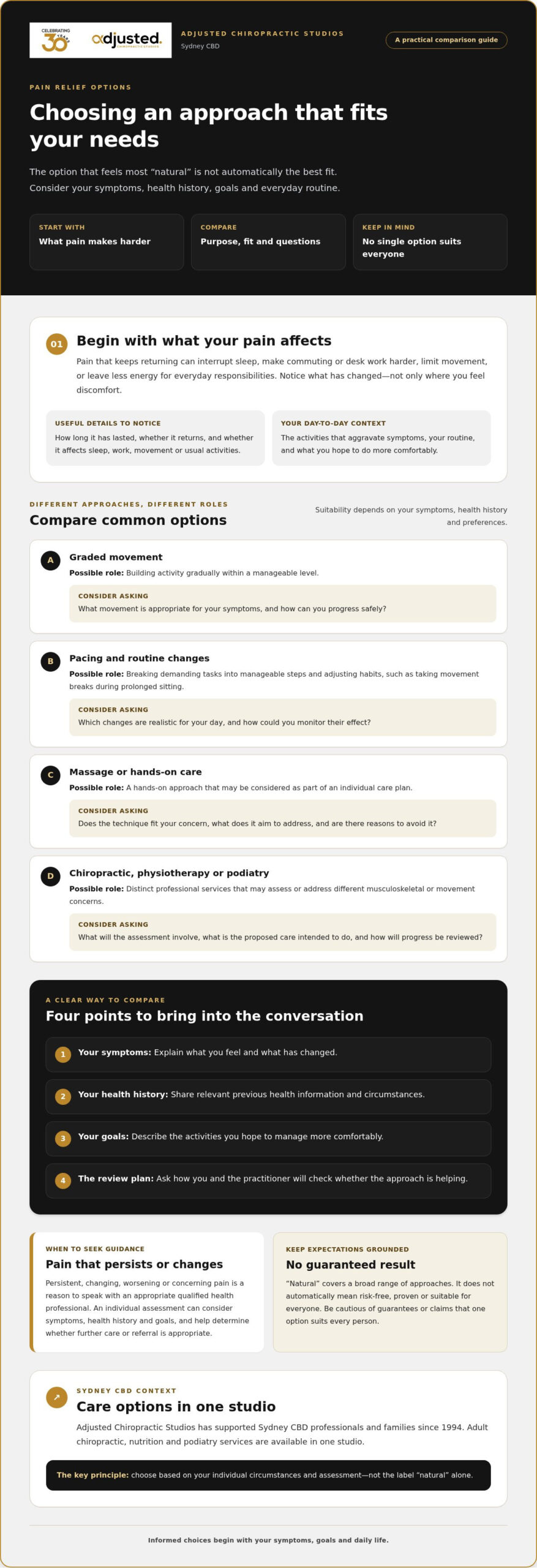
Natural pain relief options Sydney readers encounter range from everyday self-management to care from allied health professionals. Each has a different aim, and suitability depends on your symptoms, health history and preferences. The US National Center for Complementary and Integrative Health reviews evidence and safety for several complementary health approaches; evidence varies by approach and type of pain. For Australian guidance, Healthdirect Australia also provides information about chronic pain.
| Approach | Possible role | Who might consider it and what to ask |
|---|---|---|
| Graded movement | Building activity gradually within a manageable level. | May suit people wanting to maintain or return to activity. Ask what movement is appropriate for your symptoms and how to progress safely. |
| Pacing and routine changes | Breaking demanding tasks into manageable steps and adjusting habits, such as taking movement breaks during prolonged sitting. | May be useful if work or daily tasks aggravate symptoms. Ask which changes are realistic and how to monitor their effect. |
| Massage or hands-on care | Hands-on approaches that may be considered as part of an individual care plan. | Discuss whether the technique fits your complaint, what it aims to address and any reasons to avoid it. |
| Chiropractic, physiotherapy or podiatry | Distinct professional services that may assess or address different musculoskeletal or movement concerns. | Ask about the assessment, proposed care, likely role and how progress will be reviewed. The relevant service depends on your needs. |
Movement, pacing and daily routines
Comfortable movement and gradual activity may be worth discussing with a qualified professional, particularly if pain makes you cautious about moving. There’s no single exercise programme that suits every presentation. For example, if desk work is part of your routine, you could discuss changing position during long periods of sitting. If tasks are physically demanding, spacing them out may be more manageable than doing them all at once. Notice how symptoms respond and seek individual guidance if activity worsens or changes them.
Hands-on and allied health approaches
Chiropractic care may include assessment and spinal adjustments. Physiotherapists commonly provide assessment and movement-focused care, while podiatrists focus on foot and lower-limb health. These services aren’t interchangeable, and the appropriate professional depends on your concern. Massage and other hands-on care may also be options to discuss, but they aren’t suitable for everyone or every complaint. Read the adult chiropractic care guide to understand one service in more detail.
If you’re considering chiropractic in Sydney, you can also review Adjusted Chiropractic Studios’ adult chiropractic care and discuss whether an assessment is appropriate for your circumstances.
How to choose a pain-relief approach that fits your situation
There isn’t one natural option that suits every person or type of pain. A method that fits one person’s symptoms, work demands and health history may not suit someone else. To narrow down the natural pain relief options Sydney offers, start with four considerations: what you’re experiencing, what you’d like to do more comfortably, your relevant health history and how pain affects your daily activities.
For example, a desk worker might want to manage discomfort during long periods of sitting, while someone else may be focused on moving more comfortably through daily tasks. Being specific about your goal helps you and a health professional discuss whether an approach is relevant, what it can reasonably aim to address and whether another kind of care may be more appropriate.
Questions to ask before starting care
A clear conversation can help you understand the proposed approach before deciding whether to proceed. Consider asking:
- How will you assess my concern? Ask how your symptoms and relevant health history will inform the assessment.
- What does the approach involve, and what is it intended to address? Ask about alternatives that may be appropriate for your situation.
- How will we review progress and suitability? Agree on what changes you’ll monitor, such as whether a daily activity is becoming easier, and when you’ll discuss the plan again.
Before starting, ask how your concern will be assessed, what the approach involves and aims to address, what alternatives may suit you, and how progress and ongoing suitability will be reviewed.
Safety, scope and expectations
Share relevant conditions, previous care and any changes in your symptoms with the practitioner. This context can help them consider whether the approach is suitable and whether you may need advice from another health professional. Don’t assume that a treatment described as natural is risk-free or that it replaces other care you may need.
Agree on a goal that matters to you, such as returning to a particular routine or managing a workday more comfortably. Then review whether the plan is helping you move towards it. If symptoms change, your daily function is affected in a new way or the approach isn’t meeting the goals you agreed on, raise this with your practitioner and reconsider the next step together. A considered plan can adapt as your needs change.
Practical next steps for exploring pain relief in Sydney
Choosing among natural pain relief options Sydney offers can feel easier when you prepare for a focused conversation instead of trying to decide everything at once. A few notes about your symptoms and goals can help a health professional understand how pain fits into your work, movement and everyday routine.
Prepare for a conversation with a health professional
Use this simple process to organise your next steps:
- Note your symptoms. Record when they began, where you feel them, whether they come and go, and what seems to affect them. Include any changes you’ve noticed.
- Describe the impact. Write down which daily activities are harder, such as sitting through work, commuting, sleeping comfortably or moving around at home.
- Clarify your goals. Identify what you’d like to manage or do more comfortably. A practical goal gives you and the practitioner something specific to discuss.
- Review your health history and previous care. Note relevant conditions, treatments you’ve tried and how you responded, along with any questions you want answered.
- Arrange suitable professional advice. Discuss your notes with an appropriate health professional, who can consider whether an assessment, a particular approach or another service may fit your concern.
Clear information supports a more individualised discussion, but you don’t need to have everything worked out beforehand. If symptoms are persistent, changing or concerning, seek appropriate health advice rather than relying on general article guidance.
Know when a different assessment may be needed
A practitioner may recommend another type of assessment or refer you to a different service if that better fits your symptoms and needs. This is a considered part of choosing care: the aim is to find an appropriate next step, not to assume one treatment suits every person. If you’re considering spinal adjustment, read this professional spinal adjustment guide to understand more about the approach and questions to raise.
If you’re in Sydney and considering adult chiropractic, you’re welcome to discuss whether an assessment may suit your needs. A conversation can help clarify your goals and whether this option is appropriate for your circumstances, without assuming it’s the right choice for everyone.
How Adjusted Chiropractic Studios approaches personalised care in Sydney
For people considering natural pain relief options Sydney, chiropractic may be one option to discuss, not a universal answer. Adjusted Chiropractic Studios has served Sydney CBD professionals and families since 1994. Its approach is personalised and evidence-informed, with a safety-first adjustment policy. Whether chiropractic is appropriate depends on your circumstances, symptoms and health history.
Assessment-led care and individual goals
An individual assessment and discussion of your health history can help inform whether chiropractic care is suitable and what options may be relevant. Your goals matter too. You might want to move more comfortably during a working day, manage the physical demands of commuting or make daily activities easier. Discussing posture, movement and routine can help connect care planning with the realities of city life.
If care is considered appropriate, a corrective pathway is a structured plan of interventions intended to improve function and stability. It should reflect the individual and their needs, rather than act as a fixed prescription or promise an outcome. Ask what the proposed care involves, how it relates to your goals and how its suitability will be reviewed.
The studio offers adult and kids chiropractic, nutrition and podiatry as part of its multidisciplinary offering. Core Score is described as a numerical measure representing overall central-nervous-system efficiency and adaptability. To learn how the studio presents this assessment, read the Core Score spinal scan guide. You can ask what the measure means in your situation and how it informs discussion of care.
Local access and next steps
The Hunter Street studio is opposite Martin Place Metro station, with Wynyard, Barangaroo and Martin Place nearby. For Sydney CBD professionals, this central location may make it easier to explore an in-person conversation alongside work or other city commitments.
If you’re weighing up chiropractic, you don’t need to arrive with a decision already made. Bring your questions, explain what you hope to manage and discuss whether an assessment is an appropriate next step. Contact Adjusted Chiropractic Studios to talk through your circumstances and whether an appointment may suit your needs. The conversation can help clarify your options without assuming chiropractic is right for everyone.
Choose a considered next step for your wellbeing
The most suitable approach depends on your symptoms, health history, goals and the demands of everyday life. As you compare natural pain relief options Sydney offers, look beyond the word “natural”: ask what each option involves, what it aims to address and how you’ll review whether it suits you. If symptoms persist or change, seek advice from an appropriate health professional rather than relying on general guidance alone.
Adjusted Chiropractic Studios has supported Sydney CBD professionals and families since 1994. Its studio brings adult and kids chiropractic, nutrition and podiatry together, with a Hunter Street location opposite Martin Place Metro station. Chiropractic is one option to explore, not a guaranteed answer for every person or concern.
If you’re considering chiropractic, start with a conversation about your needs and whether an assessment may be appropriate. Discuss your next step with Adjusted Chiropractic Studios. A thoughtful, individualised discussion can help you move forward with greater clarity and confidence.
Frequently Asked Questions
What are natural pain relief options in Sydney?
Natural pain relief options in Sydney can include self-management strategies and non-invasive professional care. Examples include adjusting daily routines, pacing activities, comfortable movement, massage, chiropractic, physiotherapy or podiatry, depending on the concern. “Natural” doesn’t mean risk-free or suitable for everyone, and these options don’t replace diagnosis or other care when needed. Consider your symptoms, health history and goals, and ask a qualified health professional whether an approach is appropriate for you.
Can movement and everyday habit changes help with pain?
Movement and routine changes may help some people manage everyday demands, but what’s appropriate varies with the person and their symptoms. You might consider changing position during long periods of desk work, taking a short movement break or spacing demanding tasks throughout the day. Treat these as examples, not a prescribed programme. If movement makes symptoms worse or you’re uncertain what’s suitable, ask an appropriate health professional for individual guidance.
Is chiropractic care a natural pain relief option?
Chiropractic is a professional care option some people may consider for musculoskeletal concerns, but it isn’t suitable for everyone or every type of pain. A chiropractor can discuss your symptoms, health history and goals, and explain whether an assessment or care may be appropriate. Ask what any proposed approach involves, what it aims to address and how progress will be reviewed. Don’t rely on a general description to determine whether chiropractic is right for you.
How do I choose a pain-relief approach that suits me?
Choose by matching the approach to your symptoms, health history, goals and the effect pain has on daily activities. Before starting, ask how your concern will be assessed, what the option involves, what alternatives may be suitable and how you’ll review progress. Explain whether pain affects work, sleep, commuting or movement at home. Revisit the plan with your practitioner if symptoms change or agreed goals aren’t being met.
When should I seek professional advice about ongoing pain?
Seek advice from an appropriate health professional if pain persists, keeps returning, changes or concerns you, particularly if it affects sleep, work or usual activities. You don’t need to wait until daily life is severely disrupted to ask for guidance. Describe when symptoms began, what affects them and how they limit your routine. A practitioner can assess your circumstances, discuss suitable options and recommend another service if that better fits your needs.
Can chiropractic care be combined with other health services?
Chiropractic care may be considered alongside other health services when this suits your individual needs. Adjusted Chiropractic Studios offers adult and kids chiropractic, nutrition and podiatry through one Sydney CBD studio. These are distinct services, and having them available in one place doesn’t mean every person needs each one. Tell your practitioners about other care you’re receiving, and ask how proposed approaches relate to your goals and whether communication between providers would be useful.
What should I expect from an initial chiropractic assessment in Sydney?
An initial assessment generally involves discussing your symptoms, relevant health history and goals, then considering whether chiropractic care may be suitable. The practitioner should explain any proposed next steps and give you the opportunity to ask questions before deciding how to proceed. The details can vary with your circumstances, so check with the clinic about its process. Adjusted Chiropractic Studios is on Hunter Street, opposite Martin Place Metro station.



