

Could a change in your child’s posture be part of growing up, or a reason to seek advice? If you’re searching for “spinal care for kids sydney”, it’s understandable to want clear, balanced information before considering hands-on care. Aches, movement changes or slouching can raise questions, but they don’t automatically mean your child needs treatment.
Children grow and move differently, so a considered conversation should start with your child’s health history, symptoms and everyday activities. Ask what an assessment involves, whether a suggested approach is appropriate for your child’s age, and when another health professional may be better placed to help.
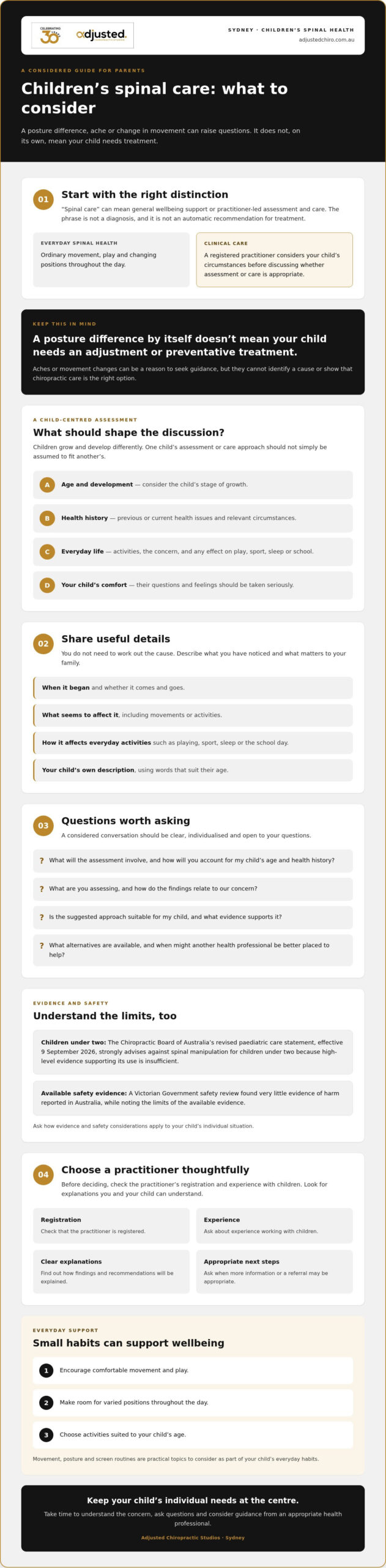
This guide explains the difference between supporting general spinal health and seeking clinical care. It also covers practical questions to ask a Sydney practitioner and everyday habits, including movement, posture and screen routines, that can support your child’s wellbeing. The aim is to help you make an informed decision at your own pace, with your child’s individual needs at the centre.
Key Takeaways
- Spinal care for kids sydney can refer to general wellbeing or practitioner-led care; the term alone isn’t a diagnosis or a reason to seek treatment.
- Before considering care, ask how the practitioner will take your child’s age, health history, concerns and activities into account.
- A posture difference by itself doesn’t mean your child needs an adjustment or preventative treatment.
- Support everyday spinal health with comfortable movement, varied positions and activities suited to your child’s age.
- Check the practitioner’s registration and experience with children, and ask how they explain findings, suitability and referrals.
What does spinal care for kids in Sydney mean?
Spinal care is a broad term for supporting spinal health or seeking assessment and care for a concern; it isn’t a diagnosis or an automatic recommendation for treatment. For children, everyday spinal health includes ordinary movement, play and changing positions throughout the day. Clinical care is different: a registered practitioner considers a child’s circumstances before discussing whether assessment or treatment is appropriate.
If you’re looking up “spinal care for kids sydney”, separate general information from a clinical decision about your child. For background on what chiropractic care involves, this overview describes its methods and history, as well as scientific scrutiny of some claims. A practitioner should explain recommendations in clear, evidence-informed terms rather than suggest every child needs an adjustment.
How is children’s spinal health different from adult spinal care?
Children’s bodies and abilities change as they grow. Their needs may relate to their stage of development, activities, health history and the concern that has prompted a parent to seek advice. An adult’s experience or treatment approach shouldn’t simply be assumed to apply to a child. A suitable discussion takes the child’s age and individual circumstances into account.
Communication matters, too. The practitioner should explain the assessment and any proposed care in language both parent and child can understand, invite questions and take the child’s comfort seriously. Ask what a recommendation is intended to address, what evidence supports it and what alternatives are available. The Chiropractic Board of Australia’s revised paediatric care statement, effective 9 September 2026, strongly advises against spinal manipulation for children under two because high-level evidence supporting its use is insufficient.
When might a parent look for spinal care in Sydney?
You might have questions because your child seems uncomfortable during an activity, moves differently, or has ongoing aches that affect everyday life. These observations can be a reason to seek guidance, but they can’t identify a cause or establish that chiropractic treatment is the right option. If you’re concerned, discuss the issue with an appropriate health professional.
Before booking with a Sydney practitioner, ask about their experience working with children, what an assessment involves and how they decide whether care is suitable. A considered conversation should include your child’s health history, your concerns and your family’s goals. Adjusted Chiropractic Studios offers kids chiropractic care in Sydney. Ask the practitioner how they would assess your child’s needs before discussing any care.
How should an assessment consider a child’s growth and health history?
A useful assessment starts by listening, then considers whether a physical examination is appropriate for the child’s age and concerns. Growth and development, previous or current health issues, daily activities and the reason for seeking advice all help shape the discussion. The practitioner should explain what they’re assessing and how the findings relate to the question you brought in.
One child’s assessment can’t be assumed to fit another’s, because age, development, health history and individual concerns all shape what may be appropriate. Findings should guide whether care is suitable, whether more information is needed, or whether referral to another health professional is the better next step. A Victorian Government official safety review found very little evidence of harm reported in Australia, while noting the limits of the available evidence. Ask how a practitioner applies evidence and safety considerations to your child’s situation.
What should parents share at an initial appointment?
Bring relevant health history and describe the concern in your own words. Note when you first noticed it, whether it comes and goes, and whether anything seems to affect it. Explain any impact on ordinary activities such as playing, sport, sleep or getting through the school day. These details give the practitioner useful context without requiring you to identify a cause.
Give your child room to describe what they notice, using words that suit their age. A younger child might point to where something feels uncomfortable, while an older child may explain which movements or activities bring it on. Your family’s goals matter, too. Be clear about what you hope to understand, and invite your child to ask questions or say if they feel unsure.
What questions can parents ask about care and safety?
You’re entitled to understand the process before agreeing to care. Ask the practitioner:
- What will the assessment involve, and how will you explain the findings?
- What approach are you proposing, and what are its possible limitations?
- Are there alternatives, including monitoring the concern or seeking another opinion?
- How will you adapt your approach to my child’s age and development?
- Are you registered to practise in Australia, and what experience do you have working with children?
Clear answers should leave you better informed, not pressured. If you’re considering kids chiropractic care in Sydney, Adjusted Chiropractic Studios offers personalised chiropractic services for children. Discuss your child’s needs and ask for an explanation you and your child can understand before deciding whether to proceed.
Does every child need spinal care or a chiropractic adjustment?
No. A child doesn’t automatically need spinal care, an adjustment or preventative treatment. A posture difference, such as slouching while reading, doesn’t by itself show that a child has a condition or needs clinical intervention. An assessment is a way to understand a specific concern, not a promise that treatment will be recommended or improve a particular outcome.
For parents exploring spinal care for kids sydney, ask what a recommendation is based on and whether it relates to their child’s age and concern. Evidence for a particular approach shouldn’t be assumed to apply to every child or every reason for seeking care. The Chiropractic Board of Australia’s paediatric care statement strongly advises against spinal manipulation for children under two, citing insufficient high-level evidence to support its use. This is a clear example of why age and evidence matter.
What does evidence-informed care mean for children?
Evidence-informed care means a practitioner should explain what is known, what remains uncertain and how the information applies to your child’s circumstances. A parent’s positive experience may be meaningful to that family, but an anecdote alone can’t establish that a treatment is effective or safe for other children. Ask about the evidence for the proposed approach, its limitations and reasonable alternatives, including whether treatment is needed at all.
Before consenting, make sure you understand the intended purpose of care and how progress would be reviewed. Ask what would prompt the practitioner to pause, change course or recommend another opinion. A considered answer should help you make a decision without pressure or guarantees.
When might another health professional be more appropriate?
If an assessment raises concern about a potentially serious condition, referral for appropriate medical assessment may be the right next step. Ask the practitioner to explain why they’re recommending referral and what to do next. Chiropractic care shouldn’t be treated as a replacement for other health services.
If your child’s symptoms persist, worsen or concern you, seek timely advice from an appropriate health professional rather than relying on a general posture check or online search. For parents weighing up practitioner choice, Raising Children Network offers information on how to find a registered chiropractor and encourages discussion with a GP in the context of its guidance. You can also ask a Sydney practitioner directly about registration, experience with children and when they would recommend referral. If you’d like to learn about kids chiropractic care, start by discussing your child’s individual needs and whether an assessment is suitable.
How Sydney families can support kids’ spinal health
Everyday routines can encourage comfortable movement without turning posture into something your child has to get “right”. If you’re researching spinal care for kids sydney, remember that family habits support general wellbeing. They don’t replace an assessment if you have an ongoing concern, and they can’t guarantee a child won’t experience discomfort.
Which daily habits are worth discussing as a family?
Look for realistic opportunities to move and change position through the day. After sitting for homework or screen use, your child might stand, stretch, walk around or return to play. There’s no single ideal way to sit or stand all day. A range of comfortable positions and regular movement is more practical than repeatedly correcting a child’s posture.
Consider the wider routine, too. Play, age-appropriate physical activity and sleep all contribute to a child’s general health. The Australian Government recommends that children aged 5 to 17 have no more than two hours of sedentary recreational screen time a day, excluding screen use for schoolwork. It also recommends avoiding screens for an hour before sleep and keeping them out of the bedroom. For children aged 2 to 5, the recreational screen-time limit is one hour a day; for children under two, the recommendation is no screen time apart from video-calling with family. These are broad guidelines, not a treatment plan for a spinal concern.
Keep changes supportive and achievable. For example, agree on a screen-free wind-down routine or choose an after-school activity your child enjoys. If a routine seems to cause difficulty, adapt it rather than insisting on one “correct” position or schedule.
How can parents talk with children about discomfort?
Ask calm, open questions such as, “Can you tell me what you’re noticing?” or “Does anything make it feel different?” Avoid suggesting a diagnosis or leading your child towards a particular answer. Their description may change with age, mood and how easily they can explain what they feel.
Notice whether the concern affects sleep, school, play, sport or another part of everyday life. If it recurs, briefly note when it happens, what your child was doing and how long it lasts. This can help you give a suitable health professional a clear account, without trying to interpret the pattern yourself. Seek advice if the concern persists, worsens or worries you.
Small, steady adjustments to family routines can support wellbeing, while individual concerns deserve individual attention. If you’d like to discuss whether an assessment may suit your child, talk with Adjusted Chiropractic Studios about kids chiropractic care.
Choosing children’s spinal care in Sydney: what to check
Choosing a practitioner is as much about clear communication as convenience. If you’re comparing options for spinal care for kids sydney, look for someone who takes time to understand your child’s needs, explains their reasoning and is willing to discuss whether care is suitable. You should feel comfortable asking questions before making a decision.
How can parents check a Sydney practitioner’s approach?
Use this checklist to guide your conversation:
- Check registration. Confirm the practitioner’s registration on the Australian Health Practitioner Regulation Agency (AHPRA) public register, and review relevant information from the Chiropractic Board of Australia.
- Ask about experience with children. Find out how the practitioner adapts assessment and communication to your child’s age, development and circumstances.
- Request a clear explanation. Ask what the assessment involves, what the findings mean and how they inform any recommendation.
- Discuss safety and uncertainty. A practitioner should explain the potential limitations of an approach, relevant evidence and alternatives, without promising a particular result.
- Ask about referral. Clarify what would lead them to recommend another health professional or further assessment.
Clear answers matter. If you feel rushed, don’t understand the proposed approach or aren’t comfortable proceeding, it’s reasonable to pause and seek further advice. A considered discussion should leave you informed, not pressured.
What can families expect from Adjusted Chiropractic Studios?
Adjusted Chiropractic Studios offers kids chiropractic care and has over 30 years of experience delivering chiropractic care in the Sydney CBD. The clinic provides individual consultations and spinal adjustments, as well as Core Score scanning during the assessment phase. Ask the team whether this technology is relevant to your child’s assessment and what any findings would mean. No particular scan or technique should be assumed without confirmation.
Before deciding, discuss your child’s health history, what prompted your enquiry and whether an appointment is appropriate. If you’re considering children’s spinal care in Sydney, you can book a consultation online or call the Sydney office to discuss your child’s needs. There’s no need to assume treatment is the next step; suitability should be considered first.
Make an informed next step for your child
Good decisions about your child’s spinal health begin with their individual needs, not a general assumption that treatment is required. A posture difference alone doesn’t mean a child needs an adjustment. If you have a concern, an assessment should consider their age, health history and daily activities, explain whether care may be suitable, and identify when referral is more appropriate.
Simple family habits, including regular movement and varied positions, can support general wellbeing. They aren’t a substitute for advice if discomfort persists or affects everyday life. Asking clear questions about a practitioner’s registration, experience with children, proposed approach and its limitations can help you feel more confident about your options for spinal care for kids sydney.
Adjusted Chiropractic Studios has over 30 years of experience delivering chiropractic care in the Sydney CBD. The clinic offers kids chiropractic services and consultations, with the opportunity to discuss your child’s needs and whether an assessment is appropriate. If you’d like to take the next step, book a consultation online or call the Sydney office to discuss your child’s needs.
Frequently Asked Questions
Is chiropractic care safe for children?
Chiropractic care isn’t automatically safe or suitable for every child; risks depend on the child and the care proposed. Ask what the assessment involves, whether the practitioner has experience with children, and what possible risks and alternatives apply. The Chiropractic Board of Australia strongly advises against spinal manipulation for children under two because high-level evidence supporting its use is insufficient. Discuss concerns with an appropriately qualified health professional and review current guidance.
Can chiropractic care help with a child’s posture?
Posture varies between children and doesn’t automatically indicate a problem that needs treatment. A practitioner can discuss your child’s individual presentation, but chiropractic care shouldn’t be promised to correct posture or prevent future issues. Everyday habits, including comfortable movement and changing positions, are worth considering. If a posture concern persists or affects your child’s activities, seek advice from an appropriate health professional about whether an assessment may be useful.
What happens at a child’s first chiropractic appointment?
An initial appointment generally begins with a conversation about your child’s health history, current concerns, activities and your family’s goals. If indicated, the practitioner may then conduct an assessment suited to your child’s age and circumstances. They should explain the findings and discuss options with you and your child before any care is considered. Not every child will need the same assessment, test, adjustment or treatment plan.
Does every child need a spinal health check?
No, a routine spinal health check isn’t automatically necessary for every child. You can seek advice if you have a specific concern, but posture or growth alone doesn’t establish a need for treatment. Ask a suitable health professional how your child’s health history and everyday function relate to the concern, and why any assessment is being suggested. If you’re researching spinal care for kids Sydney, focus on your child’s individual needs rather than a general assumption.
At what age can a child see a chiropractor?
There isn’t one age that establishes chiropractic care as suitable for every child. Development, health history and the reason for seeking advice all matter, as does the practitioner’s experience with children. Ask how the assessment and any proposed approach would be adapted to your child’s age and needs. The Chiropractic Board of Australia strongly advises against spinal manipulation for children under two; discuss other concerns with an appropriately qualified health professional.
When should I seek medical advice instead of chiropractic care for my child?
Seek timely advice from an appropriate health professional if your child’s concern seems serious, is worsening or persistent, or follows an injury. Chiropractic care shouldn’t replace medical assessment. Ask a practitioner about referral for suspected serious conditions and what the next steps should be. When seeking advice, share relevant health history and describe what you’ve noticed, including when it began and how it affects your child’s everyday activities.



