

Could an unsteady step be coming from somewhere other than your spine? If you’ve noticed hesitation on stairs, wobbliness during exercise or a change in confidence when moving around, it’s understandable to wonder whether improving balance with chiropractic care could help. Balance depends on several body systems working together, so a spinal or musculoskeletal concern may be only one part of the picture.
A careful assessment can help clarify whether chiropractic care is appropriate, but it can’t establish every cause of balance changes or replace broader medical assessment when that’s needed. This article explains common factors that can affect balance, what a responsible chiropractic assessment may involve, and what it can and can’t determine. You’ll also learn when symptoms call for assessment beyond chiropractic care, so you can choose a sensible next step with greater confidence.
Key Takeaways
- Balance relies on several body systems working together, so a change in steadiness can have different possible contributors.
- Improving balance with chiropractic care should begin with an individual assessment, not an assumption that spinal treatment is the answer.
- Compare care options based on your symptoms and assessment needs; balance concerns may call for input beyond chiropractic care.
- Keep a brief record of when unsteadiness occurs, what you were doing, how long it lasts and any symptoms that accompany it.
- At Adjusted Chiropractic Studios, a safety-first conversation can help clarify whether chiropractic assessment may be relevant or referral is appropriate.
What does improving balance involve, and why can it change?
Feeling unsteady can be unsettling, especially if it affects walking, exercise or everyday tasks. Balance isn’t controlled by one body part. It depends on sensory information being processed by the nervous system and translated into coordinated movement.
In plain English, balance is your body’s ability to gather information about its position, make sense of it and adjust your movements to stay steady. Vision, inner-ear input, muscle strength, sensation, medication effects and musculoskeletal function may all be relevant. These are possible contributors, not a diagnosis: an assessment is needed to explore what might be affecting you.
How the body maintains balance during everyday movement
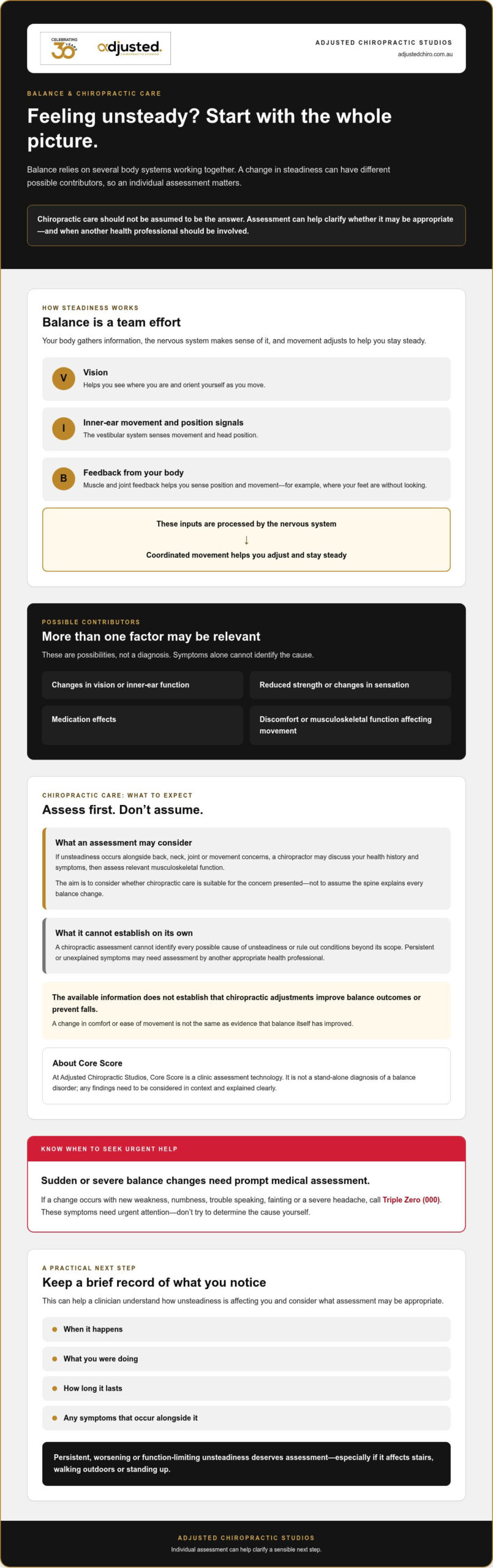
Your eyes help you see where you are; the vestibular system in the inner ear senses movement and head position; and feedback from your body helps you respond to changes. Proprioception is your awareness of joint position and movement, such as knowing where your feet are without looking. You can read a plain-language overview of Proprioception. Together, these inputs help you turn, walk over uneven ground or stand from a chair without needing to consciously plan every movement.
The systems continually adjust to each other. For example, uneven ground may require your legs and torso to respond while your eyes help you orient yourself. Reduced strength, changes in sensation, vision or inner-ear function, some medications, or discomfort affecting movement may alter how steady a task feels. The possible factors vary between people, so symptoms alone can’t identify the cause.
When unsteadiness deserves closer attention
An occasional awkward step may happen, but persistent, worsening or function-limiting unsteadiness deserves assessment. Take note if it’s affecting your confidence with stairs, walking outdoors or standing up. A clinician can consider your health history, symptoms and relevant contributing factors, and advise whether another type of assessment is appropriate.
Seek prompt medical assessment for a sudden or severe change in balance. If it occurs with concerning symptoms such as new weakness, numbness, trouble speaking, fainting or a severe headache, call Triple Zero (000). These symptoms need urgent attention; don’t try to determine the cause yourself.
Understanding what’s involved is a useful first step before considering improving balance with chiropractic care. The next question is whether a chiropractic assessment fits your situation, particularly if balance changes occur alongside musculoskeletal concerns.
Can chiropractic care help with balance, and what does the evidence support?
It’s reasonable to ask whether a spinal adjustment could make you feel steadier. The careful answer is that balance has several contributing systems, and chiropractic care shouldn’t be presented as a proven stand-alone treatment for balance problems. The available information for this article doesn’t establish that chiropractic adjustments improve balance outcomes or prevent falls.
A change in comfort or ease of movement is not the same as evidence that balance itself has improved. Even if a musculoskeletal concern affects how you move, that alone doesn’t show it caused your unsteadiness. The US National Institute on Deafness and Other Communication Disorders explains that balance concerns can have varied contributors in its overview of Balance Disorders.
What a chiropractor may assess before recommending care
If balance changes occur alongside back, neck, joint or movement concerns, a chiropractor may discuss your health history and symptoms, then assess relevant musculoskeletal function. The purpose is to consider whether chiropractic care is suitable for the concern presented, not to assume the spine explains every balance change.
Findings may guide whether care is appropriate, needs to be limited, or isn’t indicated. At Adjusted Chiropractic Studios, Core Score is a clinic assessment technology; it isn’t a stand-alone diagnosis of a balance disorder. Any findings need to be considered in context and explained clearly.
What chiropractic care cannot establish on its own
A chiropractic assessment can consider musculoskeletal function, but it can’t by itself identify every possible cause of unsteadiness or rule out conditions beyond its scope. Spinal alignment alone doesn’t establish why your balance has changed. Persistent or unexplained symptoms may need assessment by another appropriate health professional.
An assessment can help decide whether chiropractic care is appropriate; it doesn’t prove that the care will change balance outcomes. If an adjustment is considered, it should be individualised to your circumstances and discussed with you. It isn’t a guaranteed way to improve balance or prevent falls.
If you’re considering improving balance with chiropractic care, focus first on whether you also have musculoskeletal concerns and what kind of assessment your symptoms call for. Sydney CBD readers can learn about Adjusted Chiropractic Studios’ chiropractic care and discuss whether an assessment may be relevant. If your symptoms suggest a broader concern, appropriate referral is the safer next step.
Chiropractic care and other balance approaches: how to compare options
There isn’t one balance-care pathway that suits everyone. The useful starting point is the pattern of your symptoms, your health history and what an assessment can reasonably establish. If unsteadiness occurs alongside joint discomfort or restricted movement, a chiropractic assessment may help consider those musculoskeletal concerns. It can’t, on its own, explain every possible cause of balance changes.
Exercise-based balance rehabilitation may be considered where appropriate, with guidance from a suitably qualified health professional. If symptoms suggest a broader cause, assessment by another appropriate clinician may be needed first. A published study has examined this topic, but research on chiropractic care and balance should be interpreted in context: one study cannot establish that chiropractic care is a reliable, stand-alone way to improve balance for everyone.
The right pathway depends on your symptoms, health history and assessment, not on a one-size-fits-all promise. That’s a practical way to think about improving balance with chiropractic care: consider it only where relevant, and be clear about what the assessment can and cannot tell you.
Questions to ask when choosing a balance-care pathway
Before starting care, ask what the assessment is designed to identify and what it can’t determine. Find out how your progress will be reviewed, what changes would prompt a referral, and how recommendations relate to your health history and everyday goals. You might mention specific challenges, such as turning while walking, getting up from a chair or feeling unsteady on uneven ground.
When a multidisciplinary approach may be useful
Different concerns may call for different expertise. Chiropractic may be relevant to assessed musculoskeletal concerns; podiatry may be considered if foot function is part of the picture; and nutrition input may be relevant to individual dietary needs. These services aren’t required for everyone, and none should replace appropriate assessment of unexplained balance changes. Care and referrals should match your needs and remain within each practitioner’s scope.
At Adjusted Chiropractic Studios in Sydney CBD, chiropractic, podiatry and nutrition are available within one studio, but that doesn’t mean every person needs each service. A conversation can help clarify whether a chiropractic assessment is relevant or whether another clinical assessment is the more appropriate next step. You can read about chiropractic care at Adjusted Chiropractic Studios as you consider your options.
What can you do next if balance feels less steady?
If you’re feeling less steady, a few simple steps can make it easier to seek suitable support. Start by noting what’s changed, take care to reduce immediate hazards, and arrange an assessment that fits your symptoms. Then review any next steps with the relevant clinician rather than trying to identify the cause on your own.
Keep a brief record of:
- When the unsteadiness occurs and what you were doing, such as walking, turning or standing up.
- How long it lasts and whether it’s becoming more frequent or affecting everyday activities.
- Any symptoms that happen at the same time, along with recent health or medication changes.
Until you’ve had advice, use practical precautions that feel appropriate, such as holding a handrail on stairs and avoiding activities where a sudden loss of steadiness could put you at risk. Don’t stop or change prescribed medicines without discussing it with the professional responsible for your care. If symptoms are sudden or severe, seek urgent medical help; call Triple Zero (000) for an emergency. If they’re worsening, arrange prompt medical assessment.
Prepare for an initial assessment
Bring a concise health history, details of current concerns and relevant health conditions, plus a list of medicines if available. Describe how the change affects you, for example, whether you feel less confident on stairs, while walking or when turning. You don’t need to label the problem or arrive with a suspected diagnosis.
The clinician may ask when symptoms began, what brings them on and how they affect daily function. If you’re considering improving balance with chiropractic care, a chiropractor can discuss your history and assess relevant musculoskeletal function before deciding whether chiropractic care is appropriate. If the concern needs assessment beyond their scope, they can explain that and recommend referral.
Track function without relying on a single score
Choose a few ordinary activities that matter to you, such as walking comfortably around your home or turning during a usual task. Note how they feel over time, using the same descriptions each time. Don’t deliberately test your balance in an unsafe situation, or treat one score as a diagnosis.
A Core Score reading should not be taken as a validated measure of balance outcomes. Review your notes and any assessment findings with your clinician. Together, you can discuss whether the plan remains suitable or needs to change as your needs become clearer.
If musculoskeletal concerns accompany your balance changes, you can learn about adult chiropractic care at Adjusted Chiropractic Studios and discuss whether an assessment may be relevant.
How Adjusted Chiropractic Studios approaches balance-related concerns in Sydney
If unsteadiness is happening alongside joint discomfort, restricted movement or another musculoskeletal concern, an individual chiropractic assessment may help clarify whether that aspect of your health is relevant. At Adjusted Chiropractic Studios, the first step is a conversation about your concerns, health history and movement goals, not an automatic adjustment or assumption about the cause.
Safety comes first. The practice has operated in Sydney CBD since 1994 and takes an evidence-informed approach, including referral when a concern needs assessment beyond chiropractic scope. An assessment can help consider relevant musculoskeletal function; it isn’t a substitute for broader clinical assessment where symptoms point to other possible causes.
Assessment-led care, not a one-size-fits-all adjustment
Your chiropractor may ask when the unsteadiness occurs, how it affects everyday activities and whether you have related pain or movement limitations. They can then assess relevant musculoskeletal function and explain what the findings may mean, including the limits of what the assessment can establish. Any recommendation should reflect your individual findings, health history and practical goals, such as moving more comfortably at work or feeling more confident with everyday tasks.
Core Score may form part of the clinic’s assessment process, but it should be understood as an assessment tool, not as a stand-alone diagnosis of a balance disorder or proof that chiropractic care will improve balance. A care plan or adjustment should only be discussed if the assessment indicates it may be appropriate, with options and limitations explained clearly.
When to ask about an appointment or referral
If movement limitations or musculoskeletal concerns accompany unsteadiness, you can ask whether a chiropractic assessment may be relevant. If symptoms are sudden, severe or unexplained, seek appropriate medical assessment rather than relying on a chiropractic appointment to identify the cause. For an emergency, call Triple Zero (000).
The clinic is on Hunter Street, opposite Martin Place Metro station, with access to the Sydney CBD. If you’d like to discuss whether an assessment fits your situation, Discuss your concerns with the Sydney team. The aim is to help you understand a suitable next step, which may include referral when chiropractic care isn’t the right pathway.
Take a considered next step towards steadier movement
Balance changes can have different contributors, so the most useful next step is one guided by your symptoms and an appropriate assessment. Keep track of how unsteadiness affects the activities that matter to you, and share that information with a health professional. Chiropractic care may be worth discussing when musculoskeletal concerns are also present, but it isn’t established as a stand-alone solution for balance problems.
At Adjusted Chiropractic Studios, an individual conversation comes before any care recommendation. The Sydney CBD practice has supported the community since 1994, with a safety-first clinical approach and an integrated allied-health team that includes podiatry and nutrition. If you’re weighing up whether a chiropractic assessment may fit your needs, discuss your concerns with the Sydney team.
Understanding your options is a constructive start to improving balance with chiropractic care where appropriate, and to finding another assessment pathway when it isn’t. With clear information and support tailored to your circumstances, you can move towards your next step with greater confidence.
Frequently Asked Questions
Can chiropractic care improve balance?
Chiropractic care isn’t established as a proven stand-alone treatment for balance problems. Balance involves several body systems, so an adjustment shouldn’t be assumed to address the cause of unsteadiness or prevent falls. If you’re exploring improving balance with chiropractic care, a chiropractor may assess relevant musculoskeletal concerns, such as discomfort or restricted movement, and explain whether care may be appropriate or whether another assessment is needed.
What causes poor balance when walking?
Poor balance while walking can have different possible contributors, including changes in vision, inner-ear function, strength, sensation or musculoskeletal function. Some medicines or health conditions may also affect steadiness. The way symptoms feel doesn’t identify their cause by itself. Note when the change happens, such as during turns or on uneven ground, and discuss the pattern with an appropriate health professional for individual assessment.
Can a chiropractor assess balance problems?
A chiropractor may assess musculoskeletal function relevant to your movement, particularly if unsteadiness occurs with joint discomfort or restricted movement. They can discuss your health history and symptoms, explain what their assessment can establish, and advise if chiropractic care may be suitable. This doesn’t replace assessment of other possible causes. Persistent, unexplained or worsening balance changes may need input from another appropriate health professional.
What happens during a chiropractic assessment for balance concerns?
The chiropractor will generally ask about your health history, when the unsteadiness occurs, related symptoms and how it affects daily activities. They may assess relevant musculoskeletal movement and discuss whether chiropractic care is appropriate, limited or not indicated. Ask what the findings can and can’t tell you, how progress would be reviewed, and what might lead to referral. An assessment alone doesn’t prove treatment will change balance outcomes.
Should I see a chiropractor or another health professional for balance issues?
Choose the next step based on your symptoms and assessment needs. If unsteadiness accompanies musculoskeletal discomfort or movement restriction, you could ask whether chiropractic assessment is relevant. If symptoms are unexplained, persistent or worsening, seek assessment from an appropriate medical professional. Sudden or severe symptoms need prompt attention; call Triple Zero (000) in an emergency. Don’t delay broader assessment to try a treatment that may not fit your situation.
Can spinal adjustments help with dizziness or vertigo?
Spinal adjustments shouldn’t be assumed to treat dizziness or vertigo. These symptoms can have different causes, and the symptom alone can’t show whether a musculoskeletal issue is involved. A chiropractor may consider relevant musculoskeletal function, but cannot establish every cause through a spinal assessment. Seek appropriate medical assessment for new, persistent or worsening dizziness, and get urgent help if it’s sudden or severe or occurs with other concerning symptoms.
How can I track changes in my balance?
Keep a simple note of when unsteadiness occurs, what you were doing, how long it lasts and any symptoms that accompany it. You might also track how familiar activities feel, such as walking around your home or turning while moving. Use the same descriptions over time, and don’t test yourself in an unsafe situation. Share your notes with your clinician so changes can be considered alongside an individual assessment.



