

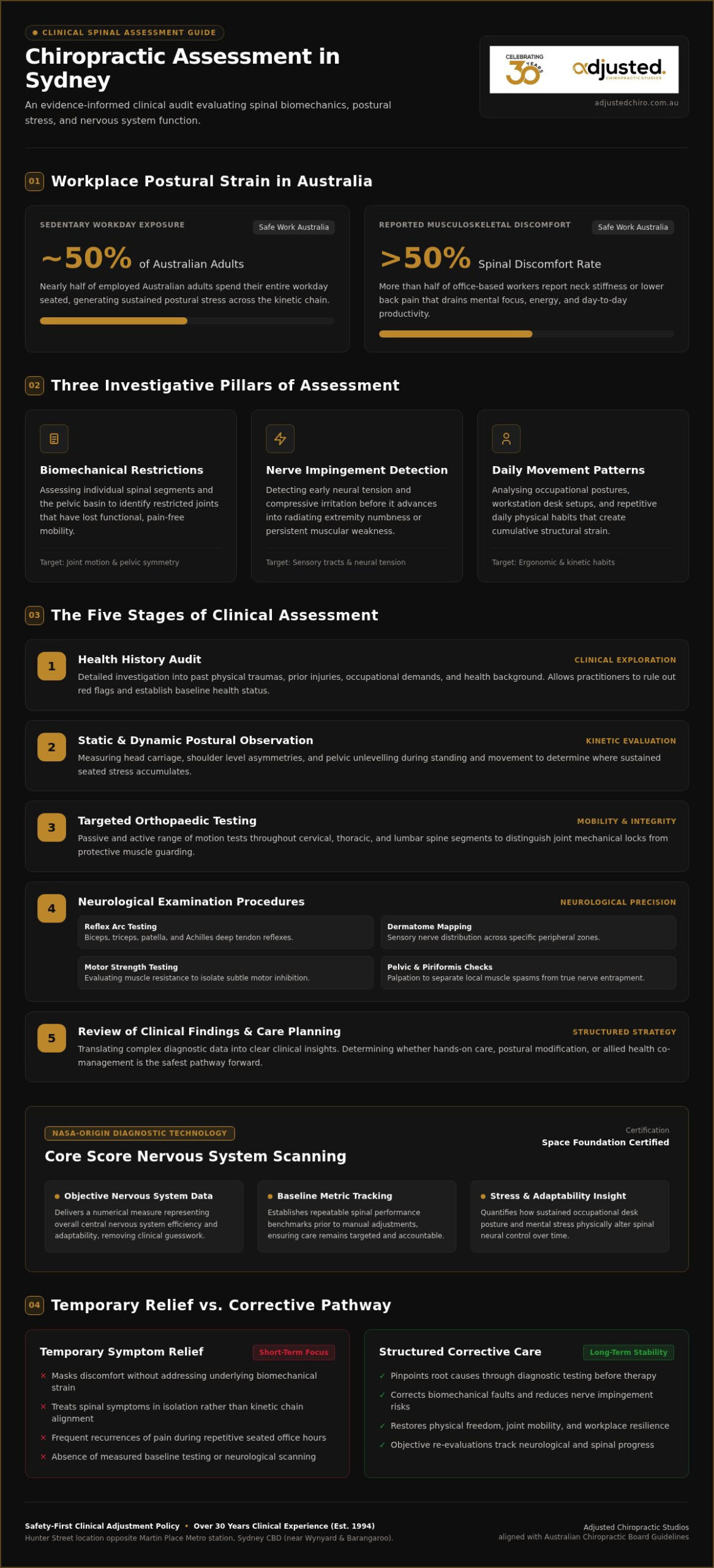
Nearly half of employed Australian adults spend their entire workday seated, with Safe Work Australia data showing over 50% reporting spinal discomfort. When recurring neck stiffness or lower back pain begins to drain your focus at work, booking an initial consultation can feel daunting. If you are considering a chiropractic assessment in Sydney, you might wonder what the physical examination entails and how safe the diagnostic methods are.
You already know that masking persistent symptoms with temporary relief does not solve the underlying mechanical strain. Safe, enduring results require an investigative approach that pinpoints why your spine is under postural stress. Discover what occurs during a professional chiropractic assessment in Sydney, from nervous system scans to personalised corrective care that rebuilds physical freedom. Here is a transparent look at the clinical steps, diagnostic technologies, and structured pathways guiding your spinal health.
Key Takeaways
- Understand the five structured stages of a thorough chiropractic assessment in Sydney, from initial consultation to reporting objective clinical findings.
- Discover how Space Foundation-certified Core Score scanning measures central nervous system function alongside traditional physical examination methods.
- Learn how sustained workplace postural stress alters spinal curvature and drains day-to-day productivity across corporate office environments.
- Gain clarity on how individual diagnostic data translates into a safe, evidence-informed corrective pathway designed for long-term spinal stability.
What is a Chiropractic Assessment and Why Does It Matter?
A clinical evaluation is not a quick conversation followed by an immediate adjustment. Instead, a thorough chiropractic assessment in Sydney operates as an in-depth musculoskeletal audit. It reviews the relationship between your spinal column, peripheral joints, and nervous system function. Rather than merely chasing the location of an ache, your practitioner evaluates structural alignment, spinal mobility, and muscular compensations to identify the true driver of your discomfort.
Every individual arrives with a unique medical background. Reviewing your comprehensive health history allows a practitioner to rule out red flags, understand past physical traumas, and map out your lifestyle habits. Gathering this background alongside objective physical metrics ensures that clinical decisions rest on measured facts rather than guesswork.
The Core Purpose of an Initial Clinical Evaluation
Your first appointment serves three primary investigative purposes:
- Identifying biomechanical restrictions: Assessing individual spinal segments and the pelvic basin to pinpoint joints that have lost functional movement.
- Detecting early nerve impingement: Pinpointing neural tension or compressive irritation before it progresses into radiating extremity numbness or persistent weakness.
- Evaluating daily movement patterns: Analysing how occupational postures, seated habits, and repetitive daily activities contribute to cumulative physical strain.
Moving Beyond Temporary Symptom Relief
Relying on quick remedies often leaves the underlying structural fault completely unchecked. While heat packs or anti-inflammatory medications might dull acute sensations, masking discomfort prevents joints and soft tissues from truly stabilising. Real recovery requires shifting focus from short-term symptom relief to genuine corrective care.
Safe practitioners strictly avoid manual therapy without prior diagnostic evaluation. A structured corrective pathway establishes baseline metrics first, identifying joint restrictions and neural tension before recommending care. This measured sequence ensures every intervention is safe, appropriate, and designed to restore your physical freedom over the long term.
The Five Stages of a Thorough Chiropractic Assessment in Sydney
Understanding what happens during a clinical visit removes uncertainty. A professional chiropractic assessment in Sydney moves through five structured stages, creating a collaborative space where your health concerns are heard and thoroughly examined before any treatment is discussed.
Stage 1 and 2: Health History and Postural Observation
The consultation begins with a detailed health history discussion. Your practitioner investigates past sports injuries, surgical procedures, and your current occupational demands. This conversation guides clinical safety and informs which physical tests are appropriate.
Following this discussion, static and dynamic postural observations take place. Prolonged sitting causes measurable structural shifts. By conducting clinical assessments of working posture, your practitioner observes head carriage, shoulder level asymmetries, and pelvic unlevelling to determine where sustained postural stress is accumulating throughout your kinetic chain.
Stage 3 and 4: Orthopaedic Testing and Neurological Examination
Targeted physical examinations confirm joint integrity and baseline movement capacity. Your practitioner tests passive and active range of motion across the cervical, thoracic, and lumbar spine, checking for mechanical restrictions or protective muscle guarding.
Neurological tests evaluate how effectively your brain communicates with your body. These precise procedures include:
- Reflex testing: Assessing deep tendon reflexes at the biceps, triceps, patella, and Achilles tendon to gauge spinal reflex arcs.
- Dermatome testing: Mapping sensory pathways to confirm skin sensation is intact across peripheral nerve zones.
- Motor strength tests: Measuring muscle resistance with neurological precision to uncover subtle motor inhibition.
- Pelvic and lower limb checks: Palpating surrounding tissues, such as the piriformis muscle, to rule out local muscle spasms that mimic nerve entrapment.
Stage 5: Review of Clinical Findings and Patient Consultation
The final phase translates complex measurements into plain English. Your clinician explains what is driving your discomfort, reviews structural findings, and outlines whether hands-on spinal care, corrective movement, or allied health co-management is the safest pathway forward. If you are experiencing ongoing discomfort from long work hours, you can explore experienced adult chiropractic care in Sydney or visit Adjusted Chiropractic Studios to discuss your findings and start rebuilding functional stability.
Advanced Diagnostic Technology: Objective Spinal and Nervous System Scanning
Skilled palpation and orthopaedic motion testing offer vital physical clues, yet manual checks alone cannot quantify internal neuro-spinal stress. Incorporating digital scanning alongside hands-on examination transforms subjective impressions into measurable data. When undertaking a modern chiropractic assessment in Sydney, objective diagnostics ensure that every clinical recommendation rests on clear physiological evidence rather than assumptions.
Official guidance on what to expect in a chiropractic examination outlines the importance of careful inspection and vitals. Digital scanning instruments elevate these standard checks, establishing transparent baselines that allow both practitioner and patient to monitor functional recovery over time.
Understanding the Core Score Assessment
The Core Score provides a single numerical index representing how efficiently your central nervous system adapts to daily physical and environmental demands. This assessment integrates Space Foundation-certified, NASA-origin diagnostic scanning technology to evaluate neural performance without radiation or discomfort. For a closer look at these diagnostic metrics, explore our guide on Core Score spinal scanning technology.
The system evaluates two key physiological markers along the spine:
- Surface Electromyography (sEMG): Measures the electrical activity and balance of the postural muscles supporting your spine. Areas of excessive tension highlight muscular overcompensation, while weak signals reveal fatigue.
- Infrared Thermal Scanning: Reads subtle cutaneous temperature differentials along the spinal column. Because these fluctuations reflect autonomic nerve activity regulating blood flow, thermal scans uncover deeper metabolic stress around spinal joints.
Evaluating Stress Resilience via Heart Rate Variability
Nervous system health extends beyond musculoskeletal joints. Heart Rate Variability measures the minute, millisecond variations between consecutive heartbeats, serving as a validated indicator of autonomic nervous system adaptability. A balanced ratio between sympathetic drive and parasympathetic recovery signals a resilient, adaptable physiology.
Demanding desk work, chronic deadlines, and disrupted sleep keep many CBD workers locked in an exhausted fight-or-flight state. By identifying nervous exhaustion through Heart Rate Variability, your practitioner designs corrective care tailored to your current physiological capacity, supporting systemic recovery alongside structural alignment.
Assessing Common Workplace Posture Challenges for Sydney CBD Professionals
Modern desk environments place relentless static loads on the human frame. Research from 2026 shows that the average Australian office worker spends 76% of their workday seated, equating to over six hours spent fixed in one position. This sustained postural stress alters natural cervical and lumbar lordosis, creating chronic tension that drains focus and drives presenteeism across city offices.
When spinal joints remain immobilised in poor positions, mechanical strain triggers local tissue irritation and low-grade systemic inflammation. Arranging a preventative spinal health check through a professional chiropractic assessment in Sydney provides a clear clinical audit, identifying structural breakdown before repetitive strain turns into debilitating injury.
The Biomechanics of Desk Fatigue and Forward Head Carriage
Working on laptops or multi-monitor setups frequently forces the head forward past the shoulder line. For every 25 millimetres your head travels anteriorly, the effective weight supported by the cervical spine and upper trapezius doubles. This continuous traction causes significant physical strain:
- Upper cervical restriction: Compression of the suboccipital region often manifests as cervicogenic tension headaches behind the eyes or temples.
- Thoracic spine stiffness: Rounded shoulder positioning locks the rib cage and thoracic vertebrae, restricting full diaphragm excursion and shallowing your breathing.
- Postural exhaustion: The postural musculature burns through energy reserves just trying to hold the head upright, causing severe mid-afternoon cognitive fatigue.
Addressing these recurring patterns forms the cornerstone of effective corporate ergonomics and broader workplace injury prevention strategies.
Lower Spine Strain, Pelvic Misalignment, and Lower Limb Referral
Prolonged sitting keeps your hips in continuous 90-degree flexion, leading to shortened hip flexors and reciprocal inhibition of the gluteal muscles. Over time, inactive gluteal muscles force the lumbar spine and pelvic ligaments to absorb walking and standing forces they were never engineered to bear.
Pelvic torsion easily irritates the sciatic nerve root, producing dull lower back aches or radiating leg symptoms. When these biomechanical compensations travel down the kinetic chain, combining chiropractic with podiatry provides lasting structural relief. Our clinic coordinates foot mechanics, pelvic stability, and spinal motion under one roof to restore natural gait patterns. If long desk hours are affecting your productivity, schedule your clinical consultation to evaluate your spinal alignment.
From Initial Assessment to Action: What Follows Your Examination?
Synthesising examination metrics into a clear clinical picture marks the turning point of your care. Rather than offering a standard adjustment routine, a reputable chiropractic assessment in Sydney uses your scan results, movement screens, and health history to build an individualised corrective pathway. This transparent blueprint identifies exactly where structural instability sits, what needs correction, and how long tissue healing typically takes.
True healing encompasses the internal cellular environment alongside mechanical realignment. Musculoskeletal joints under continuous compression generate local metabolic waste. Integrating personalised nutritional strategies and anti-inflammatory foods helps neutralise systemic inflammation, speeding tissue repair and supporting long-term joint cartilage health.
Personalised Treatment Planning and Safety Protocols
Clinical safety directs every manual intervention. Adjusting techniques must match each patient’s age, bone density, physical frame, and specific symptoms. Low-force instrument adjustments or gentle mobilisations suit individuals presenting with acute joint irritation, whereas manual diversified techniques offer focused biomechanical correction for chronic joint restrictions.
Practitioners adhere to a strict safety-first clinical policy aligned with Chiropractic Board of Australia guidelines. If your examination flags signs of fracture, severe disc pathology, progressive neurological deficits, or non-mechanical disease, care pauses immediately for referral to specialised medical networks or diagnostic imaging. To explore specific manual techniques and clinical safety checks, read more about precise spinal adjustments in Sydney.
Restoring Mobility and Sustaining Long-Term Spinal Health
Sustaining physical freedom requires moving beyond in-clinic care into daily movement habits. Your recovery plan incorporates active rehabilitation strategies to lock in structural progress:
- Targeted home mobility drills: Prescribed stretches and activation exercises that target stubborn restrictions and rebuild core stability.
- Ergonomic workspace modifications: Practical desk adjustments to monitor heights, keyboard angles, and chair support to stop postural strain from returning.
- Periodic objective re-assessments: Milestone reviews repeating range-of-motion testing and digital scanning to measure your physical progress against initial baselines.
Taking control of your spinal wellness starts with an unhurried, evidence-informed evaluation. Located conveniently on Hunter Street opposite the Martin Place Metro station, our clinical team has served city professionals and their families for over 30 years. Contact Adjusted Chiropractic Studios today to book your assessment and begin building lasting physical stability.
Take the First Step Towards Lasting Spinal Stability
Living with persistent neck stiffness or lower back discomfort does not have to be your everyday normal. A professional chiropractic assessment in Sydney moves past temporary fixes, pinpointing the mechanical and neurological drivers behind your pain. By combining clinical examinations with Space Foundation-certified Core Score scanning, you gain transparent insight into how your spine and nervous system actually function.
Serving the Sydney CBD since 1994, Adjusted Chiropractic Studios brings over 30 years of clinical experience to your care. Our Hunter Street practice, located directly opposite Martin Place Metro station, provides a supportive space where your goals are prioritised through tailored corrective pathways. Whether desk strain is limiting your focus or recurring joint tension slows your weekends, objective diagnostics remove the guesswork from your recovery.
Reclaiming physical freedom starts with an unhurried, evidence-informed evaluation. Take positive action for your posture and vitality today. Book your comprehensive spinal health check at our Sydney CBD studio and partner with a team dedicated to your long-term mobility.
Frequently Asked Questions
How long does an initial chiropractic assessment typically take in Sydney?
An initial assessment usually takes between 40 and 60 minutes. This provides dedicated time to discuss your complete health history, conduct physical and neurological examinations, and perform digital diagnostic scans. Clinicians avoid rushed evaluations so you receive an accurate diagnosis and a clear clinical pathway forward.
Will I receive a spinal adjustment during my very first appointment?
A spinal adjustment is rarely delivered during the very first visit. Practitioners follow a safety-first clinical policy aligned with the Chiropractic Board of Australia. Your clinician must first analyse your examination findings and scanning data to confirm that manual care is completely safe and appropriate for your body.
What should I wear to my chiropractic assessment consultation?
You should wear comfortable, flexible everyday clothing to your appointment. Loose trousers, activewear, or flat-soled business attire work well. Avoid restrictive fabrics, rigid belts, or bulky layers, as your chiropractor needs to evaluate your spinal posture, gait, and joint ranges of motion comfortably.
Do I need a referral from a medical doctor to book an assessment?
No, you do not need a GP referral to arrange a chiropractic assessment in Sydney. Australian chiropractors are primary contact health practitioners registered with AHPRA. However, if you are claiming through Department of Veterans’ Affairs programmes or a GP Chronic Disease Management plan, formal medical documentation is required.
How does digital Core Score scanning differ from a standard physical exam?
Digital Core Score scanning provides numerical, objective data that manual palpation cannot deliver alone. While physical tests check joint mobility and reflex responses, our Space Foundation-certified scanning measures paraspinal muscle activity, thermal balance, and Heart Rate Variability. This technology removes guesswork by tracking real-time neural efficiency.
Can a chiropractic assessment detect nerve impingement or disc problems?
Yes, targeted neurological and orthopaedic evaluations specifically identify signs of disc herniation and nerve impingement. Clinicians test dermatomes, deep tendon reflexes, and nerve stretch thresholds to pinpoint the level of compression. If examinations indicate severe neurological compromise, your chiropractor refers you for appropriate diagnostic imaging.
Are chiropractic evaluations covered by private health insurance in Australia?
Yes, most private health insurance policies cover chiropractic consultations under extras or general treatment policies. Australian funds do not cover allied health through standard hospital cover. Clinics typically provide HICAPS terminals on-site, allowing you to swipe your private health card and settle only the remaining gap.



