
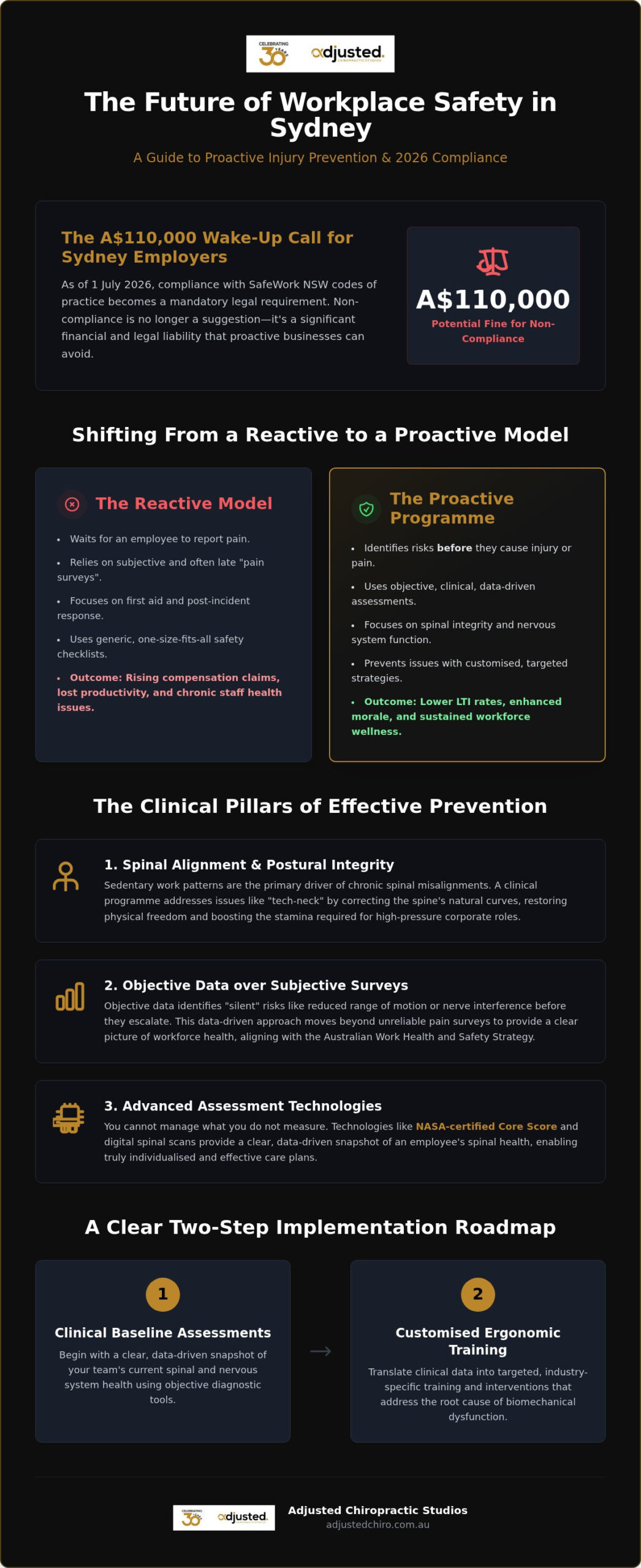
Did you know that as of July 2026, failing to meet SafeWork NSW codes of practice is no longer just a suggestion, it is a legal liability that could cost your firm up to A$110,000? Implementing a sophisticated workplace injury prevention program sydney is no longer just about ticking boxes; it is about safeguarding your team’s physical freedom and your company’s bottom line. We recognise the pressure Sydney employers face, from rising workers’ compensation premiums to the quiet productivity drain caused by “desk-bound” musculoskeletal issues. It’s often overwhelming to balance strict legislative compliance with a genuine desire to see your staff thrive.
You can protect your workforce and significantly reduce claims by moving beyond generic safety checklists toward clinical, data-driven injury prevention strategies. We’re here to show you how to turn clinical expertise into corporate stability. This 2026 resource explores how to integrate objective diagnostic tools, such as Core Score technology, and ergonomic insights to lower your LTI rates, boost morale, and ensure your business remains a leader in workplace wellness.
Key Takeaways
- Understand the 2026 SafeWork NSW regulatory shift, where adhering to clinical codes of practice is now a mandatory legal requirement for Sydney employers.
- Discover how a proactive workplace injury prevention program sydney identifies biomechanical dysfunction before it manifests as a costly workers’ compensation claim.
- Learn to move beyond basic safety checklists by focusing on spinal integrity and nervous system function to sustain long-term workforce productivity.
- Gain a clear, two-step implementation roadmap that begins with clinical baseline assessments and ends with customised ergonomic training for your specific industry.
- Explore how NASA-certified Core Score technology provides the objective data needed to prove the effectiveness of your wellness initiatives to stakeholders.
What is a Workplace Injury Prevention Programme in the Sydney Context?
The Economic Impact of Workplace Injuries in NSW
Regulatory Compliance and Duty of Care
The 2026 WHS legislative framework has significantly raised the bar for employer responsibility. As of July 1, 2026, approved codes of practice in NSW are legally enforceable, meaning businesses must either comply with these codes or prove their alternative safety measures are of an equivalent or higher standard. Every Person Conducting a Business or Undertaking (PCBU) now has a clearer, more rigorous duty of care to manage Occupational safety and health risks, including those related to spinal health and psychosocial hazards. A formal programme acts as a protective shield, guiding the organisation through complex regulations while fostering a culture of genuine care and professional excellence.
The Clinical Pillars of Effective Injury Prevention
Relying on subjective “pain surveys” is a common pitfall for many firms. These assessments depend on an employee’s personal perception of discomfort, which is often reported only after a problem has become chronic. To meet the goals of the Australian Work Health and Safety Strategy, employers must transition toward objective, clinical data. This shift allows for the identification of “silent” risks, such as reduced range of motion or nerve interference, before they manifest as a formal workers’ compensation claim. Integrating adjacent disciplines like podiatry and nutrition further strengthens this holistic model, ensuring that physical stability is supported by proper biomechanics and metabolic health.
Spinal Alignment and Postural Integrity
Sedentary work patterns are the primary driver of chronic spinal misalignments in the Sydney CBD. When staff spend eight hours a day hunched over laptops, the natural curves of the spine are compromised, leading to a phenomenon known as “tech-neck.” This postural crisis isn’t just about looking slumped; it places immense pressure on the cervical spine and surrounding nerves. For many professionals, incorporating adult chiropractic sydney is the first step in restoring this balance. It provides a corrective pathway that helps individuals regain their physical freedom and maintain the stamina required for high-pressure corporate roles.
Objective Assessment Technologies
You cannot manage what you do not measure. Clinical baseline testing provides a clear, data-driven snapshot of an employee’s current spinal health. Digital spinal scans are particularly effective here, as they reveal areas of stress and tension that a standard workplace safety walk would simply miss. While a safety walk might identify a chair height issue, a clinical assessment identifies how the individual’s body is actually responding to that environment. This investigative approach allows for individualised care plans that address specific biomechanical needs. If you’re ready to move toward a more precise model of care, you might consider how Core Score testing can provide the objective evidence your wellness program needs to succeed.
Comparing Prevention Models: Reactive vs. Proactive
Many Sydney firms fall into the trap of the traditional safety model: waiting for a staff member to report pain before providing treatment. This reactive approach is fundamentally flawed because, by the time symptoms appear, biomechanical dysfunction is often already deep-seated. In contrast, a proactive workplace injury prevention program sydney focuses on identifying these issues in their infancy. This investigative approach aligns with the goals of SafeWork NSW injury prevention programs, which encourage organisations to move beyond crisis management and toward a sustainable culture of health.
While some modern tools offer AI-based triage to manage incidents, these still operate after a problem has occurred. A clinical model, however, looks at the underlying causes of physical limitation, such as spinal misalignment or reduced joint mobility, before an injury manifests. One-off workshops often fail to create lasting change because they don’t address the ongoing physical stresses unique to the CBD professional. A sustained, clinical programme provides the regular assessments needed to ensure physical freedom is maintained over the long term, rather than just offering a temporary fix. For a deeper understanding of the specific spinal health challenges facing office-based staff, our chiropractor for desk workers sydney checklist outlines the key warning signs every employer should know.
The Myth of the Ergonomic Fix
It is a common misconception that an expensive chair or a standing desk is a complete solution for back pain. While high-quality equipment is beneficial, it cannot fix a misaligned spine or poor neural communication. An ergonomic chair is only as effective as the person sitting in it. This is why office ergonomics training sydney is an essential partner to any equipment upgrade. We must focus on the “user” by educating them on how to maintain postural integrity, rather than simply relying on the “tools” to do the work for them.
Strategic Health Investment vs. Cost
Viewing injury prevention as a cost rather than an investment is a risky perspective for any PCBU. The financial burden of a single long-term claim often far outweighs the expenditure required for a robust workplace injury prevention program sydney. Regular clinical health checks act as an early warning system, significantly reducing the frequency and severity of musculoskeletal issues. For firms looking to navigate these decisions, our workplace ergonomics training sydney buying guide offers a clear pathway for procurement. By prioritising clinical assessment over generic wellness perks, Sydney businesses can secure both their employees’ health and their own financial stability.
Implementing Your Sydney Workplace Health Programme
Tailoring for the Sydney CBD Office
The high-performance nature of the Sydney corporate environment demands a specific type of care. Stressors like long-distance commutes and high-pressure deadlines often manifest as physical tension in the neck and shoulders. To be effective, a workplace injury prevention program sydney must be scheduled to minimise disruption to the working day, fitting seamlessly into the rhythm of a busy CBD firm. Mastering workplace posture sydney is a daily practice, not a one-time event, and it requires consistent clinical support to become a permanent habit among staff.
Engaging Employees in the Process
For a programme to truly take root, staff must feel a sense of ownership over their own health. We foster this through educational workshops that teach spinal self-care and the importance of nervous system function. This holistic wellness culture is further supported by integrating nutrition and podiatry, ensuring that every aspect of physical vitality is addressed. When employees understand the link between their physical freedom and their professional success, they become active partners in the journey. If you’re ready to transform your office culture, our Corporate Health Training provides the expert guidance your team deserves.
Adjusted Chiropractic: 30 Years of Sydney Corporate Excellence
Since 1994, Adjusted Chiropractic Studios has served as a steady, reliable guide for the Sydney professional community. Led by Dr. Adrian Couzner, our practice has spent three decades refining a clinical approach that addresses the unique physical demands of CBD life. We understand that a workplace injury prevention programme sydney must be as sophisticated as the firms it serves. By blending seasoned expertise with a patient-centric philosophy, we help businesses move beyond temporary fixes toward long-term stability and the restoration of physical freedom for every team member.
The Power of Core Score Scanning
One of the most significant challenges for Sydney employers is finding objective data to justify health investments to stakeholders. We solve this through NASA-certified Core Score technology. This diagnostic tool allows us to provide each employee with an objective “Stress Score”, revealing how their nervous system is coping with the daily physical and mental demands of their role. It identifies “silent” risks that subjective surveys miss, such as nerve interference or reduced autonomic function. When these scans indicate a high level of neural stress, we can create a precise roadmap for an individual spinal adjustment sydney. This data-driven clarity ensures that your resources are directed exactly where they are needed most, providing a clear ROI through improved workforce vitality.
Starting Your Journey to a Healthier Workforce
The path to a more resilient office begins with an initial corporate health evaluation. During this investigative phase, we assess the specific needs of your firm and determine how to best customise our allied health services, including podiatry and nutrition, to support your team. Whether your staff requires better biomechanical support through podiatry or metabolic energy through nutritional guidance, we ensure every aspect of their health is addressed. We invite you to take the first step toward a more productive, injury-free environment. Enquire about our Corporate Health Training today and discover how 30 years of clinical excellence can transform your Sydney workplace.
Transforming Corporate Health into Clinical Stability
Navigating the 2026 WHS landscape requires a shift from reactive first aid to a proactive, clinical foundation. By prioritising spinal integrity and using objective diagnostic data, your firm can protect its bottom line while fostering a culture of genuine physical freedom. Implementing a comprehensive workplace injury prevention program sydney is the most effective way to reduce absenteeism and meet the latest SafeWork NSW standards with confidence.
With over 30 years of Sydney CBD experience, Dr. Adrian Couzner and the team at Adjusted Chiropractic Studios function as your expert partners in health. We utilise NASA-certified Core Score technology to move beyond subjective surveys, providing the precise data needed to ensure your team thrives. It is time to replace uncertainty with a methodical approach to long-term wellness. Contact our Sydney CBD studio to discuss a tailored Corporate Health Training programme for your team. We look forward to helping you build a more resilient and productive workforce.
Frequently Asked Questions
What are the legal requirements for workplace injury prevention in NSW for 2026?
Legal requirements in NSW for 2026 include the strict enforceability of approved codes of practice as of July 1. This means your business must either follow these codes or demonstrate that your alternative safety measures provide an equivalent or higher standard of care. Failing to comply can result in significant financial penalties, with fines for large employers reaching up to A$110,000 for serious breaches.
How much does a workplace injury prevention programme typically cost for a Sydney CBD office?
The investment for a workplace injury prevention program sydney depends on the size of your team and the clinical depth required for your specific industry. While we don’t provide a generic price list, most Sydney CBD firms find that the reduction in workers’ compensation premiums and absenteeism far outweighs the initial programme cost. It’s a strategic move that shifts expenditure from reactive injury management to proactive health preservation.
Can chiropractic care be part of a formal WHS injury prevention strategy?
Chiropractic care is an essential component of a modern WHS strategy, particularly when addressing musculoskeletal risks. Since body stressing is the leading cause of serious claims in New South Wales, focusing on spinal integrity helps resolve the underlying biomechanical issues that lead to injury. A clinical approach ensures that staff aren’t just following a checklist but are physically capable of performing their roles without discomfort.
How do you measure the ROI of a corporate health programme?
You measure the ROI by tracking specific health outcomes and financial metrics over a set period. Key performance indicators include a reduction in Lost Time Injury (LTI) rates, lower workers’ compensation premiums, and a decrease in staff absenteeism. Using objective diagnostic tools allows you to see the physical improvement in your workforce, providing clear evidence that your health investment is yielding tangible business results.
What is the difference between an ergonomic assessment and a clinical spinal scan?
An ergonomic assessment focuses on the external environment, such as the height of a chair or the position of a monitor. A clinical spinal scan, however, investigates the internal health of the individual by measuring nervous system function and spinal alignment. While ergonomics provides the right tools, a clinical scan ensures the person using those tools has the physical stability to remain healthy and productive.
How long does it take to see results from a workplace health programme?
Most firms notice an immediate lift in employee morale and postural awareness once a programme is introduced. Measurable clinical results, such as improved spinal mobility and reduced reports of chronic discomfort, typically become evident within three to six months. This progressive improvement reflects a steady journey toward long-term wellness rather than a superficial, temporary fix.
Do these programmes cover remote or hybrid workers in Sydney?
What happens if an employee is already suffering from a chronic back injury?
Employees with chronic back injuries require a personalised, clinical pathway to prevent their condition from worsening. A robust workplace injury prevention program sydney identifies these individuals through baseline testing and provides them with specific corrective strategies. This investigative approach helps the business manage its risk while supporting the employee’s journey back to full physical freedom and workplace participation. Employees in this situation may also benefit from reviewing our dedicated guide for desk workers seeking chiropractic care in sydney, which outlines the practical steps toward rebuilding spinal resilience.