

The persistent glow of a screen is the backdrop to modern life, especially in a bustling hub like Sydney’s CBD. From the morning commute on the T8 train to late-night emails, our devices are constant companions. But this digital dependency comes at a physical cost: a forward-leaning posture that strains the neck and spine, a condition now universally known as "text neck." For many Sydney professionals, what begins as a minor ache can evolve into chronic pain, tension headaches, and even long-term structural changes.
This is more than just poor posture; it’s a neurological and structural shift demanding a sophisticated approach. Simply stretching or "sitting up straight" often isn’t enough to reverse the damage. Effective text neck treatment in Sydney requires a deep understanding of spinal biomechanics, precise diagnostics, and a corrective strategy that addresses the root cause, not just the symptoms. This guide explores the science behind text neck, evaluates modern treatment options, and outlines a clinical pathway toward lasting posture correction.
Understanding Text Neck: The Growing Epidemic in Sydney’s CBD
In the context of our hyper-connected lives, "Text Neck" has become the shorthand for a repetitive stress injury. Clinically, it refers to forward head posture, where the head juts forward, placing the cervical spine under excessive and unnatural strain. As we tilt our heads down to look at phones, tablets, and laptops, the weight that our neck and shoulders must support increases exponentially, leading to a cascade of physiological problems.
- Defining "Text Neck": It is a state of forward head posture caused by the habitual downward gaze at digital devices. This posture forces the cervical spine out of its natural, gentle curve, straining the muscles, ligaments, and discs of the neck.
- Why Sydney Professionals Are at Higher Risk: The daily "commuter posture"—hunching over a phone on a crowded train or bus—compounded by long hours at a desk creates a perfect storm for developing text neck. The high-pressure environment of the CBD often leads to physical tension, which further exacerbates postural issues.
- The Physiological Shift: A healthy cervical spine has a lordotic curve (a gentle C-shape) that acts as a natural shock absorber. Text neck gradually straightens and can even reverse this curve, leading to increased pressure on the vertebral discs and nerve roots.
- Common Symptoms: The most obvious symptom is neck and shoulder pain. However, text neck can also manifest as chronic tension headaches, jaw pain (TMJ dysfunction), numbness or tingling in the arms and hands, and a visible rounding at the base of the neck.
The "Invisible" Symptoms of Text Neck
While neck pain is the primary complaint, the consequences of forward head posture extend throughout the body, often in ways people don’t immediately connect to their necks. These "invisible" symptoms can significantly impact overall health and quality of life.
- Reduced Lung Capacity: A forward, hunched posture compresses the chest cavity, restricting the diaphragm’s movement. Research has shown this can reduce lung capacity by up to 30%, leading to lower oxygen intake, fatigue, and decreased physical stamina.
- Chronic Tension-Type Headaches: The suboccipital muscles at the base of the skull become chronically tight from supporting a forward head position. This tension can refer pain up into the head, causing persistent headaches that often originate from the neck. For many, this is a key reason to seek migraine and chiropractic treatment in Sydney.
- The "Dowager’s Hump": Over time, the body may deposit a pad of fat and fibrous tissue at the C7 vertebra (the bony bump at the base of your neck) to protect the stressed area. This formation, known as a Dowager’s Hump, is becoming increasingly common in younger adults due to prolonged screen time.
Why Sydney CBD Workers are Most at Risk
The unique lifestyle of a Sydney CBD professional creates a specific set of postural challenges that accelerate the onset and severity of text neck. It’s a combination of environment, technology, and stress.
- The Commuter Strain: The daily commute on packed trains like the T8, T9, and T10 lines often involves standing or sitting in cramped positions, invariably with the head tilted down at a screen. This hour-long (or more) daily ritual ingrains poor posture.
- Dual-Screen Setups: Modern workstations with multiple monitors encourage repetitive neck rotation and strain. If not configured correctly, this setup can force the neck into awkward, sustained positions, leading to muscle imbalances and joint fixation.
- The Physical Toll of Stress: The high-pressure demands of CBD corporate life often manifest physically. Stress causes muscles, particularly the trapezius and neck extensors, to tighten, pulling the head forward and down, compounding the effects of poor ergonomics.
The Physics of Posture: Why Your Head Feels Heavier Than It Is
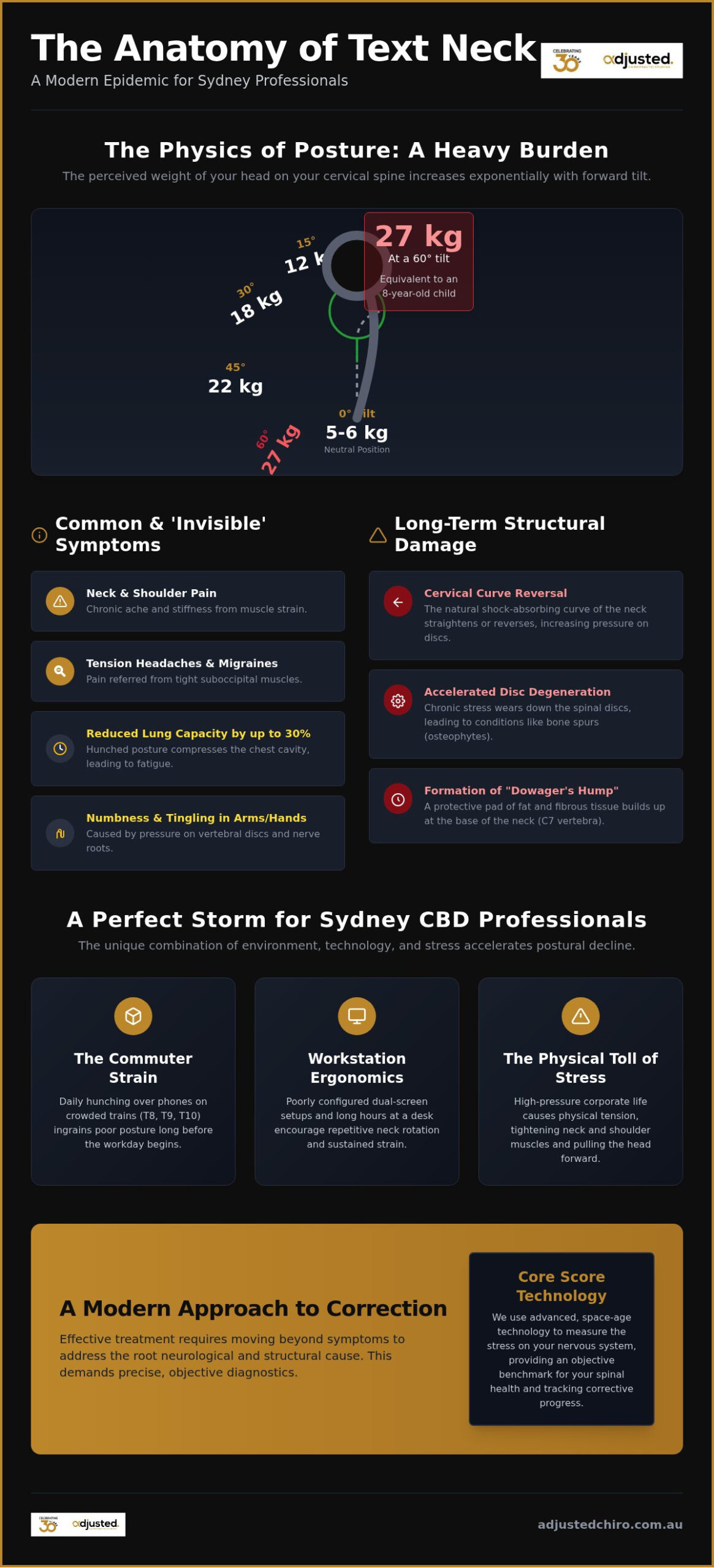
The human head is heavy, weighing approximately 5 to 6 kilograms in a neutral position. However, the principles of physics dictate that the perceived weight on your cervical spine increases dramatically as your head moves forward. This is not just a muscular issue; it’s a profound neurological and structural burden that your body is not designed to withstand long-term.
- The Lever Principle: For every centimetre your head moves forward from its ideal alignment over your shoulders, the load on your cervical spine effectively doubles. A 15-degree forward tilt makes your head feel like it weighs 12kg. At 60 degrees—the typical angle for looking at a phone in your lap—the strain on your neck is a staggering 27kg.
- Neurological Impact: The constant tension on the spinal cord and nerve roots alters proprioception—your brain’s sense of your body’s position in space. Your brain starts to accept this forward posture as "normal," making it harder to self-correct and affecting your balance and coordination.
- Long-Term Structural Changes: The body adapts to chronic stress. This can lead to the formation of bone spurs (osteophytes) as the vertebrae try to stabilise themselves, accelerated disc degeneration, and the thickening of supporting ligaments, all of which reduce mobility and can lead to nerve compression.
- Introducing Core Score: To truly understand the neurological impact, we need to look beyond what’s visible. We use advanced, space-age technology called Core Score to measure the stress on your nervous system, providing an objective benchmark for your spinal health.
The 27-Kilogram Strain
It can be difficult to grasp the severity of a 27kg load on your neck. This is not a fleeting pressure; for many, it’s a sustained force endured for several hours each day. Visualising this strain helps clarify why text neck is a serious clinical concern.
- Visualising the Strain: A 27-kilogram load is equivalent to carrying an average 8-year-old child on your neck. Imagine maintaining that posture for the two, three, or even four hours a day that many people spend on their phones.
- Stretching the Spinal Cord: This constant forward load places the spinal cord and its delicate nerve roots under sustained mechanical tension, interfering with the vital communication between your brain and your body.
- The cervical curve is designed to act as a spring-like shock absorber, distributing the weight of the head evenly through the spine.
NASA-Certified Diagnostics in Sydney
A physical examination can identify postural deviations, but it cannot quantify the underlying neurological stress. To achieve genuine, lasting correction, we need objective data that shows us precisely how your nervous system is functioning under postural load. This is where advanced diagnostic technology becomes essential.
- Seeing What a Physical Exam Misses: We use Core Score scanning, which incorporates technology certified by the Space Foundation, to measure nerve activity along the spine. This allows us to pinpoint areas of interference and stress that are the root cause of symptoms like pain and stiffness.
- Measuring Nervous System Efficiency: The scan provides an "Efficiency" score, showing how much energy your body is wasting to maintain its current state. Poor posture is energetically expensive, and this data helps us track your progress toward a more efficient, healthier state.
- The Gold Standard for Correction: Digital scanning provides the baseline and objective metrics necessary for a truly corrective care plan. It is the gold standard for anyone seeking comprehensive posture correction in Sydney, moving treatment from guesswork to a data-driven science.
Evaluating Posture Correction Options in Sydney
When seeking treatment for text neck, Sydney residents are faced with numerous options, from physiotherapy and massage to DIY stretches and posture braces. While many approaches can provide temporary relief, understanding their focus and limitations is crucial for achieving long-term structural correction.
- Chiropractic Care vs. Physiotherapy: While there is overlap, the core focus differs. Physiotherapy often excels at rehabilitating injured muscles and improving function through exercise. Corrective chiropractic care focuses on restoring proper motion and alignment to the spinal joints, which in turn alleviates nerve interference and allows the muscles to function correctly.
- The Limitation of "Posture Braces": Braces can serve as a temporary reminder to sit up straight, but they act as a crutch. They don’t strengthen the deep postural muscles needed for sustained correction and can lead to muscle dependency and weakness over time.
- Why "Cracking Your Own Neck" is Dangerous: Forcing a "crack" in your own neck often moves the joints that are already hypermobile (moving too much), while leaving the fixated, misaligned joints untouched. This can accelerate instability and worsen the underlying problem.
Chiropractic Adjustments vs. Soft Tissue Therapy
Massage and other soft tissue therapies feel good because they address the muscular symptoms of text neck. However, if the underlying spinal alignment is not corrected, the muscles will inevitably tighten up again as they continue to compensate for the structural imbalance.
- Restoring Joint Mobility: A spinal adjustment in Sydney is a precise technique designed to restore movement to spinal joints that have become "stuck" or fixated. No amount of exercise or massage can restore mobility to a misaligned joint; this requires a specific, targeted adjustment.
- Re-training the Brain: Corrective adjustments provide powerful feedback to the brain, helping to reset its perception of "normal" posture. This process, known as neuroplasticity, is essential for re-training your body to hold a healthier alignment automatically.
- When to Choose a Chiropractor: For chronic text neck issues where pain persists despite stretching and exercise, a chiropractor is best equipped to assess and correct the underlying structural and neurological components of the problem.
The Danger of the "Quick Fix"
In our fast-paced culture, the allure of a quick fix is strong. However, when it comes to spinal health, shortcuts often lead to bigger problems down the line. A sustainable solution requires addressing the root cause, not just masking the symptoms.
- Masking the Problem with Medication: Pain relievers and anti-inflammatories can reduce discomfort, but they do nothing to correct the mechanical strain on your spine. The underlying structural problem continues to worsen while the warning signals (pain) are silenced.
- Risks of Unguided Stretching: Stretching an already unstable cervical spine can be counterproductive. Without a proper assessment, you may be stretching ligaments that need to be stable, further contributing to instability and long-term damage.
- The Wise Mentor Approach: A truly corrective approach focuses on long-term stability. Our philosophy centres on a 12-month vision for spinal health, not just 20 minutes of temporary relief. We act as your mentor, educating and empowering you to build a foundation for lifelong wellness.
How to Correct Text Neck: A Step-by-Step Guide for Sydney Professionals
Reversing text neck involves a combination of professional care and conscious daily habits. This step-by-step guide provides a framework for Sydney professionals to reclaim their posture and protect their spinal health for the long term.
- Step 1: The Professional Ergonomic Audit: Your workstation is a primary battleground for posture. A professional assessment can help you set up your desk, chair, and monitors to support a neutral spine, reducing daily strain.
- Step 2: The "Eye-Level" Rule: Whether you’re using a phone, tablet, or laptop, make a conscious effort to bring the device up to eye level. This simple act prevents the downward head tilt that causes text neck. Use a stand for your laptop and hold your phone up in front of your face.
- Step 3: Micro-Break Protocols: The human body isn’t designed for static positions. Use the 20/20/20 rule: every 20 minutes, look at something 20 feet (about 6 metres) away for 20 seconds. This relaxes your eye muscles and provides a prompt to reset your posture.
- Step 4: Clinical Assessment: You can’t fix what you don’t measure. The crucial first step in any effective treatment plan is a comprehensive clinical assessment, including advanced spinal scanning, to establish your objective baseline.
- Step 5: Corrective Exercises: Once your spine is moving correctly, specific exercises can strengthen the muscles needed to maintain good posture. The focus should be on endurance and control, not just brute strength.
Sydney Office Ergonomics 101
Creating a spine-friendly workspace is one of the most powerful preventative measures you can take. Small adjustments can yield significant long-term benefits for your neck and overall health.
- Chair Height and the Lumbar-Cervical Link: Adjust your chair so your feet are flat on the floor and your knees are at or slightly below hip level. Proper lumbar (lower back) support is critical, as a slouched lower back forces your head and neck forward.
- The Standing Desk Caveat: Standing desks can be excellent for reducing sedentary time, but if your monitor is too low, you’ll simply be standing with text neck. Ensure your screen is at eye level, regardless of whether you are sitting or standing.
- Optimal Monitor Height: The top of your computer monitor should be at or slightly below eye level. This encourages a neutral neck position, preventing the downward gaze that strains the cervical spine. For more tips, explore this guide on office ergonomics training in Sydney.
The "Text Neck" Exercise Routine
These simple exercises, when performed consistently, can help counteract the effects of daily screen time by strengthening key postural muscles. They should be done gently and without pain.
- Chin Tucks: The cornerstone of correcting forward head carriage. Sit or stand tall, look straight ahead, and gently draw your head backward as if making a double chin, keeping your gaze level. Hold for 5 seconds and repeat 10 times.
- Scapular Squeezes: This movement opens the chest and strengthens the muscles between your shoulder blades, which provide the foundational support for your neck. Sit or stand tall, and gently squeeze your shoulder blades together and down. Hold for 5-10 seconds and repeat.
- The Brugger Relief Position involves sitting at the edge of your chair, opening your legs slightly, resting your weight on your legs, tilting your pelvis forward to create a lumbar curve, lifting your sternum, and externally rotating your arms with palms facing up to instantly reset your posture.
The Adjusted Chiropractic Approach to Text Neck Treatment
At Adjusted Chiropractic, we combine over three decades of clinical experience with cutting-edge technology to provide a text neck treatment solution that is both comprehensive and personalised. Our approach is built on the philosophy of being a "wise mentor" for your health journey, guiding you from relief to lasting correction and lifelong wellness.
- Our 30-Year History: For over 30 years, we have been a trusted health partner for Sydney’s desk-bound workforce. We understand the unique postural challenges faced by CBD professionals and have refined our methods to deliver effective, lasting results.
- The Initial Consultation: Our process begins with a thorough consultation and assessment that goes beyond your symptoms. We use tools like Core Score scanning to identify the root structural and neurological cause of your text neck. Find out more about what to expect at your first chiropractic visit.
- Personalised Care Plans: There is no one-size-fits-all solution. Your care plan is tailored to your specific scan results, lifestyle, and health goals, combining precise spinal adjustments with targeted advice on ergonomics, nutrition, and even podiatry.
- The "Wise Mentor" Philosophy: Our goal is not just to treat your pain but to empower you with the knowledge and tools to maintain your spinal health for life. We educate you on the "why" behind your condition and the "how" of preventing its return.
From the Ground Up: How Podiatry Impacts Your Neck
A truly holistic approach to posture recognises that the body is an interconnected system, or kinetic chain. Imbalances in your foundation—your feet—can have a direct and significant impact on the alignment of your head and neck.
- The Kinetic Chain: Issues like flat feet or poor foot mechanics cause a chain reaction up the body. Your knees, hips, and pelvis may rotate inward to compensate, causing your shoulders to round and your head to shift forward to maintain balance.
- In-House Podiatry Services: Our integrated approach includes in-house podiatry services. By addressing foundational imbalances with custom orthotics or specific exercises, we support and enhance the stability of your spinal corrections.
- Benefits of a Holistic Evaluation: A comprehensive health evaluation in our Sydney CBD centre ensures no stone is left unturned. We look at your spine, your nervous system, your foundation, and your lifestyle to create the most effective path to wellness.
Our commitment is to your long-term health. We prioritise care that not only resolves your current symptoms but also builds a more resilient and adaptable body for the future.
- Corrective Care vs. Relief Care: "Relief Care" is about temporarily reducing pain. "Corrective Care" is about fixing the underlying structural problem to prevent the pain from coming back. Our focus is firmly on the latter.
- The Role of Nutrition: Chronic inflammation can worsen joint pain and slow down the healing process. We provide nutritional guidance to help you reduce systemic inflammation, support healthy disc tissue, and improve your overall well-being.
- Begin Your Journey: Taking the first step is simple. If you are ready to move beyond temporary fixes and invest in a long-term solution for your posture and health, we invite you to start your journey with an experienced chiropractor in Sydney.
Book Your Posture Assessment at Adjusted Chiropractic Studios Today
Frequently Asked Questions (FAQs)
How do I know if I have text neck?
Common signs include persistent neck and shoulder pain, stiffness (especially after using a device), chronic headaches originating from the base of the skull, and a visible forward head posture when viewed from the side. You may also notice a developing "hump" at the base of your neck or experience tingling in your arms and hands.
Can a chiropractor actually fix my posture?
Yes, a corrective care chiropractor can play a crucial role in fixing posture. By using specific spinal adjustments to restore proper joint mechanics and motion, chiropractic care addresses the structural root of poor posture. This is combined with targeted exercises and ergonomic advice to retrain your body to hold a healthier alignment.
How long does text neck treatment take in Sydney?
The duration of treatment varies depending on the severity of the condition, how long it has been present, and the patient’s commitment to the care plan. Initial relief can often be felt within a few weeks, but structural correction is a process that typically takes several months to a year to achieve lasting stability.
Are text neck exercises safe to do at home?
Basic exercises like chin tucks and scapular squeezes are generally safe. However, it is always best to have a professional assessment first. An unstable or inflamed spine can be aggravated by the wrong movements. A chiropractor can provide a diagnosis and recommend exercises that are specifically suited to your condition.
Does text neck cause permanent damage if left untreated?
Yes, if left untreated, the chronic strain of text neck can lead to permanent structural changes. This includes accelerated degenerative disc disease, the formation of bone spurs (arthritis), and permanent ligamentous deformity, which can lead to chronic pain, reduced mobility, and potential nerve compression issues.
Is text neck treatment covered by private health insurance in Australia?
Chiropractic care is included in the "extras" cover of most Australian private health insurance policies. The amount of rebate you receive will depend on your specific fund and level of cover. You will be provided with a detailed receipt to submit directly to your health fund for reimbursement.
What is the best way to hold my phone to prevent neck pain?
The best way is to bring the phone up to eye level, rather than tilting your head down to see it. Hold the phone in front of your face with a slight bend in your elbows. When sitting, you can rest your elbows on a table or on your torso to support the weight of your arms, making it easier to maintain this position.