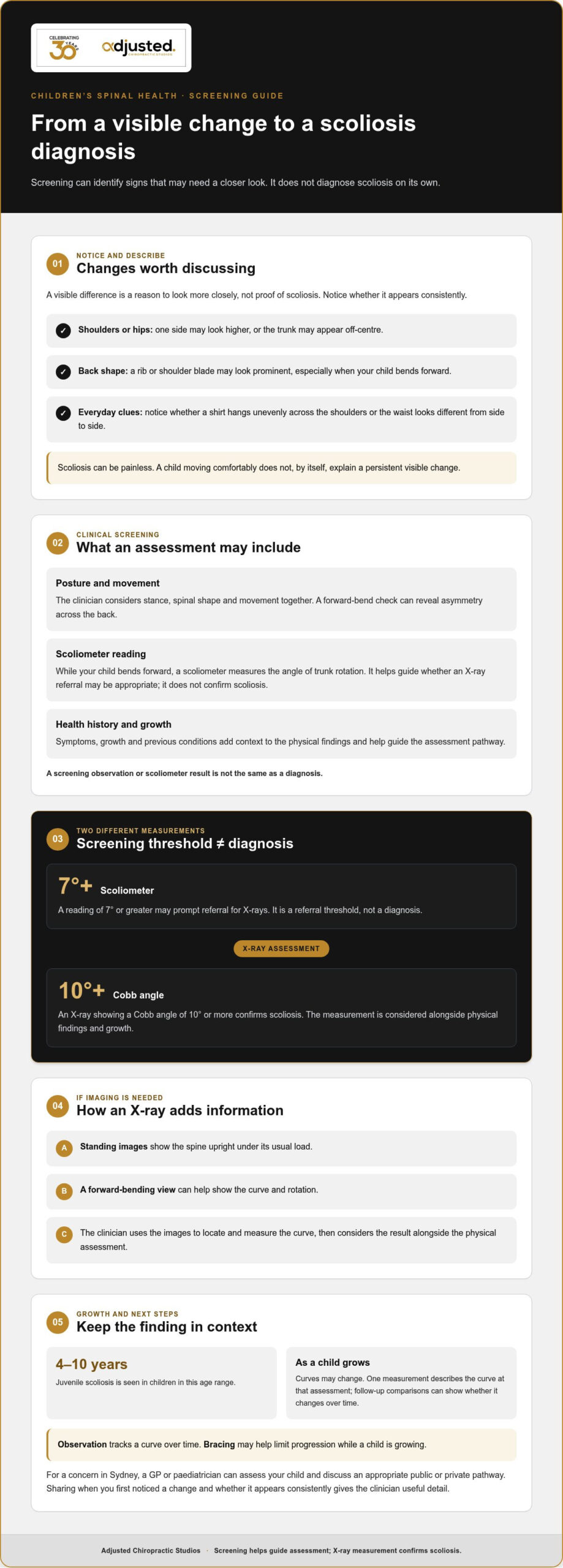
A visible difference in your child’s shoulders or back can be a reason to look more closely, but screening alone doesn’t diagnose scoliosis. In scoliosis screening for children in Sydney, an assessment may include observing posture and a forward-bend check; a scoliometer reading of 7° or greater may prompt referral for X-rays. Scoliosis is confirmed when an X-ray shows a Cobb angle of 10° or more.
It’s understandable to wonder whether uneven shoulders, a prominent shoulder blade or a change in posture is simply part of growing. Scoliosis can be painless, so knowing which signs deserve attention can help you respond calmly and seek an assessment when appropriate.
This article explains what early screening can and can’t tell you, what checks may be involved and how clinicians decide whether an X-ray is warranted. You’ll also learn why growth spurts matter and how a screening finding differs from a diagnosis.
Key Takeaways
- Uneven shoulders or hips, a prominent rib or shoulder blade, and changes seen when bending forward can be signs to discuss during an assessment.
- A forward-bend check and scoliometer reading help assess trunk asymmetry, but neither confirms scoliosis on its own.
- A scoliometer reading of 7° or greater may lead to an X-ray referral; a Cobb angle of 10° or more on X-ray confirms scoliosis.
- Growth spurts can be a time when spinal curves progress, so changes in posture are worth noticing even when a child has no pain.
- Learn how screening findings guide the next steps, including when monitoring or further assessment may be appropriate.
Why Does Early Scoliosis Screening Matters?
Uneven shoulders or hips, a prominent rib or shoulder blade, and a trunk that appears off-centre can prompt a closer look at a child’s spine. These signs may be subtle, and scoliosis can occur without pain. A child who runs, plays and moves comfortably may still have a visible change worth discussing at an appointment.
Notice whether a difference appears consistently. For example, compare how a shirt hangs across the shoulders, whether the waist looks uneven, or whether one side of the back rises when your child bends. These observations don’t establish a diagnosis, but they give you clear examples to describe when arranging an assessment.
Age and growth provide useful context. Juvenile scoliosis is seen in children aged 4 to 10 years, while curves may change as a child grows. A curve that goes unnoticed can progress beyond 40-50°. Early identification can therefore help clarify whether a finding needs monitoring or further clinical assessment.
Monitoring, bracing and surgery have different purposes. Observation tracks a curve over time; bracing may help limit progression while a child is growing; surgery is considered for severe curves. The appropriate pathway depends on the curve and the child’s growth, not on a visible sign alone.
Families in Sydney can raise a concern with a GP or paediatrician, who can assess the child and discuss an appropriate public or private pathway. A school information sheet can help parents recognise possible signs, but you can also discuss a concern directly with a clinician.
When speaking with a clinician, describe when you first noticed the change and whether it appears consistently. A note such as “one shoulder looked higher in recent family photos” is more useful than a general concern about posture. Mention any back discomfort or changes in movement, even though scoliosis may be painless.
Screening identifies signs that may need closer assessment; it doesn’t predict how a curve will develop. Visible asymmetry can have different explanations, so a finding needs to be considered alongside the child’s growth and health history. This helps families respond thoughtfully without assuming every uneven shoulder means scoliosis.
Early attention is most useful when a specific observation leads to an appropriate next step. If you notice a persistent change in your child’s back or posture, write down what you see and discuss it at an appointment. Clear details help the clinician understand your concern and decide what assessment is appropriate.
Physical and neurological diagnosis
A physical assessment helps distinguish a spinal curve from uneven posture or shoulder height. The clinician considers the child’s stance, spinal shape and movement together, rather than treating one visual difference as proof. A forward-bending assessment can reveal asymmetry across the back, while a health history adds context about symptoms, growth and previous conditions.
Scoliosis affects the spine in three dimensions, so the visible curve is only part of the picture. A clinician may consider trunk rotation and whether the shoulders, ribs or pelvis appear uneven. These observations help determine whether imaging is needed; they don’t measure the spinal curve precisely.
A neurological assessment looks for signs that may suggest a problem beyond spinal alignment. The clinician may ask about changes in sensation, strength, coordination or walking, and whether symptoms affect daily activities. A child’s history of cerebral palsy or another diagnosed condition is relevant, as different underlying causes can change the assessment pathway.
An X-ray is used to measure the curve and support a diagnosis. The Cobb angle is calculated from the angle between selected vertebrae on the image. A Cobb angle of 10° or more confirms scoliosis. This measurement gives clinicians a consistent way to describe curve size, but it is considered alongside the child’s growth and physical findings.
Diagnosis may involve spinal X-rays. Standing images show the spine upright under its usual load, while a forward-bending view can help display the curve and rotation. The clinician uses the images to locate the curve, measure its angle and compare the findings with the physical assessment.
Imaging is different from screening. A postural observation or scoliometer reading can raise a concern, but an X-ray provides the Cobb angle used to confirm scoliosis. This explains why an initial check may lead to a referral rather than an immediate diagnosis.
For an adolescent, clinicians also consider whether the spine is still growing, because growth can affect how a curve changes. A single measurement describes the curve at that assessment; follow-up comparisons can show whether it changes over time. Examination, imaging and growth context together guide decisions about monitoring or further care.
Physiotherapy or rehabilitation may be discussed as part of a care plan, depending on the child’s needs and clinical findings. These approaches don’t replace diagnostic imaging when the Cobb angle needs to be measured. Unusual neurological symptoms alongside a spinal curve also inform the next steps in assessment.
Scoliometer readings and X-ray referral
A scoliometer helps assess trunk rotation during screening, but it cannot confirm scoliosis. The reading and physical findings help guide whether an X-ray referral is appropriate.
Scoliometer Readings
A scoliometer measures the angle of trunk rotation when a child bends forward. A reading of 7° or greater is a threshold for referral for X-rays, not a diagnosis of idiopathic scoliosis. A clinician considers the measurement with the examination and the child’s growth. This helps distinguish a screening result from evidence of a spinal curve.
When X-rays Are Needed
An X-ray may follow screening when the reading or examination raises enough concern to measure the spinal curve. The 7° referral threshold helps avoid treating every uneven posture as a reason for imaging. It also supports a targeted decision about whether an X-ray can clarify diagnosis or guide follow-up.
To avoid unnecessary radiation exposure, imaging isn’t automatic after every screening; referral depends on the clinical findings. The need for an X-ray is weighed against whether it will answer a relevant question, such as whether a curve is present and how large it is.
Referral After a Positive Screen
A positive screen means further assessment is warranted, not that scoliosis has been confirmed. Australia’s National Scoliosis Detection Program advises girls or parents who suspect a spinal curve after reading its fact sheet to seek GP follow-up. A GP can review the findings and arrange further assessment when appropriate.
If imaging identifies a curve, referral to an orthopaedic specialist may help assess its size, growth-related progression and management options. Radiologist education in the national program supports decisions about specialist referral for small spinal curves below 20°. The next step depends on the clinical findings, rather than the screening result alone.
For families, the practical sequence is straightforward: a screening observation prompts review, a raised scoliometer measurement may lead to X-rays, and imaging provides a curve measurement. A Cobb angle of 10° or more confirms scoliosis. The X-ray result then gives the GP or specialist more information than a surface observation can provide.
Bracing may be considered for skeletally immature patients with curves between 20-40°, while monitoring may suit milder curves. These figures describe different management contexts, not automatic outcomes from a screening. The X-ray measurement, the child’s remaining growth and evidence of progression inform the discussion.
A GP referral is a useful route when parents notice a change or receive a positive screening result. Bring any screening notes and describe when the asymmetry first appeared, such as a shoulder looking higher in school photos. These details put the finding in context with the child’s health history and inform the assessment.
Postural observation and the Adams forward bend test
In Sydney, scoliosis screening may combine posture checks, the Adams forward bend test and, sometimes, a scoliometer. These checks look for asymmetry but don’t confirm scoliosis on their own.
Postural Observation
Postural observation checks how a child’s shoulders, hips and trunk align while standing naturally. A visible difference can prompt a closer spinal assessment, even when the child feels well.
A clinician may compare shoulder levels and waist shape, then observe whether the trunk appears centred. For example, parents can mention a shoulder that looks higher in a family photograph. One observation alone doesn’t establish a diagnosis, but it can help guide the next check.
Adams Forward Bend Test
The Adams forward bend test is a screening check where a child leans forward to touch their toes with straight legs. It helps reveal whether both sides of the back appear even.
During the forward bend, the clinician observes the child’s back from behind, looking for one side to appear higher. This position may make trunk asymmetry easier to see than standing posture alone. The test is a screening method, not an X-ray measurement or confirmed diagnosis.
Scoliometer Screening
A scoliometer is a handheld tool used during forward bending to measure trunk rotation in degrees. It adds a recorded measurement to the visual assessment.
The reading can help indicate whether further assessment, such as an X-ray referral, may be appropriate. It doesn’t show the spinal curve itself or establish its cause. Clinicians interpret it alongside posture and the Adams test, not as a stand-alone diagnosis.
Each screening check provides different information. Postural observation notes alignment while standing; the Adams test looks for back asymmetry during bending; and a scoliometer records trunk rotation. Together, these methods describe what was observed and help determine whether further assessment should be considered.
A clinician may use a scoliometer after noticing asymmetry during the Adams test. This is one way scoliosis screening for children in Sydney can progress from visual observation to a recorded measurement. An even-looking back may not need this additional step.
For parents, the key distinction is between a screening sign and a diagnosis. The Adams test and scoliometer can identify asymmetry, while spinal X-rays measure a curve using the Cobb angle. If arranging scoliosis screening for children in Sydney, share a specific observation, such as unevenness during a forward bend, to give the clinician a clear starting point.
A doctor may diagnose scoliosis using a forward bending test in which the child leans forward to touch their toes with straight legs to check whether the back is even. In this position, the doctor can observe whether the back looks even or whether one side appears higher. This keeps the assessment focused on visible back symmetry while bent forward, alongside the standing observations and screening measurements described above. The observation remains a visual finding, distinct from the Cobb-angle measurement made on spinal X-rays.
Early scoliosis screening and identification
Early identification means noticing possible spinal changes during growth and responding with an appropriate assessment. In Sydney, school information and family observations can both bring a concern to a clinician’s attention.
Screening Age and Frequency
Australia’s National Scoliosis Detection Program targets girls aged 10-12 with information about scoliosis signs and the forward bend test. In most states and territories, scoliosis fact sheets are distributed to girls in Years 5 and 7, generally aged 10 and 12, each spring.
This information doesn’t set a schedule for repeated clinical checks. The program doesn’t recommend routine screening for boys unless there is a family history. Parents who notice a change or suspect curvature can raise it with a GP, whether or not a school handout has arrived.
School-Based Screening Programs
School-based scoliosis screening programmes began in many countries during the 1970s. In Australia, the cost of school screening had led to the abandonment of most government-school programmes by the early 1990s.
Australia’s National Scoliosis Detection Program provides school-based information through fact sheets rather than routine physical checks at school. It is endorsed by the Paediatrics and Child Health Division of the Royal Australasian College of Physicians. For New South Wales families, this distinction clarifies that school information supports awareness but doesn’t replace clinical assessment.
Growth is relevant because curves can progress during growth spurts. Scoliosis curves often progress most rapidly during growth spurts, usually at ages 10-12 for girls and 12-14 for boys. These ages provide context for parents noticing a change; they are not a diagnosis or a schedule requiring every child to be screened at fixed intervals.
A useful family observation is a difference that appears repeatedly, not a single moment when a child stands awkwardly. Note whether a postural change remains visible during ordinary activities or in family photographs. Share when you first noticed it and whether it has changed as your child grows.
Include family history and existing health conditions in the conversation. If a child has a known condition such as muscular dystrophy or cerebral palsy, tell the clinician when discussing a spinal concern. This context helps the clinician interpret the findings and decide what assessment is appropriate.
Exercises, bracing and surgery are management options, not screening tests. A screening observation alone doesn’t show that a child needs an intervention. Clinical assessment considers the child’s findings, growth and any evidence of curve progression before management options are discussed.
Puberty, typically around ages 10 to 15, is a higher-risk period for scoliosis in children. Because scoliosis is often not painful, changes may go unnoticed.
Adjusted Chiropractic Studios: Adult Chiropractic
Adjusted Chiropractic Studios offers Adult Chiropractic for adults seeking personalised support with spinal and musculoskeletal concerns. If your child’s screening raises questions, follow the assessment pathway outlined above. A chiropractic visit doesn’t replace GP follow-up or an X-ray referral when indicated.
For families considering Kids Chiropractic, care is tailored to the child’s needs and health history. A screening observation alone doesn’t establish a diagnosis, so keep any GP or specialist recommendations central to decisions about your child’s care.
If you’re an adult seeking support for your own spinal health, contact Adjusted Chiropractic Studios to discuss your needs and possible next steps.
Take a thoughtful next step for your family’s spinal health
Noticing a change in your child’s posture can leave you unsure what to do next. If you’re considering scoliosis screening for children in Sydney, use your observations to guide a calm conversation with your GP. For your own spinal health, Adjusted Chiropractic Studios offers Adult Chiropractic, Spinal Adjustments and Core Score Testing, with care tailored to your needs.
Children’s screening concerns and an adult’s musculoskeletal care are different needs, so follow the appropriate pathway for each. If you’d like to discuss your own care, contact Adjusted Chiropractic Studios. Taking a considered next step can help you feel more informed and supported.
Frequently Asked Questions
What does the current medical evidence say?
Current estimates state that 3 to 4% of Australians have scoliosis, and around 80% of cases are idiopathic, meaning their cause is unknown. Evidence supports distinguishing a screening observation from a confirmed diagnosis: screening can identify signs that need assessment, while X-rays measure spinal curvature. This helps families understand why a visible difference is a reason to follow up, not proof that a child has scoliosis.
Who is at risk of developing scoliosis?
Scoliosis can affect children of any gender, but girls are more likely than boys to develop severe curves. Curves can progress during growth spurts, often around ages 10-12 for girls and 12-14 for boys. A family history is also relevant, particularly when considering screening for boys. These factors help guide awareness, but they don’t establish whether an individual child has scoliosis.
What are the signs of scoliosis in children and when should parents seek screening?
Look for changes such as a shoulder or hip sitting higher, an uneven waist, or one side of the back appearing raised when your child bends. A child may have no pain, so don’t rely on symptoms alone. Raise a new or persistent change with a GP, especially during a growth spurt. A dated note or photograph can help you describe when you first noticed the difference.
How is scoliosis screening arranged through a GP or paediatrician in Sydney?
In Sydney, raise a concern with your child’s GP or paediatrician and describe the specific change you’ve noticed. Bring any school screening information and details about when the change appeared. The clinician can assess your child and decide whether imaging or specialist assessment is appropriate. Australia’s National Scoliosis Detection Program recommends GP follow-up when a girl or her parents suspect spinal curvature.