Can chiropractic genuinely help you perform better in sport, or might it support movement without changing your results? If you’re considering improving athletic performance with chiropractic, that uncertainty is reasonable. Moving more comfortably isn’t the same as running faster, lifting more or preventing injury.
Chiropractic care should not be treated as a guaranteed performance enhancer. What it may contribute depends on your needs, goals and how care fits alongside training, recovery and other health support. This article separates movement and comfort goals from claims about sporting results, explains how to assess those claims and outlines what to consider before adding care to your routine.
At Adjusted Chiropractic Studios in Sydney CBD, care starts with an individual assessment and a conversation about your health history, training demands and goals. Techniques are gentle and patient-comfort-focused. Adjustments also carry potential risks, so the chiropractor discusses the risks versus rewards before proceeding. This gives you a clearer basis for deciding whether chiropractic may suit your needs and how movement, posture and lifestyle guidance could fit your broader routine.
Key Takeaways
- Athletic performance includes skill, strength, endurance, coordination, recovery and training consistency, not just a single result.
- When considering improving athletic performance with chiropractic, distinguish support for movement and comfort from claims of better sporting results.
- Chiropractic assessment considers movement, posture and musculoskeletal function in the context of your sport and individual needs.
- Decide whether care fits your routine by clarifying your goal, sharing your health history, discussing the assessment and reviewing the proposed plan.
- At Adjusted Chiropractic Studios in Sydney CBD, personalised adult chiropractic care starts with your goals and assessment findings.
What does improving athletic performance with chiropractic actually mean?
Athletic performance is broader than a finish time or a personal best. It can include sport-specific skill, strength, endurance, coordination, recovery and the ability to train consistently. These aspects are shaped by many factors, including practice, training, rest and an athlete’s health.
In this article, improving athletic performance with chiropractic means considering chiropractic assessment or care as one part of an athlete’s wider plan, not assuming it will raise performance. Chiropractic care assesses spinal and musculoskeletal concerns in the context of a person’s symptoms and goals. It doesn’t replace sport-specific training, coaching or recovery planning.
Sports chiropractic describes chiropractic care in a sporting context. The label alone doesn’t establish that a particular approach improves measurable results. Focus instead on what is being assessed, the purpose of any proposed care and what the evidence can reasonably show.
Which parts of performance might relate to movement and comfort?
Mobility, posture and physical comfort may be relevant to how an athlete experiences sport. A runner needs to turn to check their surroundings, a swimmer reaches repeatedly, and a court-sport player changes direction. These examples don’t mean chiropractic will improve those movements. The demands of each sport, training history, health and personal goals differ, so relevance needs to be considered individually.
Comfort and performance are related questions, but they aren’t interchangeable. Feeling more comfortable during a movement is a personal experience. Demonstrating a sport-specific change requires an appropriate measure, such as comparing a relevant skill or result over time. Training load, technique, rest and other factors can also affect what you notice. Avoid attributing every change to one part of your routine without considering those influences.
Does chiropractic directly make athletes faster or stronger?
Chiropractic should not be presented as a reliable way to increase speed or strength. An athlete’s positive experience may be meaningful to them, but it isn’t the same as evidence of a measurable improvement in competition. Claims about injury prevention or faster recovery also need evidence that supports those specific outcomes.
If you’re considering an adjustment, base the decision on an individual assessment, not a promise of sporting advantage. Adjustments have potential risks, and the chiropractor discusses risks versus rewards before proceeding. This helps you weigh whether the proposed care is relevant to your concerns while keeping training and measurable sport goals in view.
How chiropractic may relate to athletic movement, function and performance
Chiropractic assessment may consider how your movement, posture and musculoskeletal function relate to your sport, symptoms and everyday demands. This provides context for discussing care. It does not mean that a particular movement pattern needs correcting or that an adjustment will change a result. For example, the demands of a recreational runner’s week differ from those of an athlete training for repeated overhead movements.
Care may be relevant to comfort or function, but that alone doesn’t prove improved sporting performance. Training, recovery, skill, health and the way a sport is practised all contribute to results. Any decision about care should sit alongside those factors, not in place of them.
What does evidence-aware language about chiropractic mean?
Evidence-aware wording describes a possibility without presenting it as a promised outcome. A chiropractor may assess a concern and discuss whether care could be relevant to comfort or function. That individual clinical assessment helps guide a conversation, but it isn’t research evidence that treatment improves a sporting result.
Personal reports matter to the person sharing them, yet they don’t establish what caused a change or whether it would occur for other athletes. Research findings are a separate type of evidence. Their relevance depends on what was studied, how outcomes were measured and which people took part. A claim about performance should be supported by evidence that relates to the outcome being described.
Why results and goals differ between athletes
A useful goal starts with your circumstances. Sport demands, training load, health history and current symptoms can all shape what you want to address. Someone returning to regular recreational exercise may prioritise moving comfortably through sessions, while an experienced competitor may focus on a particular movement relevant to their sport. Neither goal is a universal measure of athletic success.
It also helps to distinguish the intended focus from an outcome you can observe. If your concern relates to a movement during training, describe when it occurs and what you hope to do more comfortably. A personal goal can guide discussion and follow-up, but changes in performance may also reflect training, rest, technique or other factors. Avoid attributing a result to chiropractic alone without evidence supporting that conclusion.
For athletes in Sydney CBD, a personalised adult chiropractic assessment provides an opportunity to discuss movement concerns in the context of your wider routine. At Adjusted Chiropractic Studios, individual goals guide the conversation about care. Explore adult chiropractic care as one possible part of that discussion.
Chiropractic for athletes: weigh potential benefits against common assumptions
Chiropractic may be considered as one part of an athlete’s broader care when a musculoskeletal concern or movement goal is relevant. That doesn’t mean every athlete needs adjustments or that regular visits are necessary to perform well. The practical question is whether an assessment and proposed care plan fit your circumstances, not whether chiropractic should be part of every training programme.
Keep the purpose clear. Care may be discussed in relation to comfort or function, but it doesn’t replace sport-specific coaching, planned training, adequate recovery or other health support relevant to you. Claims that go further need evidence that matches the outcome being promised.
Reasonable expectation: An individual assessment may help clarify whether a movement or musculoskeletal concern is relevant to your goals.
Unsupported promise: Adjustments will prevent sports injuries, speed recovery or reliably improve your results.
Question to consider: What specific goal is being addressed, and how would you recognise a meaningful change?
Can chiropractic prevent sports injuries or guarantee faster recovery?
Chiropractic should not be presented as a way to prevent injuries or make recovery faster. A change in comfort after care doesn’t establish either outcome. If you have new, severe or changing symptoms, seek appropriate clinical assessment rather than relying on an adjustment or continuing training without guidance. A chiropractor can discuss whether your concern is suitable for assessment and explain the potential risks and rewards of adjustments before proceeding.
How to judge whether a performance claim is credible
Look for a clearly named outcome, evidence behind the claim and an explanation of its limits. A statement about feeling more comfortable isn’t proof of a measurable change in speed, strength or competition results. Consider whether the evidence relates to athletes and outcomes like yours, and whether the claim accounts for other influences such as training and recovery.
For example, “supports movement” is broad. A more useful explanation identifies the movement or function being discussed and what the evidence can show, without promising the same result for everyone. Personal reports can describe an individual’s experience, but they shouldn’t be treated as proof that care caused a sporting improvement or that another athlete will respond similarly.
Use your own goal as a filter. If a claim doesn’t relate to your sport, current concern or training priorities, it may not help you decide whether care is appropriate. The phrase improving athletic performance with chiropractic can imply more than the evidence establishes, so weigh specific, measured outcomes more carefully than broad benefit language. A useful discussion leaves room for uncertainty, alternatives and a decision not to proceed.
How athletes can decide whether chiropractic fits their training routine
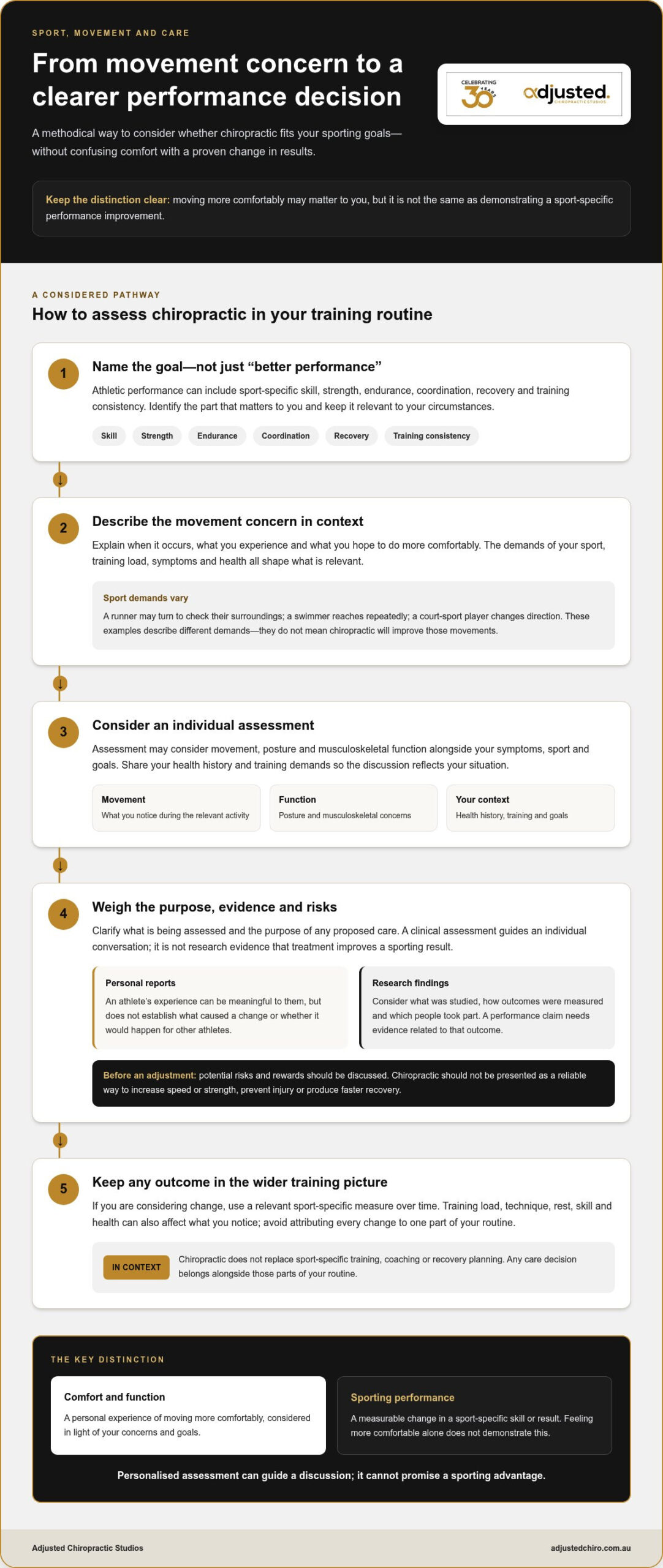
A clear decision starts with your needs, not a standard schedule for athletes. An individual assessment can help establish whether chiropractic care is relevant to a concern and what options may be appropriate. Use these steps to make the discussion practical and keep your training priorities in view.
- Clarify your goal. Identify what you want to address, such as a movement that feels restricted or discomfort during a particular activity. A specific goal is easier to discuss than a general hope of performing better.
- Share your health history. Describe relevant past and current health concerns, symptoms, recent changes and any care you’re receiving. Include details that may affect the assessment.
- Discuss the assessment. Explain your sport, training demands and the movements or activities that feel limited. The practitioner can consider your concerns in context.
- Review the plan. Discuss the recommendations, their purpose and how they relate to your goal before deciding whether to proceed.
Your individual needs guide the next step: clarify the goal, share your history, discuss the findings, then decide whether the proposed plan suits you.
What should an athlete share during an initial discussion?
Give a straightforward picture of your routine: the sport you play, how training challenges you and what you’d like to do more comfortably. Describe symptoms in your own words, including when they began, which activities feel limited and whether anything has changed recently. Relevant health history provides context. You don’t need to diagnose yourself or minimise a concern.
Be open about training priorities, too. For example, mention if you’re building towards an event or managing a demanding training period. Don’t assume you should stop or alter training based on general information alone. If a change may be needed, discuss your circumstances with an appropriate health practitioner so advice can be individualised.
How to keep expectations and care decisions realistic
Choose a practical goal linked to comfort or function, rather than expecting a particular competitive result. A practitioner should explain the assessment findings and recommendations, and how a proposed plan relates to your priorities. You can ask what the care is intended to address, what it can’t establish and how you’ll review whether it remains relevant.
Adjustments have potential risks. Before proceeding, the chiropractor discusses the risks versus the rewards so you can make an informed decision. Consider that information alongside the demands of your sport, your health history and other parts of your routine. Recommendations should follow an individual assessment, not a fixed schedule based simply on being an athlete.
If you’d like an individual discussion about your movement goals and chiropractic care, book an adult chiropractic assessment with Adjusted Chiropractic Studios in Sydney CBD.
Personalised chiropractic assessment for athletes in Sydney CBD
For athletes considering chiropractic, the starting point is an assessment, not an assumption about what care can achieve. Adjusted Chiropractic Studios provides personalised adult chiropractic care in Sydney CBD, with recommendations shaped by your health history, assessment findings and individual goals. This keeps discussion of improving athletic performance with chiropractic grounded in your needs rather than a standard approach for all athletes.
What may happen during an individual assessment?
Your first visit includes a discussion of your health history and concerns, along with a physical assessment. Explain how your sport and training fit into daily life, which movements you want assessed and what you hope to address. These details help put your concerns in context.
Computerised spinal scans, including Space-certified Core Score testing, are used as assessment tools. Digital spinal X-rays are taken if indicated, rather than assumed to be necessary for every athlete. Core Score testing is not a prediction of sports performance and should not be treated as proof that chiropractic will improve a particular result.
The purpose is to build an informed picture before discussing care. Ask how any assessment findings relate to your concern and what they can and can’t tell you. Recommendations should connect to your individual findings and goals, not simply to the fact that you play sport.
How Adjusted Chiropractic Studios discusses care and safety
Care plans are personalised and evidence-based, and techniques are gentle and patient-comfort-focused. If a recommendation includes an adjustment, the chiropractor discusses potential risks versus rewards before proceeding. You can ask questions, consider the information and decide whether the proposed care feels appropriate for your circumstances.
An assessment may lead to a care recommendation, further discussion or no adjustment. The aim is to make the next step understandable and relevant, not to promise a sporting outcome. No referral is required, and appointments can be booked online or by phone.
Before an appointment, note your sport, current concerns, recent changes and training priorities so you can explain them clearly. If you’re in Sydney CBD, an individual assessment can help you discuss whether chiropractic care relates to your goals.
Take the next step with your goals in focus
If you’re considering improving athletic performance with chiropractic, focus on a specific movement or comfort goal rather than expecting faster times or better results. Think about what meaningful progress would look like for you and how that goal fits alongside your current training priorities. This can help you decide whether an individual assessment is relevant to your needs.
Adjusted Chiropractic Studios has delivered chiropractic care in Sydney CBD for 30+ years. The team brings 40+ years of combined clinical experience and has helped over 18,000 people. This experience informs a thoughtful approach, while your own assessment and goals guide any recommendations.
Book an assessment with Adjusted Chiropractic Studios to discuss your movement goals and whether personalised care may suit your routine. Bring your questions and training priorities. A clear, individual conversation is a positive place to begin.
Frequently Asked Questions
Can chiropractic improve athletic performance?
Chiropractic care may be relevant to an athlete’s comfort or movement, but it hasn’t been established as a guaranteed way to improve sporting results. If you’re considering improving athletic performance with chiropractic, be clear about the outcome you mean, such as a competition time or a movement goal. Results can have many influences, so don’t assume care alone caused an improvement.
Is chiropractic safe for athletes?
Whether chiropractic care is appropriate depends on your individual circumstances and assessment. At Adjusted Chiropractic Studios, techniques are gentle and patient-comfort-focused. Adjustments have potential risks, so the chiropractor discusses the risks versus rewards before proceeding. Share relevant health information and ask questions if anything is unclear. Consider the recommendations before deciding whether an adjustment suits your needs and preferences.
Can chiropractic help with flexibility or range of motion?
Some people may notice a change in how comfortable a movement feels, but individual experiences vary and an increase in flexibility or range of motion isn’t assured. If a particular movement matters to you, describe it during assessment, including what feels restricted and in which activity you notice it. That gives the practitioner context to discuss whether care may be relevant to your concern.
Should I see a chiropractor before or after a sporting event?
There’s no single timing recommendation that suits every athlete. Whether an appointment is relevant may depend on your health, reason for seeking care and event or training schedule. Discuss upcoming competition dates and your current routine during assessment. The chiropractor can consider your circumstances and explain whether an appointment at that point is appropriate.
How often should an athlete see a chiropractor?
There isn’t a standard visit schedule for all athletes. Recommendations depend on your individual assessment, concerns and goals, and should be discussed with you rather than assumed from your sport or training level. If care is recommended, ask what each visit is intended to address and how the plan will be reviewed. You can then decide whether it fits your routine.
Do I need a referral to see a chiropractor in Sydney?
No, you don’t need a referral to book directly with Adjusted Chiropractic Studios in Sydney. You can arrange an appointment online or by phone. If you have a specific sporting concern, note what you’ve been experiencing and what you’d like assessed so you can describe it clearly. The chiropractor can then discuss your health history and individual needs.
What should I expect at my first chiropractic appointment?
Your first appointment includes a discussion of your health history and concerns, followed by a physical assessment. You’ll have an opportunity to explain how your training or daily activities relate to what you’re experiencing. The chiropractor can explain relevant findings and recommendations, including whether further assessment is indicated. Ask questions as you go so you understand the reasoning before deciding on next steps.