If you’re comparing sports nutritionist Sydney options, look beyond a profile title. The right support should fit your training, schedule, food preferences and goals, and the practitioner’s qualifications and experience should suit the kind of guidance you need.
In Australia, the title “nutritionist” isn’t government-regulated, while dietitian is a regulated profession. An Accredited Practising Dietitian (APD) has completed an accredited university degree, and an Accredited Sports Dietitian has further specialised training. Understanding the difference can help you choose the right scope of support, particularly if you have a health condition or take part in high-performance sport.
Good nutrition support also needs to work in everyday life. Training demands, work hours, food preferences and your usual routine all shape what’s practical to maintain. This guide explains what to compare, how to prepare for an individual consultation and how to make meal planning more realistic. At Adjusted Chiropractic Studios in Sydney CBD, nutrition counselling focuses on sustainable dietary lifestyle changes shaped around your circumstances.
Key Takeaways
- Sports nutrition support should reflect your activity, schedule, food preferences and broader health context, not rely on generic meal advice.
- When comparing sports nutritionists in Sydney, consider relevant experience, consultation approach, service scope and how practical the planning is for your routine.
- Prepare for a consultation by noting your goals, training week, eating patterns and the everyday barriers that make food planning difficult.
- Use your weekly schedule to identify manageable meal-planning actions that can fit around training and work.
- Adjusted Studio offers nutrition counselling in Sydney CBD, focused on personalised support for sustainable dietary lifestyle changes.
What does a sports nutritionist in Sydney help you plan?
Sports nutrition support considers how your eating habits fit with your physical activity, routine and personal goals. It can help you turn a broad aim, such as establishing a steadier eating routine around exercise, into practical choices you can repeat. Your sport is only one part of the picture. Training frequency, work hours, food preferences, cooking time and broader health context also matter. This sports nutrition overview introduces the field and some factors that can influence nutritional needs.
General nutrition counselling and specialist sports dietetics have different scopes. In Australia, “nutritionist” isn’t a government-regulated title, so qualifications can vary. Dietitian is a regulated profession, and an Accredited Practising Dietitian (APD) has completed an accredited university degree. An Accredited Sports Dietitian is an APD with further specialist sports nutrition training. These distinctions can help you decide what kind of support suits your circumstances, particularly if your goals relate to a health condition or high-performance sport.
Which goals might nutrition support address?
You might seek guidance on organising food around training, creating a more consistent routine or finding eating habits that feel manageable. These are useful topics to discuss, not promised outcomes. A practical plan takes account of what you already eat, what you enjoy and what fits your week, rather than applying a standard template.
For example, if you train in the evening, you could discuss how meals fit before and after a session. If you start work early, you might want to explore a routine that works with limited time in the morning. The right approach depends on your individual circumstances. Clear, realistic goals also give you a way to review whether a plan fits and discuss changes when your routine shifts.
How does meal planning fit around Sydney life?
A plan needs to work outside the training session, too. Commuting across Sydney, long work hours, family commitments and limited preparation time can all affect food choices. Instead of starting with a fixed menu, map out your usual week and identify when decisions about meals tend to become difficult.
Note which days involve a lunchtime gym session, an after-work run or a late finish. Then consider what preparation is realistic around those commitments. That could mean choosing a regular time to shop, preparing some ingredients in advance or keeping flexible options available. The aim is to find repeatable choices that suit your preferences and changing schedule, not to create another demanding task. A sports nutritionist Sydney search can lead to different kinds of support, so bring details of your real routine to help make a consultation specific and useful.
What should a personalised sports nutrition consultation assess?
Useful nutrition recommendations start with understanding you, not just your training programme. An individual assessment can consider your goals, health history, current eating patterns and the practical circumstances shaping your choices. Training type and frequency matter, as can work hours, food preferences, time available to prepare meals and other commitments.
This context helps separate what sounds suitable in theory from what you can realistically put into practice. Two people doing the same activity may have different schedules, preferences or health needs, so another person’s routine won’t necessarily suit you. If you’re seeking sports nutrition support in Sydney, look for a consultation that gives you room to explain what is working, what feels difficult and what you want to change.
If a health concern or complex dietary need is part of the picture, raise it early. It may call for appropriate clinical assessment and advice within the practitioner’s scope. Resources such as sports nutrition information from the University of Illinois can introduce topics such as fuelling and hydration, but general information can’t replace guidance tailored to your circumstances.
What information should you bring to an appointment?
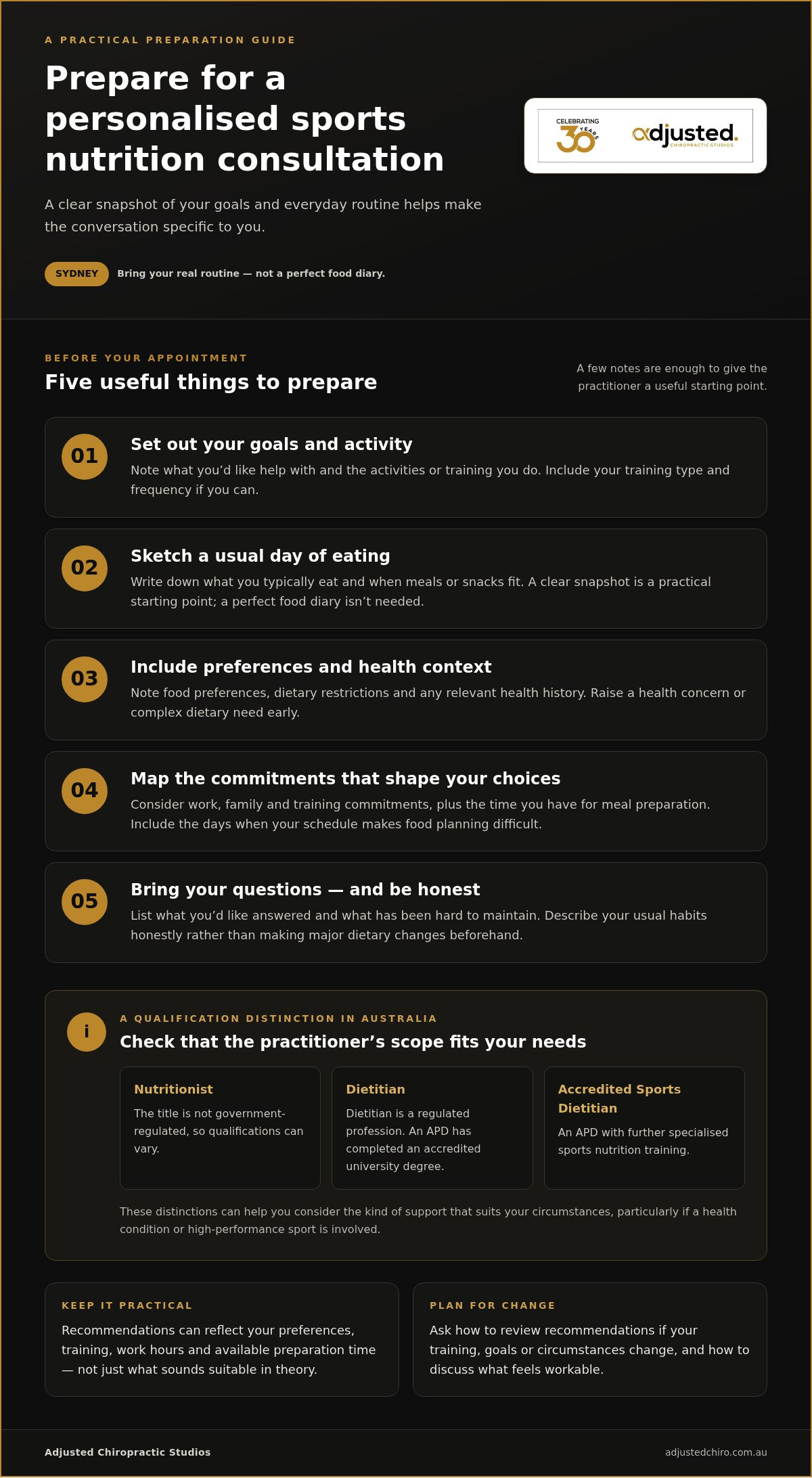
A few notes can make the consultation more focused. You don’t need a perfect food diary or a complete training log. A clear snapshot of your usual routine is a practical starting point. Consider jotting down:
- Your main goals and the activities or training you do.
- A typical day of eating, including when meals and snacks usually fit.
- Food preferences, dietary restrictions and any relevant health history.
- Work, family or training commitments that limit preparation time or meal choices.
- Questions you’d like answered, including what has been difficult to maintain.
Describe your usual habits honestly rather than making major dietary changes beforehand to present a particular picture. An accurate account gives the practitioner a more useful basis for discussion.
How should recommendations become an everyday plan?
Once your circumstances are understood, the next step is to identify manageable actions. This could mean working on one routine first, considering how food choices fit around training or finding practical alternatives for days when your schedule changes. Recommendations should reflect your preferences and capacity, rather than add unnecessary pressure.
Ask how you can review the recommendations and what to do if your training, goals or circumstances change. A follow-up discussion can help you explain what feels workable, raise new questions and consider adjustments. Assess progress in context rather than comparing your routine with someone else’s.
Adjusted Studio provides nutrition counselling at its Sydney CBD studio, with a focus on sustainable dietary lifestyle changes. You can explore nutrition counselling at Adjusted Studio. Appointments can be booked online or by phone, without a referral.
How to compare sports nutrition support in Sydney
A polished profile may describe someone’s experience, but it won’t always show how their advice will fit your needs. Compare qualifications and relevant experience with the type of support you’re seeking. Then consider how the practitioner assesses your circumstances and turns recommendations into practical steps. When comparing sports nutrition support in Sydney, first decide whether you need specialist sports dietetics or broader nutrition counselling.
In Australia, “nutritionist” isn’t a government-regulated title, while dietitian is a regulated profession. An Accredited Practising Dietitian (APD) has completed an accredited university degree. An Accredited Sports Dietitian is an APD with additional specialist sports nutrition training. Understanding the distinction can help you match the service to your needs, particularly for high-performance sport or nutrition advice related to a health condition.
| What to compare | What to look for |
|---|---|
| Credentials and experience | Review the practitioner’s stated qualifications and experience relevant to your activity, training level and goals. |
| Assessment approach | Look for discussion of your goals, health history, eating patterns, schedule and preferences, rather than a plan based only on your sport. |
| Service scope | Understand whether the service is specialist sports dietetics, broader nutrition counselling or another form of support, and whether that scope suits your needs. |
| Practical planning | Consider whether recommendations account for your everyday routine and include a way to review or adjust them as circumstances change. |
Which questions help you assess a provider’s fit?
Ask how your goals and lifestyle will shape the consultation, and how recommendations can work beyond the appointment. You could ask about the practitioner’s experience with your sport or activity level, how they account for changing training demands, and how they review progress or next steps. Clear answers help you understand what the service involves without relying on broad promises.
When might general nutrition counselling be a better fit?
If your focus is developing sustainable eating habits around work, family life and regular activity, broader nutrition counselling may suit your needs. Adjusted Studio offers nutrition counselling and sustainable nutrition planning at its Sydney CBD studio. The service focuses on dietary lifestyle changes, while specialist sports dietetics has a different scope.
Use your comparison to identify the kind of guidance you need, then choose a service whose scope and approach align with that goal. A good fit means the discussion is relevant to your circumstances and the next steps make sense in your day-to-day life.
How to prepare for nutrition support and make meal planning workable
A plan is more useful when it starts with your actual week, not an idealised routine. Before a consultation, map out when you work, train, travel and have time to prepare food. This gives you and the practitioner a practical starting point for discussing possible changes without turning meal planning into another demanding commitment.
Use this sequence to organise your thoughts:
- Clarify your goal. Decide what you’d like help with, such as making your eating routine more consistent around exercise.
- Record your routine. Note work hours, training sessions, commute patterns and regular social or family commitments.
- Identify barriers. Consider what tends to disrupt your plans, such as late finishes, limited preparation time or changing training days.
- Discuss options. Share your preferences and ask what practical approaches could suit your circumstances.
- Choose manageable actions. Agree on a small step to try, then review how it fits your week.
How can you organise a realistic week of meals?
Start with your calendar. Mark work and training times, then look for when meals and food preparation can realistically fit. A day with an early session may call for a different routine from a day when training follows work. You don’t need to plan every detail in advance. Identifying busy periods can show where a little preparation or flexibility might help.
Build around foods you enjoy, the time you have and the facilities available to you. If a workday changes or a session moves, adapt the plan rather than treating it as a rule you’ve failed to follow. Specific dietary targets or restrictive changes shouldn’t be assumed without individual assessment. Focus on discussing practical options that make sense for you.
What helps you keep the plan sustainable?
Small, repeatable actions can be easier to fit into everyday life than a complete routine overhaul. You might focus on one part of the week that regularly feels rushed or prepare for a predictable training day. Keep brief notes on what worked, what felt difficult and what changed in your schedule. These observations can make follow-up discussions more useful and help guide any adjustments.
Personalised nutrition support should account for work demands, training and social commitments, rather than rely on an all-or-nothing approach. Adjusted Studio’s sustainable nutrition support in Sydney CBD can help you explore dietary changes that fit your circumstances.
Nutrition counselling at Adjusted Studio in Sydney CBD
If you’re comparing sports nutritionist Sydney options, start by matching the type of support to your goals. Adjusted Chiropractic Studios provides nutrition counselling focused on sustainable dietary lifestyle changes. The discussion can consider how your goals, eating patterns and everyday routine fit together, with practical guidance shaped around your circumstances rather than a one-size-fits-all meal plan.
When choosing support for sport-specific needs, compare the practitioner’s qualifications and service scope with the guidance you’re looking for. For people who want to build more workable food habits alongside everyday activity, a conversation about sustainable dietary changes can be a useful starting point.
Nutrition is available at Adjusted Chiropractic Studios’ Sydney CBD location, alongside chiropractic care and podiatry. The practice has served the Sydney CBD for over 30 years and helped over 18,000 people. Its integrated setting brings these services together in one studio, with each appointment focused on the support you’re seeking. Chiropractic adjustments have potential risks. Before proceeding, your chiropractor will discuss the risks and rewards with you after reviewing your health history, examination and any testing.
What can you expect from a personalised nutrition discussion?
Bring your goals, current routine and questions to the conversation. You might describe what you’d like to change, which food habits already work for you and what makes consistency difficult. These details help keep the discussion grounded in your circumstances.
Rather than assuming everyone needs the same plan, nutrition counselling can explore dietary lifestyle changes that feel manageable for you. Suggestions should be discussed in context, with room to explain your preferences and consider what fits your daily life. No particular performance, recovery, symptom or body composition outcome can be promised.
How do you take the next step in Sydney CBD?
Adjusted Chiropractic Studios is located on Hunter Street, opposite Martin Place Metro station, in the Sydney CBD. You can book nutrition counselling directly online or by phone, without a referral. Before your appointment, consider the goals or everyday food routines you’d like to discuss.
For personalised support focused on sustainable dietary changes, book a nutrition consultation with Adjusted Chiropractic Studios.
Take a practical next step towards nutrition support
Your next step doesn’t need to be a complete change to the way you eat. Start by deciding what you’d most like help making clearer, whether that’s fitting food around regular activity or finding dietary habits that feel more manageable. This gives your first conversation a useful focus while leaving room to explore what suits you.
As you consider a sports nutritionist Sydney option, keep the type of guidance you want in mind. Specialist sports dietetics and broader nutrition counselling have different scopes. Choosing support that aligns with your needs can help you move forward with greater clarity. You can ask questions, explain what matters to you and take time to consider your next step.
Adjusted Studio offers nutrition counselling focused on sustainable dietary lifestyle changes. If you’re ready to discuss your goals and routine, book a nutrition consultation with Adjusted Studio.
Frequently Asked Questions
What does a sports nutritionist do?
Sports nutrition support connects food choices with physical activity and personal goals. A discussion may cover eating routines around exercise and planning for changing training demands. For example, if your sessions shift between mornings and evenings, ask how recommendations can account for both patterns. The practitioner’s qualifications and service scope shape the advice they can provide, so consider whether their experience fits your needs.
How do I choose a sports nutritionist in Sydney?
Start by identifying what you want help with, then compare qualifications and experience relevant to your activity. A sports nutritionist Sydney consultation should give you room to explain your schedule, food preferences and health context, rather than simply apply a standard plan. Ask how recommendations are developed and how they can be reviewed if your routine changes. A clear explanation of the service scope can help you decide whether it suits your goals.
Can a nutritionist help with meal planning for training?
Nutrition support can help you think through how meals fit around exercise and other commitments. For instance, you could discuss what makes eating on a training day harder than on a rest day, then explore practical options that suit your preferences. Recommendations should reflect your circumstances rather than copy another athlete’s routine. Avoid adopting someone else’s dietary targets without individual guidance.
What should I bring to a sports nutrition appointment?
Bring your questions and a rough outline of your activity week. A calendar showing when you usually train can be more useful than trying to recreate a detailed log from memory. You could also note foods you prefer or avoid and any relevant health information you’re comfortable sharing. There’s no need to prepare a perfect food diary. An honest account of your usual routine is a helpful starting point.
Is a sports dietitian different from a nutritionist?
Yes, the titles reflect different professional pathways in Australia. “Nutritionist” isn’t a government-regulated title, while dietitian is a regulated profession. An Accredited Practising Dietitian (APD) has completed a degree accredited by Dietitians Australia, and an Accredited Sports Dietitian is an APD with additional sports nutrition training. Review the practitioner’s credentials and experience rather than relying on a profile title alone.
Can I book nutrition counselling at Adjusted Studio without a referral?
Yes, you can book directly online or by phone without a referral. Adjusted Studio offers nutrition counselling in its Sydney CBD studio, focused on sustainable dietary lifestyle changes. You can explain what you’d like to discuss, such as how your routine affects your eating habits, to give the conversation a useful starting point.
How can I make a meal plan fit a busy work and training schedule?
Start with your calendar and mark work commitments, training sessions and other regular activities. Then identify when you have time to organise food, including on days when plans might shift. You could discuss a flexible approach for busier days alongside your usual routine, rather than expecting every week to run exactly as planned. Review what was practical and what wasn’t so future planning reflects your real schedule.